
SYLLABUS
GS-3: Conservation, Environmental Pollution and Degradation, Environmental Impact Assessment.
GS-2: Important International Institutions, agencies and fora – their Structure, Mandate.
Context: The United Nations has released the Global Forest Goals (GFG) Report 2026, highlighting that global efforts towards sustainable forest management and forest-related Sustainable Development Goals (SDGs) remain inadequate to achieve the 2030 targets.
More on the News
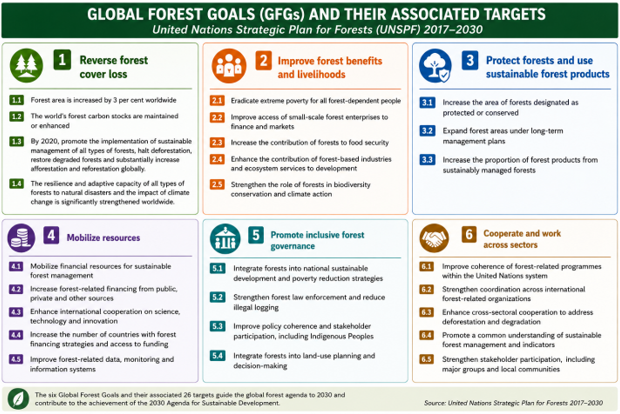
• The Global Forest Goals Report 2026 is the second global assessment report on progress towards achieving the six Global Forest Goals and 26 associated targets under the United Nations Strategic Plan for Forests (UNSPF) 2017–2030.
• The report has been prepared by the United Nations Department of Economic and Social Affairs (UN DESA) and the Secretariat of the United Nations Forum on Forests (UNFF).
• The assessment is primarily based on Voluntary National Reports (VNRs) submitted by 48 countries representing nearly 51% of the global forest area, along with data from FAO’s Global Forest Resources Assessment (FRA) 2025.
• The report was launched during the 21st Session of the United Nations Forum on Forests (UNFF21) held at the UN Headquarters in New York in May 2026.
About the Global Forest Goals (GFGs)
• The Global Forest Goals (GFGs) were adopted under the United Nations Strategic Plan for Forests (UNSPF) 2017–2030 as a universal voluntary framework for sustainable management, conservation, and restoration of all types of forests.
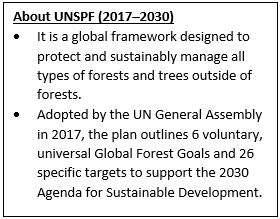
• The framework consists of 6 Global Forest Goals and 26 associated targets to be achieved by 2030.
• The GFGs are closely linked with the Sustainable Development Goals (SDGs), particularly those related to climate action, biodiversity conservation, poverty reduction, food security, ecosystem restoration, and sustainable livelihoods.
Key Findings of the Report
Overall Progress Across Global Forest Goals
• According to the assessment, out of the 26 Global Forest Goal (GFG) targets:
- 7 targets are broadly met,
- 17 are partially achieved, and
- 2 targets – increasing forest area by 3% worldwide (target 1.1) and eradicating extreme poverty for all forest-dependent people (target 2.1) – are off track.
Global Forest Loss Continues
• Global forest area declined by more than 40 million hectares between 2015 and 2025 (from 4.18 billion hectares in 2015 to 4.14 billion hectares in 2025), including the loss of nearly 16 million hectares of primary forests.
• South America recorded the steepest decline, losing 4.1 million hectares annually, while Africa lost nearly 3 million hectares every year.
Poverty and Livelihood Challenges Persist
• The target of eliminating extreme poverty among forest-dependent populations remains off track, particularly in Sub-Saharan Africa, where poverty reduction has remained limited.
• The report estimates that the global formal forest economy is worth nearly USD 1.5 trillion annually, though the contribution of the informal forest economy and ecosystem services remains inadequately measured.
Financing and Governance Gaps
• Global financing for Sustainable Forest Management (SFM) reached approximately USD 84 billion in 2023, far below the estimated annual requirement of nearly USD 300 billion needed by 2030.
• Financing gaps are especially severe in low-income and lower-middle-income countries, where dependence on public funding remains high and innovative financing mechanisms remain underdeveloped.
Policy Recommendations
• Accelerating Forest Conservation: Countries need to strengthen efforts to halt deforestation, reverse forest degradation, protect primary forests, and expand restoration and afforestation initiatives.
• Strengthening Governance and Coordination: Improved forest governance, stricter action against illegal logging, and stronger coordination across sectors such as agriculture, mining, and infrastructure are essential to address deforestation drivers.
• Mobilising Finance and Community Support: Greater public, private, and climate finance is required for sustainable forest management, along with better land tenure security and livelihood support for forest-dependent communities and Indigenous Peoples.
• Improving Data and International Cooperation: Stronger forest monitoring systems, data frameworks, and international cooperation are needed to enhance accountability and accelerate progress towards the Global Forest Goals by 2030.
United Nations Department of Economic and Social Affairs (UN DESA)
• UN DESA is a department of the UN Secretariat that supports international cooperation on sustainable development through policy research, statistical analysis, and capacity-building assistance to member states.
• It also supports the implementation of global development agendas, including the SDGs and forest-related governance frameworks.
United Nations Forum on Forests (UNFF)
• The UNFF is a subsidiary body of the UN Economic and Social Council (ECOSOC) established in 2000 to promote sustainable management and conservation of all types of forests.
• It serves as the principal global intergovernmental platform overseeing implementation of the United Nations Strategic Plan for Forests (UNSPF).