
SYLLABUS
GS-2: Welfare Schemes for Vulnerable Sections of the Population by the Centre and States and the Performance of these Schemes.
GS-3: Indian Economy and issues relating to Growth, Development and Employment. Inclusive Growth and issues arising from it.
Context: PM SVANidhi, launched in 2020 to provide collateral-free working-capital loans to street vendors, has completed one year of its restructured phase, with an expanded focus on formal credit, digital inclusion, social security and livelihood development.
About PM SVANidhi
- PM SVANidhi is a Central Sector Scheme launched on 1 June 2020 by the Ministry of Housing and Urban Affairs (MoHUA) to provide collateral-free working-capital credit to urban street vendors affected by the COVID-19 pandemic.
- The scheme provides progressive loans, with the original tranches of ₹10,000, ₹20,000 and ₹50,000 subsequently enhanced to ₹15,000, ₹25,000 and ₹50,000, respectively. Timely repayment attracts a 7% interest subsidy, while digital transactions are incentivised.
- Beyond credit, the scheme seeks to promote financial inclusion and formalisation by bringing vendors into institutional finance, encouraging digital transactions and creating pathways towards greater creditworthiness. Vendors can access the scheme through Certificates of Vending/Identity Cards or, where applicable, a Letter of Recommendation (LoR).
- The 2025 restructuring extended lending until 31 March 2030, with an outlay of ₹7,332 crore and a target of 1.15 crore beneficiaries, including 50 lakh new beneficiaries. It also introduced a UPI-linked RuPay Credit Card of up to ₹30,000 for eligible vendors.
- The restructured scheme additionally emphasises digital and financial literacy, entrepreneurship, marketing, food-safety training and social-security convergence, signalling a shift from credit delivery towards broader livelihood development.
What Changed with Restructuring?
- Enhanced credit: First and second tranches increased to ₹15,000 and ₹25,000, while the third remains ₹50,000, enabling progressive access to larger working capital.
- New digital-credit channel: Eligible vendors who repay the second tranche can access a UPI-linked RuPay Credit Card up to ₹30,000, providing an additional formal source of credit.
- Digitalised lending and wider coverage: An end-to-end Digital Lending Platform (DLP) simplifies application, verification, approval and disbursement, while the City Region Approach expands coverage to Census Towns and the Vendor Migration Module facilitates continuity of benefits when vendors move between ULBs and Census Towns.
- Beyond credit: Cashback of up to ₹1,600 for retail and wholesale digital transactions, along with entrepreneurship, financial literacy, digital skills and marketing support, seeks to deepen financial and livelihood inclusion.
- Social security and infrastructure: SVANidhi se Samriddhi, Lok Kalyan Melas, FSSAI training and 50 planned Street Food Hubs broaden the scheme towards welfare convergence, capacity building and improved vending infrastructure.
One Year of Restructuring: Key Achievements
- Expanded credit outreach: In the first year, 21.86 lakh loans worth ₹6,294 crore were disbursed to 10.56 lakh new beneficiaries. Since inception, 78.68 lakh vendors have accessed more than 1.18 crore loans worth ₹19,171 crore.
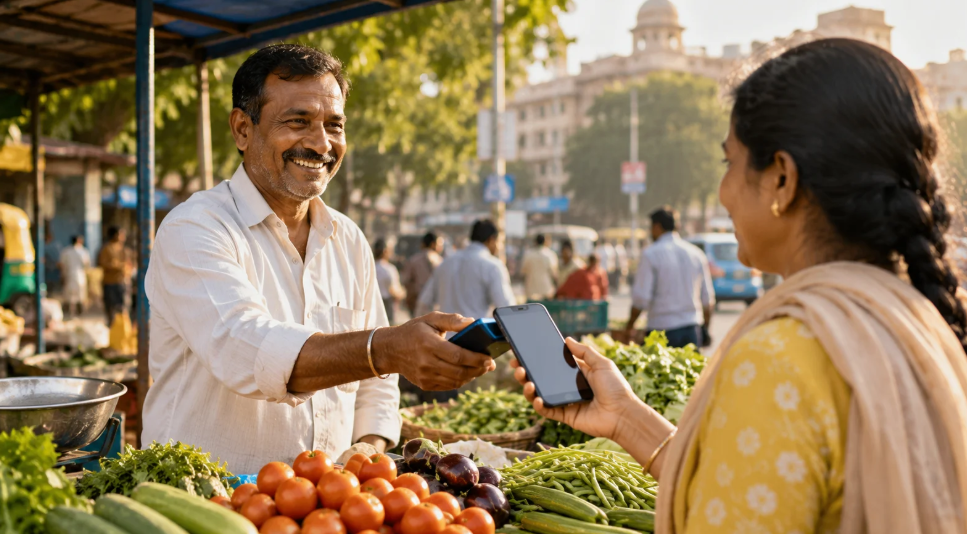
- Deepening digital inclusion: 57.09 lakh vendors have undertaken over 908 crore digital transactions, while ₹418.78 crore has been released as digital cashback incentives.
- Growing formal financial access: 27,077 UPI-linked RuPay Credit Cards have been approved during the first year; cumulatively, ₹421 crore has been released as interest subsidy for timely repayment.
- Social-security convergence: Under SVANidhi se Samriddhi, socio-economic profiling of more than 51.15 lakh beneficiary families has resulted in over 1.59 crore sanctions under eight selected Central Government welfare schemes.
- Livelihood and capacity building: More than 6 lakh street-food vendors have received FSSAI training, while Street Food Hubs, Lok Kalyan Melas and the Startup Challenge are expanding support towards infrastructure, market access and enterprise development.
Significance: From Micro-Credit to Livelihood Development
- Formalising informal finance: Independent assessments found that nearly 95% of beneficiaries accessed formal institutional credit for the first time, while around 30% subsequently accessed additional credit beyond PM SVANidhi, indicating improved financial inclusion and creditworthiness.
- Supporting enterprise mobility: Progressive credit can help vendors move beyond livelihood restoration towards higher inventory, improved vending infrastructure and business diversification.
- Digital financial empowerment: Digital transactions and UPI-linked credit bring vendors into formal financial systems, while transaction histories can potentially support future access to formal credit.
- Holistic social protection: SVANidhi se Samriddhi extends the scheme beyond working capital by connecting vendors and their families with multiple welfare interventions.
- Inclusive urban development: Recognition of street vendors as legitimate economic actors, alongside improved vending infrastructure and market opportunities, can help integrate informal livelihoods into more inclusive urban economies.