

SYLLABUS
GS-2: Parliament and State Legislatures — Structure, Functioning, Conduct of Business, Powers & Privileges and Issues Arising out of these.
Context: The Public Accounts Committee (PAC) has examined the short transfer of cess and levy collections to designated Reserve Funds, based on findings in the CAG’s Report. The issue highlights earmarked taxation, management of public funds and parliamentary financial oversight.
Key Findings of the CAG Report & PAC’s Concern
- ₹9,222 crore short transfer: CAG’s test check found a short transfer of ₹9,222 crore to four designated Reserve Funds during FY 2024–25.
- Scale of collections: The Union Government collected ₹3,89,220 crore through cess, charges and levies during FY 2024–25, amounting to 10.25% of its Gross Tax Revenue.
- Funds involved: The short transfer related to the Investor Education and Protection Fund (IEPF), Prarambhik Shiksha Kosh (PSK), Pradhan Mantri Swasthya Suraksha Nidhi (PMSSN) and Oil Industry Development Fund (OIDF).
- PAC’s concern: The PAC examined the issue with the Ministry of Finance and Ministry of Health & Family Welfare on 8 September 2026 and reiterated the importance of using cess proceeds for their intended purposes.
- Earlier recommendation: In its 69th Report (2023), the PAC had recommended scientific assessment before imposing a levy, periodic review of its intended objective and regular crediting of proceeds to designated Reserve Funds.
- Dormant funds: CAG identified 10 Reserve Funds and 21 Deposit Accounts with an aggregate net credit balance of ₹844.93 crore that had remained dormant for three or more financial years and required review.
Understanding Cess, Surcharge, Tax and Reserve Funds
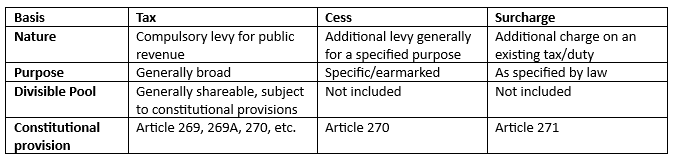
- Fiscal Federalism: Cesses and surcharges are excluded from the divisible pool of Union taxes and therefore are not shared with States through the normal tax-devolution mechanism.
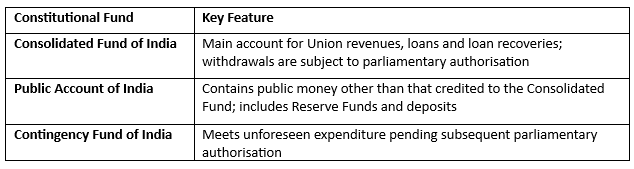
- Reserve Funds: Created for specific purposes and form part of the Public Account.
- Accounting Mechanism: Cess/levy collections are credited to the Consolidated Fund and transferred to the designated Reserve Fund in the Public Account through the prescribed process, with Parliament’s approval.
Parliamentary Financial Oversight
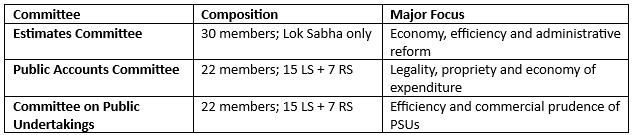
- Parliament exercises financial control through three Financial Committees, each dealing with a distinct aspect of public finance:
- Estimates Committee: Examines budget estimates and suggests economies, organisational improvements, administrative reforms and alternative policies for greater efficiency. It is often described as a “continuous economy committee.”
- Public Accounts Committee: Examines Appropriation Accounts, Finance Accounts and CAG reports; checks whether expenditure was legally available, applied to the authorised purpose and incurred according to applicable rules. It also examines financial propriety, including waste, loss and inefficiency.
- Committee on Public Undertakings: Examines accounts and reports of public undertakings and relevant CAG reports, with emphasis on sound business principles, autonomy, efficiency and prudent commercial practices.
- CAG–Committee Link: CAG audit reports provide an important basis for parliamentary financial scrutiny, while the CAG assists the Financial Committees in examining evidence and verifying financial records.