

Birth Anniversary of Shaheed Bhagat Singh
Context: The 119th birth anniversary of Shaheed Bhagat Singh was observed on 28 September 2026, remembering his contribution to India’s freedom struggle and his enduring revolutionary and intellectual legacy.
About Shaheed Bhagat Singh
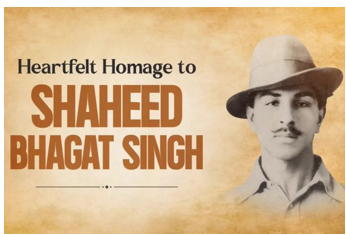
- Born: 28 September 1907, Banga village, Lyallpur district (now in Faisalabad, Pakistan), in a family actively involved in the freedom movement.
- The Jallianwala Bagh massacre (1919) profoundly influenced his commitment to the struggle against colonial rule.
- He founded the Naujawan Bharat Sabha in 1926 to mobilise youth and promote patriotism, secularism and social reform.
- He was associated with the Hindustan Republican Association (HRA), which later became the Hindustan Socialist Republican Association (HSRA).
- Following the death of Lala Lajpat Rai after the 1928 anti-Simon Commission protest, Bhagat Singh and his associates killed J.P. Saunders.
- On 8 April 1929, Bhagat Singh and Batukeshwar Dutt threw bombs in the Central Legislative Assembly to protest repressive legislation and surrendered.
- During imprisonment, he participated in a hunger strike demanding better treatment for political prisoners.
- He was executed along with Rajguru and Sukhdev on 23 March 1931 in the Lahore Conspiracy Case.
Legacy of Bhagat Singh
- Bhagat Singh was not only a revolutionary but also a voracious reader, writer and thinker. Influenced by socialist and Marxist ideas, he advocated a socialist republic, secularism, equality and the organisation of workers and peasants.
- His writings, including “Why I Am an Atheist,” reflected his emphasis on rationalism, critical thinking and questioning social inequalities.
- His slogan “Inquilab Zindabad” (Long Live the Revolution) became closely associated with the freedom struggle.
- His legacy therefore represents sacrifice, revolutionary nationalism, intellectual inquiry and the pursuit of social justice.
Steel Industry Safety Council (SISC)
Context: The Ministry of Steel has decided to establish an apex-level Steel Industry Safety Council (SISC) to strengthen safety standards, accident prevention and safety culture across India’s steel industry.
About the Steel Industry Safety Council (SISC)
- Administrative control: Ministry of Steel.
- Chairman: Secretary, Ministry of Steel.
- Composition: Senior officials of the Ministry, Chief Executives of integrated steel producers, and representatives of key technical and statutory organisations.
- Key participating organisations include Directorate General of Mines Safety (DGMS), Petroleum and Explosives Safety Organisation (PESO), National Disaster Management Authority (NDMA) and recognised steel technology institutions.
- Key Functions:
- Assess the overall safety situation in the steel industry.
- Facilitate studies to improve safety practices.
- Approve industry safety standards and Recommended Practices.
- Review serious accidents, other accidents and near-miss incidents.
- Provide directions for strengthening safety awareness, worker training and preventive measures.
- Promote greater consistency in safety practices across steel plants.
About the Steel Industry Safety Directorate (SISD)
- The SISD will provide specialised technical and professional support to the SISC.
- Areas of expertise: Process safety, blast furnaces, steel melting, rolling mills, coke ovens, refractory systems, electrical and mechanical safety, occupational health, fire engineering and disaster management.
- Key Functions:
- Implement decisions of the SISC.
- Conduct periodic safety audits and reviews.
- Maintain and disseminate accident and near-miss information.
- Investigate serious safety incidents.
- Review emergency preparedness and safety training.
- Develop and issue Steel Industry Safety Standards, Recommended Practices and Guidelines suited to Indian conditions.
India’s First Orbital Computing Satellite — MOI-1A
Context: Indian space startup TakeMe2Space is scheduled to launch MOI-1A, which it describes as India’s first orbital computing satellite, aboard SpaceX’s Transporter-18 rideshare mission on 1 October 2026.
About the MOI-1A
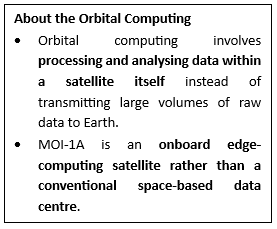
- MOI-1A is a sub-50 kg edge-computing satellite equipped with NVIDIA Orin NX processors and around 150 watts of power.
- Customers can upload containerised Artificial Intelligence (AI) models to process satellite data in orbit and transmit analysed results rather than complete raw datasets.
- TakeMe2Space has secured 23 customers, including geographic information-system companies and educational institutions, with applications in agriculture, mining, supply chains and insurance.
- An earlier 2024 technology-demonstration mission validated application uploads and AI inference in orbit; a subsequent MOI-1 satellite was lost following a launch-vehicle third-stage failure.
- The company says it designs and manufactures most satellite subsystems in India, while sourcing chips, solar cells and propulsion systems externally.
Significance
- Reduces data-downlink requirements and associated processing burden on Earth.
- Enables faster and more efficient Earth-observation data analysis.
- Opens opportunities for commercial AI-enabled space services.
- Supports the growth of India’s private space sector and indigenous satellite capabilities.
- TakeMe2Space plans larger, networked satellites from 2027 and is exploring orbital cold storage for critical data, including potential applications in financial services and defence.
India–Kazakhstan Joint Military Exercise KAZIND-2026
Context: A 60-member Indian Armed Forces contingent has departed for Oskemen, Kazakhstan, to participate in the ninth edition of the India–Kazakhstan Joint Military Exercise KAZIND, being conducted from 28 September to 11 October 2026.
About the India–Kazakhstan Joint Military Exercise KAZIND
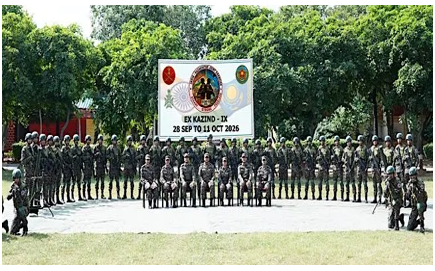
- Indian contingent: Mainly personnel from a battalion of the Garhwal Rifles, along with troops from other arms and services and the Indian Air Force. The Kazakhstan contingent is primarily drawn from its Land Forces.
- Objective: To enhance interoperability and joint capability for conducting counter-terrorism operations in a sub-conventional environment under a United Nations mandate.
- Operational focus: Semi-urban and mountainous terrain, joint planning and execution, air mobility, and integrated use of Unmanned Aerial Systems (UAS) and Counter-UAS capabilities.
- Training includes raids, search-and-destroy operations, cordon-and-search operations, securing helipads and landing sites, and Special Heliborne Operations.
- A Joint Command Post and Intelligence and Surveillance Centre will support coordinated planning and execution, followed by a comprehensive validation exercise against a simulated terrorist threat.
- The exercise began in 2016 as Prabal Dostyk and was later upgraded and renamed KAZIND in 2018.
Significance
- Strengthens India–Kazakhstan military-to-military cooperation.
- Improves interoperability for joint counter-terrorism operations, particularly in complex terrain.
- Facilitates the exchange of operational experience and best practices.
- Enhances preparedness for the use of air mobility, drones and counter-drone systems in joint operations.
- Contributes to the two countries’ shared objective of regional peace, stability and collective security.