
SYLLABUS
GS-3: Indian Economy and issues relating to planning, mobilization of resources, growth, development and employment.
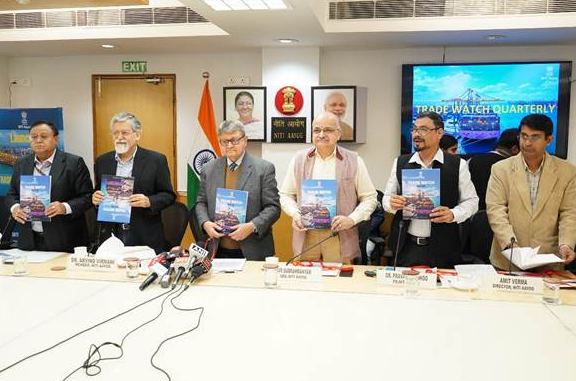
Context: NITI Aayog released the ninth edition of Trade Watch Quarterly, highlighting global and domestic trade trends and the challenges and opportunities in India’s metals and ores sector.
About the Report
• It provides an assessment of global and domestic trade developments amid geopolitical and trade policy uncertainties, with a thematic focus on India’s metals and ores trade.
• The report examines India’s export competitiveness, growing import dependence, and opportunities to strengthen domestic value addition, critical mineral capabilities, and integration with global value chains.
Key Findings of the Report
• Global and Indian Trade Performance: Global goods trade reached $13.7 trillion in the first half of 2026, registering 12.5% year-on-year growth, while services trade grew by 10.5%.
- India’s total trade reached $506.9 billion in Q1 FY27, registering 15.5% year-on-year growth.
- India’s digitally delivered services exports increased from $277 billion in 2024 to $317 billion in 2025, making India the fourth-largest global exporter of digitally delivered services, after the United States, the United Kingdom, and Ireland.
- Trade with Free Trade Agreement partners recorded 36.3% growth in exports and 10% growth in imports.
• Metals Export Competitiveness: Global imports of metals and ores increased from $1.2 trillion in 2015 to nearly $2 trillion in 2025. However, India’s share of global exports rose only marginally, from 1.7% to 1.8%.
- India’s metals and ores exports stood at approximately $36.8 billion in 2025, with metals and articles thereof accounting for $34.8 billion.
- Iron and steel, articles of iron and steel, and aluminium accounted for nearly 78% of metals exports in 2025.
- India’s exports remain concentrated in traditional metal segments, while global demand is increasingly shifting towards high-value non-ferrous metals and critical minerals.
- India’s copper exports were valued at $2.9 billion in 2025, accounting for approximately 1.1% of global copper and articles of copper imports.
- Aluminium exports increased from $2.7 billion in 2015 to $6.8 billion in 2025, raising India’s share of global aluminium demand from 1.7% to 2.6%.
- India accounted for 12.1% of global lead demand, supported by its recycling ecosystem.
• Rising Import Dependence: India’s metals and ores imports increased from $32.2 billion in 2015 to $60.5 billion in 2025, driven by growing industrial and infrastructure demand.
- Copper imports increased from $3.2 billion in 2015 to $11.8 billion in 2025.
- India meets approximately 96% of its copper ore and concentrate requirements through imports.
- India remains 100% import-dependent on nickel, cobalt, and lithium.
- Cumulative foreign direct investment equity inflows into mining stood at only $3.5 billion between 2000 and 2025.
Recommendations of the Report
• Strengthen Mineral Exploration: Improve geological data, promote exploration, and accelerate the auction and operationalisation of mineral blocks.
• Promote Domestic Value Addition: Develop domestic processing and specialised manufacturing capabilities for critical minerals and high-value non-ferrous metals.
• Reduce Import Dependence: Encourage critical mineral recycling and support Indian companies in securing mineral resources overseas.
• Improve Export Competitiveness: Reduce logistics and export-finance costs and expand access to renewable energy for industries.
• Address Global Trade Challenges: Strengthen preparedness for the European Union’s Carbon Border Adjustment Mechanism and establish stronger rules of origin under Free Trade Agreements.
• Simplify Regulatory Processes: Streamline mining and forest clearances to encourage investment and strengthen India’s integration with global value chains.