
Syllabus
GS 1: Salient features of Indian Society, Diversity of India- Gender, Poverty, Secularism, communalism etcGS 2: Issues relating to poverty and hunger
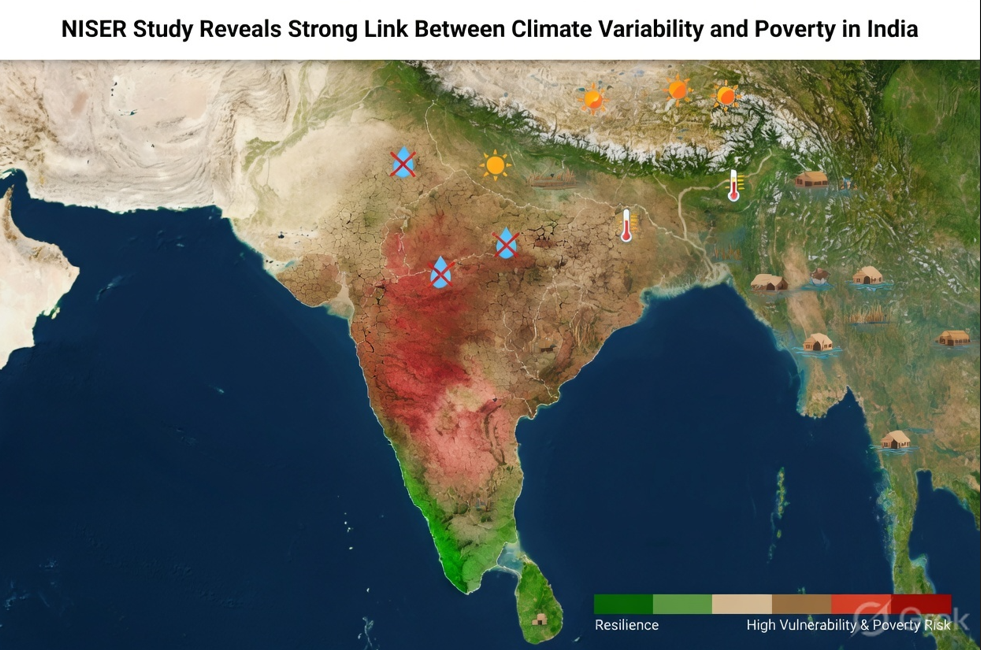
Context: A study by the National Institute of Science Education and Research (NISER), covering 593 districts across 21 states, shows that poverty in India is increasingly influenced by climate variability, marking a shift from a purely economic issue to a more complex structural challenge that requires localized responses.
Key Findings of the Study
- Changing Nature of Poverty
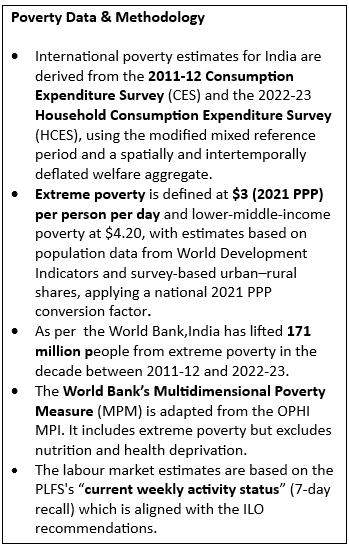
- India has witnessed a decline in poverty, with the headcount ratio falling from 24.85% to 14.96% and poverty intensity reducing from 47.14% to 44.39%.
- However, climate-related shocks are emerging as a major constraint, threatening to reverse these gains.
- Globally, nearly 700 million people continue to live in extreme poverty, with climate change increasing vulnerability.
- Climate Stress and Poverty Linkages
- The study shows that climatic factors significantly influence poverty outcomes. Temperature variability emerges as the most critical factor, with a one-unit increase raising the probability of poverty by 31.1%.
- Similarly, a one-unit increase in flood-affected areas increases poverty likelihood by 1.4%, while variations in precipitation raise it by 1.9%.
- These changes disrupt agricultural productivity, damage assets, and create income instability, particularly in rural regions.
- The drought-dependence trap
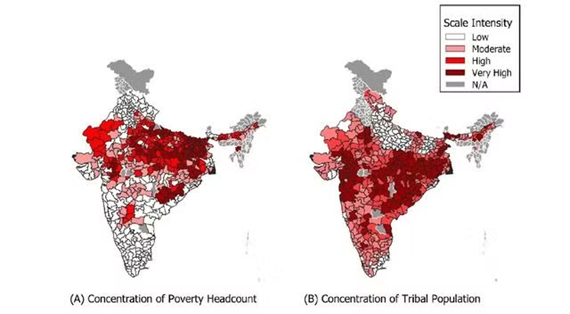
- A key insight is the compounded vulnerability in districts that are both drought-prone and dependent on agriculture. Such districts are 83% more likely to experience high poverty levels.
- Social and Regional Dimensions
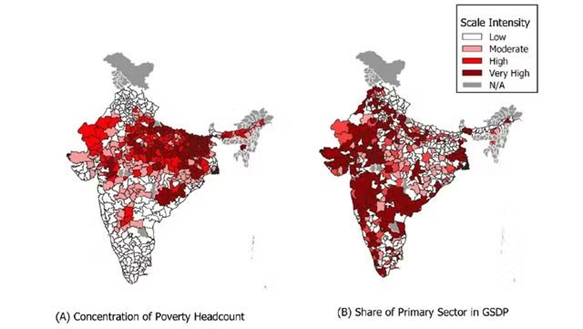
- Social factors further intensify vulnerability. Districts with higher Scheduled Tribe populations show a greater likelihood of poverty, with a one-unit increase raising poverty probability by 1.9%.
- These communities often reside in ecologically sensitive areas and face limited access to infrastructure and institutional support.
- Regionally, a clear divide exists. Eastern states such as Chhattisgarh, Odisha, Jharkhand, Bihar, and West Bengal exhibit higher poverty levels due to greater dependence on agriculture and weaker economic diversification.
- In contrast, southern and western states like Kerala, Karnataka, Tamil Nadu, Gujarat, and Maharashtra show lower poverty levels, supported by stronger infrastructure and diversified economies.
- Role of Economic Diversification
- The structure of the economy plays a crucial role in resilience. Districts with a higher share of the tertiary sector tend to experience lower poverty, with a one-unit increase reducing poverty probability by 1.9%.
- Service-oriented sectors provide more stable incomes and are less directly affected by climatic fluctuations, enhancing adaptive capacity.
Policy Challenges
- Despite national initiatives on climate action and poverty reduction, significant gaps remain at the sub-national level.
- Policies often fail to account for local vulnerabilities, institutional capacity differences, and structural inequalities, limiting their effectiveness.
Way Forward
- As India strives to meet its SDGs—particularly those related to poverty, hunger, and climate action—the study highlights the need for integrated and region-specific strategies.
- Promoting climate-resilient agriculture through drought-resistant crops and efficient irrigation systems is essential. Expanding non-farm employment opportunities can reduce dependence on climate-sensitive sectors.
- Strengthening disaster management systems is crucial to minimize the impact of floods and extreme weather events.
- At the same time, improving infrastructure, market access, and institutional capacity in vulnerable regions will enhance resilience.
- A shift towards district-level planning that integrates climate adaptation with poverty alleviation is necessary.
- A multi-pronged approach combining economic diversification, social inclusion, and institutional strengthening will be key to addressing climate-induced poverty.
Conclusion
Climate change is reshaping the geography and nature of poverty in India by interacting with economic structures and social inequalities. A targeted, integrated, and region-specific approach is essential to ensure sustainable poverty reduction and resilience in a warming world.