

10th anniversary of the Kigali Amendment
Context: The Kigali Amendment to the Montreal Protocol, adopted on 15 October 2016, marked its 10th anniversary in 2026, highlighting global efforts to phase down hydrofluorocarbons (HFCs) and combat climate change.
About the Kigali Amendment
- Adoption: Adopted on October 15, 2016, in Kigali, Rwanda, under the Montreal Protocol (1987); it entered into force in January 2019.
- Objective: To phase down HFC production and consumption.
- HFCs replaced ozone-depleting chlorofluorocarbons (CFCs) but are potent greenhouse gases.
- Climate Benefits: Full implementation could prevent up to 0.5°C of global warming by 2100.
- Global Progress: As of September 16, 2026, 174 countries had ratified the amendment. Global HFC consumption in 2024 was 30% below the collective baseline.
- Financial Mechanism: The Multilateral Fund supports developing countries in adopting alternative technologies, upgrading manufacturing and training technicians.
India and the Kigali Amendment
- Ratification: India ratified the amendment in 2021.
- Phase-down Schedule: India must freeze HFC production and consumption in 2028, reduce them by 10% below the agreed baseline in 2032, and achieve an 85% reduction by 2047.
- Cooling Demand: Cooling accounts for slightly more than one-tenth of India’s annual electricity demand, and demand is projected to more than double by 2035.
- Implementation: India’s transition involves adopting climate-friendly refrigerants and improving cooling-equipment efficiency to reduce greenhouse gas emissions and electricity consumption.
GSAT-7C Communication Satellite and Varunastra Heavy Weight Torpedoes
Context: The Ministry of Defence signed contracts worth approximately ₹4,106 crore on October 15, 2026, for GSAT-7C for the Indian Air Force (IAF) and Varunastra torpedoes for the Indian Navy, strengthening indigenous defence capabilities.
More on the News
- GSAT-7C: ₹2,563 crore contract with NewSpace India Limited (NSIL), Bengaluru.
- Varunastra: ₹1,543 crore contract with Bharat Dynamics Limited (BDL), Hyderabad.
- Both acquisitions support Aatmanirbhar Bharat and Make in India.
About GSAT-7C Communication Satellite
- Purpose: An indigenous military communication satellite dedicated to the IAF.
- Key Features:
- Provides secure, resilient and seamless communication, including beyond-line-of-sight connectivity.
- Supports real-time communication through the IAF’s Software Defined Radios (SDRs).
- Strengthens information exchange between fighter aircraft, Airborne Early Warning and Control (AEW&C) platforms, unmanned aerial platforms and ground-based command centres.
- Overcomes conventional radio limitations caused by distance, terrain and the Earth’s curvature.
- Expected Operationalisation: By 2030.
- Significance
- Operational Effectiveness: Improves real-time information exchange and coordination among IAF assets.
- Communication Resilience: Supports long-distance communication when ground networks are insufficient or disrupted.
- Network-Centric Warfare: Improves battlefield awareness and coordination of air operations.
- Strategic Autonomy: Reduces reliance on shared or foreign satellite communication capabilities.
About Varunastra Heavy Weight Torpedoes
- Developer: Naval Science and Technological Laboratory (NSTL), under the Defence Research and Development Organisation (DRDO).
- Manufacturer: BDL, Hyderabad.
- Type: Indigenous, ship-launched anti-submarine warfare torpedo.
- Key Features: Advanced manoeuvring capabilities; designed to engage enemy submarines at long ranges.
- Significance
- Anti-Submarine Warfare: Enhances the Navy’s capability to engage underwater threats.
- Maritime Security: Strengthens preparedness against hostile submarines.
- Defence Indigenisation: Promotes domestic production and reduces reliance on foreign suppliers.
National Conference on e-Governance Reforms
Context: The Department of Administrative Reforms and Public Grievances (DARPG) in collaboration with the Government of Himachal Pradesh, organised a two-day National Conference on e-Governance Reforms in Dharamshala on 16–17 October 2026.
About the National Conference on e-Governance Reforms
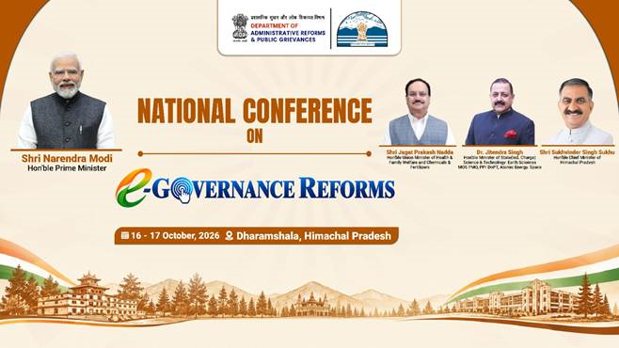
- Objective: To promote digital transformation, exchange successful governance practices and improve transparent, efficient and citizen-centric public service delivery.
- Key Discussions: The conference highlighted the role of artificial intelligence, emerging technologies, cybersecurity, data analytics and replication of successful e-governance initiatives.
- Himachal Pradesh Initiatives: Five initiatives were showcased:
- Him Parivar
- Sukh Aashraya
- Vidya Samiksha Kendra
- Green Himachal
- Rajiv Gandhi Van Samvardhan Yojana
- Other Initiatives: Presentations covered AgriStack, e-Jagriti, AI-enabled Clinical Decision Support System under e-Sanjeevani, the Multi-Hazard Early Warning Decision Support System and iGOT Karmayogi.
About the National Awards for e-Governance
- Nodal Department: DARPG presents these awards annually to recognise excellence in implementing e-governance initiatives.
- They have been awarded since 2003.
- Purpose: To recognise innovation, disseminate effective practices and encourage sustainable, technology-enabled governance solutions.
- Eligibility: Central Ministries/Departments, State/UT Governments, districts, local bodies, public sector undertakings and academic/research institutions.
- Award Categories 2026: The scheme provides for 16 awards under seven categories, covering:
- Government process re-engineering for digital transformation.
- Artificial intelligence and emerging technologies.
- Cybersecurity.
- District-level initiatives.
- Grassroots-level initiatives.
- Replication and scaling of successful e-governance projects.
- Data analytics for digital transformation.
Windfall Tax on Petroleum Exports
Context: The Central Government has revised windfall tax rates on petroleum exports, increasing the levy on petrol while reducing it on diesel for the fortnight beginning October 16, 2026.
More on the News
- The export duty on petrol has increased from ₹0.5 to ₹2.5 per litre, while the levy on diesel has decreased from ₹16 to ₹8.5 per litre.
- The export duty on aviation turbine fuel (ATF) remains unchanged at ₹10.5 per litre.
- The revised rates apply to exports, with no change in existing duties on petrol and diesel cleared for domestic consumption.
- The government reviews these duties every fortnight based on international price movements to ensure adequate domestic availability of petroleum products.
About the Windfall Tax
- A windfall tax is a special levy imposed on unusually high profits earned by companies due to unexpected market conditions, such as a sudden rise in commodity prices.
- India’s Mechanism: The government uses export duties in the form of Special Additional Excise Duty (SAED), along with the road and infrastructure cess, to regulate petroleum exports.
- Export duties on diesel and ATF were introduced on March 27, 2026, amid escalating tensions in West Asia. The levy on petrol exports was introduced on May 16, 2026.
Reasons Behind the Revision
- Ensuring Domestic Availability: Export duties discourage excessive exports and help maintain adequate domestic supplies of petroleum products.
- Addressing International Price Differences: The levy seeks to prevent exporters from taking undue advantage of higher international prices compared with domestic prices.
- Responding to Global Uncertainty: The West Asia conflict and fluctuations in global crude oil prices have created uncertainty in energy markets, necessitating periodic adjustments to export duties.