
SYLLABUS
GS-3: Science and Technology- Developments and their Applications and Effects in Everyday Life. Achievements of Indians in Science & Technology.
Context: India’s first space-based solar observatory, Aditya-L1, has provided new insights into the expansion of Coronal Mass Ejections (CMEs), revealing that solar eruptions do not always expand uniformly, which could improve space-weather understanding and forecasting.
Key Findings
• Study: Scientists from the Indian Institute of Astrophysics (IIA), Bengaluru, an autonomous institution under the Department of Science and Technology (DST), reconstructed the three-dimensional (3D) geometry and dynamics of a solar eruption using Aditya-L1, NASA’s Solar Dynamics Observatory (SDO) and 3D modelling.
• Solar Event: Researchers examined a CME that occurred on 5 August 2024, originating from an active region near the western limb of the Sun.
• Asymmetric Expansion: The CME did not expand like a symmetrical bubble. Instead, it underwent non-uniform expansion and developed an asymmetric shape.
• Role of VELC and SDO:
- NASA’s SDO, through its Atmospheric Imaging Assembly (AIA), captured the CME’s propagation across the sky.
- Aditya-L1’s Visible Emission Line Coronagraph (VELC) detected blueward and redward shifts in emission, indicating plasma moving towards and away from the observer, respectively.
- Combining these observations enabled scientists to reconstruct the eruption’s 3D structure and motion.
• 3D Modelling: A 3D geometric-kinematic model showed that an inclined CME axis and asymmetric lateral expansion could reproduce the observed spectral patterns, whereas a symmetrical expansion model could not.
• Scientific Significance: An asymmetric CME can experience different levels of drag while interacting with the solar wind. This may influence its speed and arrival time at Earth, affecting space-weather predictions.
• Future Research: Scientists plan to apply this technique to other CMEs, particularly in the lower corona, where eruptions evolve rapidly and their line-of-sight motion is difficult to determine through imaging alone.
What Is a Solar Eruption and Why Does It Matter?
• Solar Eruption: A solar eruption is a sudden release of energy, radiation and charged particles from the Sun.
- Major forms include solar flares and Coronal Mass Ejections (CMEs), which involve the release of large amounts of magnetised plasma from the solar corona.
• Coronal Mass Ejection (CME): A CME is a massive burst of hot, magnetised plasma released from the Sun’s outer atmosphere, known as the corona.
- It carries solar material and magnetic fields into interplanetary space.
• Space-Weather Disturbances: CMEs directed towards Earth can disturb its space environment and potentially affect satellites, communication networks, navigation systems and electricity networks.
• Solar Wind: It is a continuous stream of charged particles flowing outward from the Sun.
- Its interaction with CMEs can influence their speed and propagation through the heliosphere.
• Importance of Early Detection: Understanding the direction, speed and expansion of CMEs is essential for estimating their arrival time and preparing space-based infrastructure for potential disturbances.
About the Aditya-L1
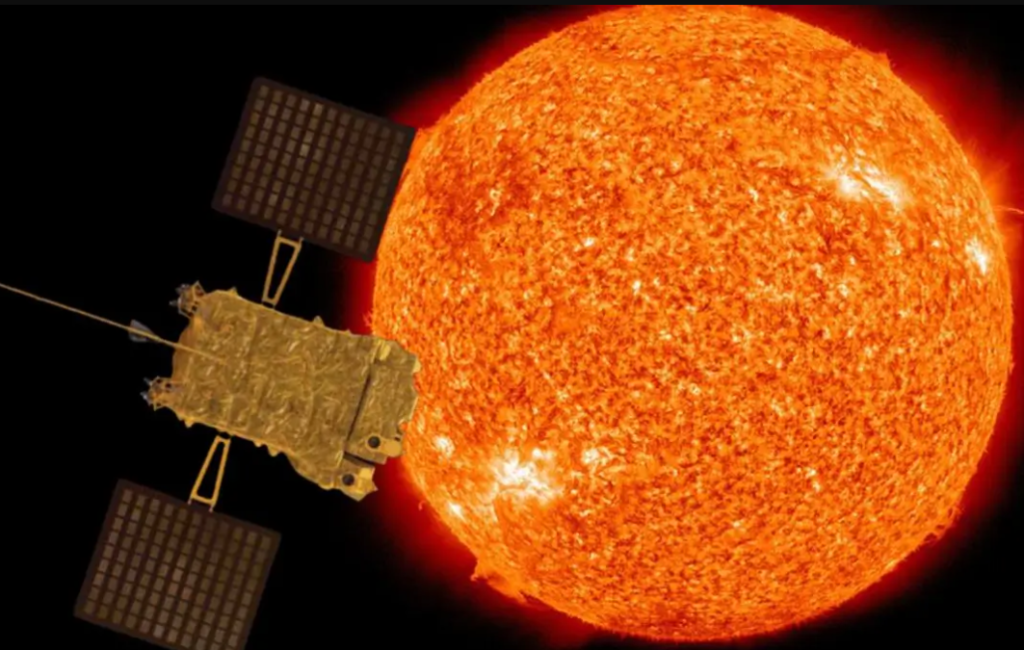
• Aditya-L1 is India’s first space-based observatory-class mission dedicated to the comprehensive study of the Sun.
• It was launched aboard PSLV-C57 on 2 September 2023.
• It operates in a halo orbit around the Sun–Earth L1 (Lagrange Point 1), approximately 1.5 million km from Earth.
• Key Advantage: Its position provides a continuous and uninterrupted view of the Sun, without occultation or eclipses caused by Earth.
• Scientific Payloads: It carries seven indigenously developed scientific payloads, five developed by ISRO and two by Indian academic institutions in collaboration with ISRO.
• Mission Objectives: It studies different layers and phenomena of the Sun, including the photosphere, chromosphere, corona, solar flares, CMEs and solar wind.
• Visible Emission Line Coronagraph (VELC): It is the primary payload, designed and developed by IIA at its MGK Menon Laboratory for Space Sciences, CREST campus, Hosakote, with substantial support from ISRO.