SYLLABUS
GS-3: Achievements of Indians in science & technology; indigenization of technology and developing new technology; Awareness in the fields of IT, Space, Computers, robotics, nano-technology, bio-technology and issues relating to intellectual property rights.
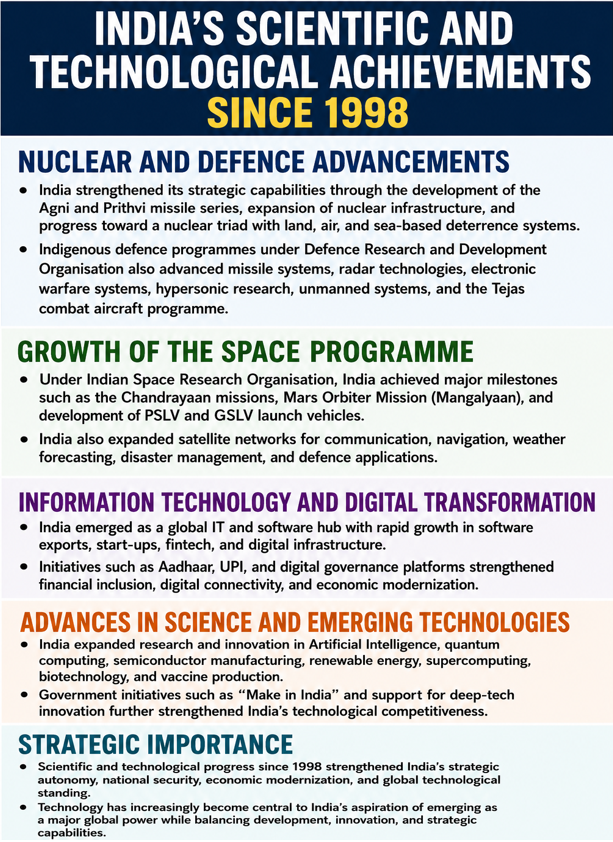
Context: National Technology Day is observed every year on May 11 to commemorate the successful Pokhran-II nuclear tests conducted in 1998 and to celebrate India’s achievements in science, innovation, and indigenous technology.
About National Technology Day
• India celebrates National Technology Day annually on May 11 to recognise the country’s achievements in science, technology, and innovation.
• The day commemorates the successful Pokhran-II nuclear tests conducted in Rajasthan on May 11, 1998, which established India as a nuclear-capable state and demonstrated its indigenous scientific and technological strength.
• The Government of India officially declared May 11 as National Technology Day in 1999 under the leadership of former Prime Minister Atal Bihari Vajpayee to honour scientists, engineers, and researchers who contributed to India’s technological advancement.
• National Technology Day also highlights the contribution of A. P. J. Abdul Kalam, who played a major role in India’s missile and nuclear programmes and became a symbol of scientific self-reliance.
• The 2026 theme is “Responsible Innovation for Inclusive Growth”, focusing on indigenous technology, AI, deep-tech innovation, and inclusive technological development.
About the Pokhran-II Nuclear Tests
• The Pokhran-II nuclear tests, code-named Operation Shakti, were conducted by India at the Pokhran Test Range in Rajasthan on May 11 and 13, 1998.
• India carried out five underground nuclear tests, including one thermonuclear (fusion) device and four fission devices.
• The five devices were named:
1. Shakti-I
2. Shakti-II
3. Shakti-III
4. Shakti-IV
5. Shakti-V
• The first three tests were conducted on May 11, while two additional tests took place on May 13.
• Pokhran-II followed India’s first nuclear test conducted in 1974 under the code name “Smiling Buddha.”
• The tests were conducted under conditions of extreme secrecy and demonstrated India’s indigenous scientific and strategic capabilities despite international technological restrictions.
• May 11, 1998, also witnessed the successful test-firing of the Trishul missile and the first flight of the indigenous Hansa-3 aircraft.
Significance of Pokhran-II
• Strategic Significance: Pokhran-II officially established India as a nuclear weapons state and strengthened its strategic deterrence capability.
- The tests marked a major shift in South Asia’s strategic and security landscape and laid the foundation for India’s doctrine of credible minimum deterrence.
• Scientific and Technological Significance: The operation showcased India’s advanced indigenous capabilities in nuclear science, engineering, electronics, materials science, and defence technology.
- It strengthened confidence in domestic research, scientific innovation, and technological self-reliance.
• Political and Diplomatic Impact: Following the tests, several countries, including the United States and Japan, imposed sanctions and restrictions on India.
- Despite international pressure, India gradually emerged as a responsible nuclear power and expanded its global strategic engagement.
• Symbol of Self-Reliance: Pokhran-II became a symbol of India’s scientific excellence, technological independence, and national confidence.
- It reinforced the importance of indigenous innovation and strategic technology in national security and development.