

SYLLABUS
GS-2: Government policies and interventions for development in various sectors and issues arising out of their design and implementation.
Context: The Ministry of Labour and Employment notified the constitution of the National Social Security Board for Unorganised Workers and Gig & Platform Workers to strengthen social security through targeted welfare schemes and institutional monitoring.
About the National Social Security Board for Unorganised Workers and Gig & Platform Workers
- Statutory Framework: Constituted under the Code on Social Security, 2020, which came into force on November 21, 2025.
- Chairperson: Union Minister for Labour and Employment, Dr. Mansukh Mandaviya.
- Vice-Chairperson: Secretary, Ministry of Labour and Employment.
- Composition: Includes representatives of Central and State Governments, aggregator companies, employers, civil society organisations, workers’ unions and gig and platform workers’ associations.
- Meetings: At least three times a year, following procedures prescribed by the Central Government.
- Key Functions:
- Recommend suitable social security schemes for different categories of unorganised, gig and platform workers.
- Advise the Central Government on matters relating to the administration of the Code.
- Monitor centrally administered social welfare schemes.
- Review State-level record-keeping functions and expenditure from the relevant fund and account.
- Undertake additional functions assigned by the Central Government.
Need and Significance of the Board
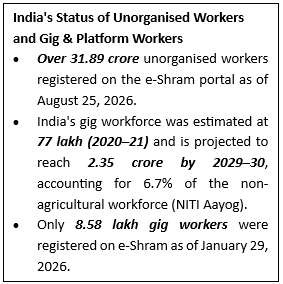
- Low Social Security Coverage: Only 8.58 lakh gig workers were registered on e-Shram as of January 29, 2026, against NITI Aayog’s estimated 1.43 crore gig workers in 2025–26, highlighting the significant registration and welfare coverage gap.
- Occupational Safety: Gig workers face increasing road accident risks due to tight delivery deadlines and incentive-based targets; trade unions estimated that 45–50 gig workers died and over 200 were injured in Andhra Pradesh during 2025.
- Weak Implementation of Welfare Schemes: A Parliamentary Committee found that 201 out of 702 approved ex-gratia claims remained unpaid as of February 18, 2025, highlighting administrative delays in delivering social security benefits.
- Statistical Invisibility: The Periodic Labour Force Survey (PLFS) does not separately identify gig and platform workers, limiting accurate assessment of their employment conditions, income insecurity and welfare requirements.
- Institutional Accountability and Representation: Representation of governments, aggregators, employers and workers’ associations, along with monitoring of welfare schemes and fund expenditure, can strengthen stakeholder participation and implementation.
India’s Initiatives for Unorganised Workers and Gig & Platform Workers
- Code on Social Security, 2020: Formally recognises gig and platform workers and provides for life and disability cover, accident insurance, health, maternity and old-age protection through notified schemes.
- Social Security Fund: Requires aggregators to contribute 1–2% of annual turnover, subject to a maximum of 5% of payments made or payable to gig and platform workers.
- e-Shram Portal (2021): To create a National Database of Unorganised Workers (NDUW), providing Aadhaar-linked registration and a Universal Account Number (UAN).
- Ayushman Bharat–PM-JAY: Budget 2025–26 announced healthcare coverage for gig workers registered on e-Shram, targeting approximately one crore beneficiaries.
- Pradhan Mantri Shram Yogi Maan-dhan (PM-SYM): Provides eligible unorganised workers an assured monthly pension of ₹3,000 after attaining 60 years of age under a voluntary contributory scheme.
- Pradhan Mantri Suraksha Bima Yojana (PMSBY): Provides eligible workers accident insurance coverage against accidental death and disability.
- State-level Initiatives: Rajasthan enacted the Platform Based Gig Workers (Registration and Welfare) Act, 2023, while Karnataka and Telangana have also taken steps towards gig worker welfare and social protection.