

SYLLABUS
GS-3: Indian Economy and issues relating to planning, mobilization of resources, growth, development and employment; Inclusive growth and issues arising from it.
Context: India’s Micro, Small and Medium Enterprises (MSMEs) sector has emerged as one of the strongest pillars of the country’s economic growth, employment generation, exports and inclusive development, with the Government focusing on formalisation, credit support, and digital integration.
About MSMEs
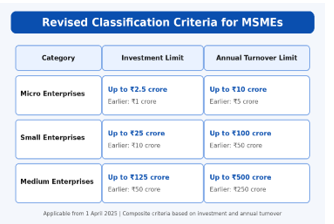
- MSMEs are governed under the Micro, Small and Medium Enterprises Development (MSMED) Act, 2006.
- MSME classification is based on the Investment in Plant, Machinery or Equipment values (excluding land and building) and Annual Turnover.
- The revised classification framework is implemented through the Udyam Registration System.
Key Achievements of MSMEs
- Massive Formalisation Drive: Around 4.72 crore enterprises registered under the Udyam Portal.
- Around 3.21 crore informal micro enterprises onboarded through Udyam Assist Platform.
- Inclusion of retail and wholesale traders under MSME guidelines since July 2021 expanded formal coverage.
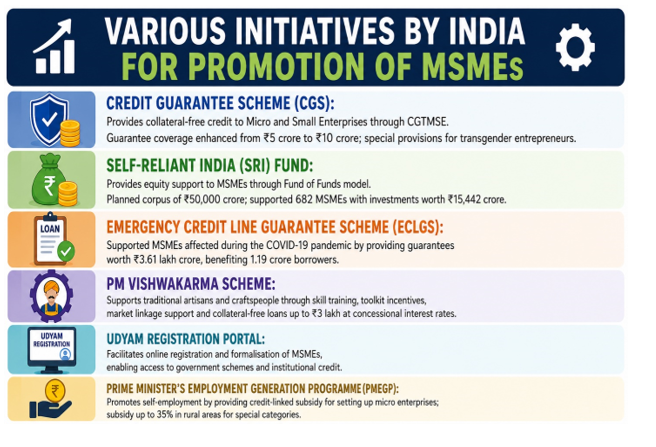
- Improved Credit Support: Credit Guarantee Scheme ceiling enhanced from ₹5 crore to ₹10 crore under Union Budget 2025–26.
- Special provisions introduced for transgender entrepreneurs with enhanced guarantee coverage up to 85%.
- ECLGS issued guarantees worth ₹3.61 lakh crore benefiting 1.19 crore borrowers.
- Strengthening Equity & Entrepreneurship: Self-Reliant India (SRI) Fund supported 682 MSMEs with investments worth ₹15,442 crore.
- PMEGP supported more than 5.8 lakh projects and generated nearly 36.3 lakh employment opportunities.
- PM Vishwakarma registered over 30 lakh artisans and approved loans worth nearly ₹5,050 crore.
- Digitalisation & Faster Payments: Platforms like GeM, TReDS, SAMADHAAN, MSME Champions Portal and PM Vishwakarma Portal improved market access and transparency.
- Dues amounting to ₹1.65 lakh crore reportedly paid to MSMEs through delayed payment monitoring mechanisms.
- Online Dispute Resolution (ODR) Portal launched in June 2025 for digitised settlement of delayed payment cases.
Importance of MSMEs
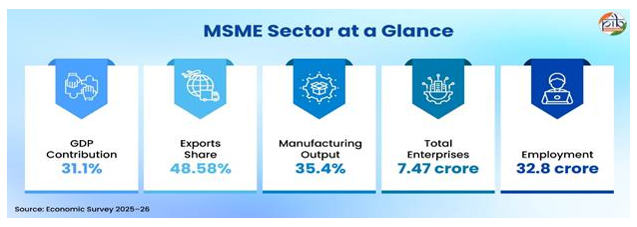
- Employment Generation: MSMEs are the second-largest source of employment after agriculture and provide livelihoods to nearly 32.8 crore people, especially in rural and semi-urban areas.
- Balanced Regional Development: Unlike large industries concentrated in urban centres, MSMEs promote decentralised industrialisation and reduce regional disparities by expanding economic activities across villages and small towns.
- Export Promotion & Manufacturing Growth: MSMEs contribute nearly half of India’s exports and around 35.4% of manufacturing output, strengthening domestic production and global competitiveness.
- Entrepreneurship & Inclusive Growth: MSMEs support self-employment, traditional artisans, first-generation entrepreneurs and local value chains, thereby promoting inclusive and grassroots economic development.
Challenges
- Limited Access to Affordable Credit: Many MSMEs, especially informal and rural enterprises, still face difficulties in obtaining timely institutional finance and working capital support.
- Delayed Payments: Delayed payments from buyers and institutions continue to affect MSME cash flow and operational sustainability despite legal safeguards under the MSMED Act, 2006.
- High Informality: A large number of micro enterprises continue to operate outside the formal economy without proper registration, documentation, and financial records.
- Technological & Market Constraints: Many MSMEs face challenges related to low digital adoption, weak market linkages, inadequate technology upgradation and limited integration into global supply chains.
Way Forward
- Strengthen Credit & Equity Support: Expand collateral-free lending, improve risk capital availability and deepen financial inclusion for rural and first-generation entrepreneurs.
- Accelerate Formalisation & Digital Integration: Further strengthen Udyam, UAP, GeM and TReDS platforms to integrate informal enterprises into formal supply chains and digital markets.
- Ensure Timely Payments & Legal Enforcement: Improve the efficiency of MSE Facilitation Councils and Online Dispute Resolution mechanisms to reduce payment delays and strengthen MSME liquidity.
- Promote Skill Development & Global Competitiveness: Encourage technology adoption, skill upgradation, export promotion, and innovation support to make MSMEs globally competitive and resilient.