
SYLLABUS
GS-3: Issues related to direct and indirect farm subsidies and minimum support prices; Public Distribution System-objectives, functioning, limitations, revamping; issues of buffer stocks and food security; Technology missions; economics of animal-rearing.
Context: The Mission for Aatmanirbharta in Pulses completed one year on 11 October 2026, marking a year of efforts to strengthen domestic pulses production, reduce import dependence and enhance farmers’ incomes.
Key Features of the Mission for Aatmanirbharta in Pulses
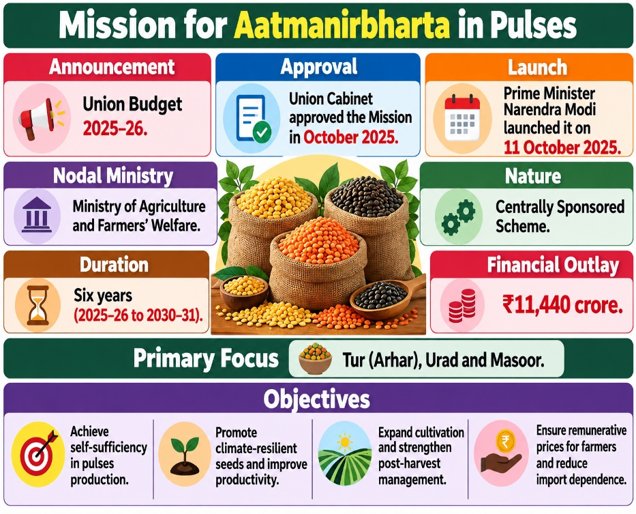
- Production and Productivity Targets (by 2030–31): Increase pulses production from 242 to 350 lakh tonnes, cultivation area from 275 to 310 lakh hectares, and average productivity from 881 to 1,130 kg/ha.
- Seed Development and Distribution: Distribute 87.5 lakh free seed kits and 126 lakh quintals of certified seeds over six years.
- Promote climate-resilient seeds, improve seed quality, productivity and protein content, and use the SATHI portal for seed authentication and traceability.
- Expansion of Cultivation: Expand pulses cultivation by 35 lakh hectares, targeting rice-fallow areas and other suitable lands.
- Promote intercropping, crop diversification and improved agricultural practices through clusters covering 489 districts.
- Assured Procurement and Price Support: Ensure procurement of 100% of Tur, Urad and Masoor offered by willing, registered farmers for four years (2025–26 to 2028–29) through NAFED and NCCF.
- Provide price support under the Price Support Scheme (PSS) of PM-AASHA.
- Post-Harvest Infrastructure: Establish 1,000 pulse processing units (dal mills), with assistance of up to ₹25 lakh per eligible unit for processing and packaging infrastructure.
- Improve storage, reduce post-harvest losses and promote value addition.
- Digital Monitoring and Implementation: Use a three-tier steering committee mechanism at national, State and district levels, with Krishi Mapper for geo-tagging, geo-fencing and tracking demonstrations.
- Use AgriStack and the Digital Crop Survey for farmer identification and crop monitoring, and e-Samriddhi and Vistaar for procurement-related services and agricultural information.
Achievements of the Mission
- Growth in Domestic Production: Pulses production increased from 256.83 lakh tonnes in 2024–25 to 274.09 lakh tonnes in 2025–26.
- According to the third advance estimates, while cultivation area expanded from 277.20 lakh hectares to 286.46 lakh hectares and average productivity improved from 926 kg to 957 kg per hectare.
- Reduction in Import Expenditure: The value of pulses imports declined by 31.52%, from ₹46,427.60 crore in 2024–25 to ₹31,793.59 crore in 2025–26, while pulses exports increased by 13.40%, from US$855 million to US$969.53 million.
- Progress in Procurement: According to the NCCF dashboard snapshot dated 17 June 2026, procurement reached 10.55 lakh tonnes across nine states, ₹7,047 crore was released directly to farmers as MSP payments, and 4.69 lakh farmers benefited out of 7.74 lakh registered farmers.
- Expansion of Processing Infrastructure: Of the 1,000 processing units envisaged, 528 were allocated to States and Union Territories in the first phase, while 18 of the 23 pulse-processing units approved under the relevant component of the Pradhan Mantri Kisan SAMPADA Yojana have been completed.
- Wider Seed Distribution: A total of 9.25 lakh free seed kits were distributed during Rabi 2025–26 to promote pulses cultivation, including in rice-fallow areas.
- Improved Price Support: For 2026–27, the Minimum Support Price (MSP) increased to ₹8,200 per quintal for Urad, ₹8,450 per quintal for Tur and ₹7,000 per quintal for Masoor compared with their respective 2024–25 rates.
Challenges and Areas for Improvement
- Persistent Demand–Supply Gap: Despite being the world’s largest producer of pulses, India continues to import pulses to meet domestic demand. Sustained production growth is essential to achieve self-sufficiency.
- Low Agricultural Productivity: Productivity remains below the Mission’s target of 1,130 kg per hectare. Yield gaps, limited adoption of improved varieties and regional variations constrain production.
- Climate and Market Uncertainties: Climate variability, pest attacks and price fluctuations can affect farmers’ output, profitability and willingness to expand pulses cultivation.
- Seed and Value-Chain Constraints: Timely access to quality seeds, adequate storage and processing facilities, and stronger private-sector participation in seed systems remain important for sustained growth.
Way Forward
- Strengthen Research and Seed Systems: Develop high-yielding, short-duration and climate-resilient varieties, and improve seed availability, certification, traceability and region-specific planning.
- Expand Sustainable Cultivation: Promote pulses in rice-fallow and rainfed areas, encourage intercropping and crop diversification, and strengthen farmer training through ICAR, Krishi Vigyan Kendras and State agricultural departments.
- Improve Market and Price Assurance: Ensure timely procurement and payments, strengthen local procurement centres and improve price monitoring to reduce farmers’ uncertainty.
- Build an Integrated Value Chain: Expand processing, storage and packaging, strengthen Farmer Producer Organisations, and explore pulses in public distribution and school meals to boost demand and nutritional security.