SYLLABUS
GS-2: Effect of policies and politics of developed and developing countries on India’s interests.
Context: India retained its position as Asia’s third-most powerful country for the third consecutive year, with its overall score rising to 40.5 in the Lowy Institute’s Asia Power Index 2026.
About the Asia Power Index
- It is an annual assessment released by Australia’s Lowy Institute to measure the distribution of power across the Indo-Pacific.
- It ranks 27 countries and territories using 131 indicators across eight measures (Economic Capability, Military Capability, Resilience, Future Resources, Economic Relationships, Defence Networks, Diplomatic Influence and Cultural Influence).
- The index measures power in Asia, not power of Asian countries.
- It includes external powers with strategic interests in the region, such as the US, Russia and Australia, if they take part in both the ASEAN Regional Forum and the East Asia Summit.
Key Findings of the Index
- India’s Position:
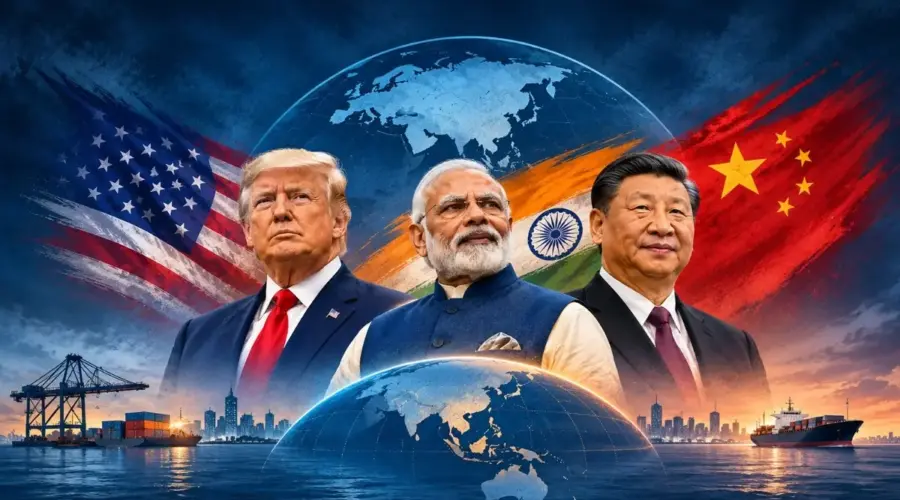
- India ranked third with 40.5 points, behind the US (78.9) and China (73.6).
- India remained a Major Power (40 points or above).
- The India-China power gap narrowed to 33.1 points, its lowest since 2018. However, China remained approximately 80% more powerful than India.
- India’s Performance Across Parameters
- Cultural Influence: Recorded the highest gain (+2.3), reaching 43.8 points, driven by cultural projection, information flows and people-to-people exchanges.
- Defence Networks: Improved by 2.1 points to 18.6, moving up two places to ninth. Greater regional defence engagement and BrahMos missile sales to Southeast Asia contributed to the improvement.
- Future Resources: Increased by 1.2 points to 56.2, reflecting a favourable economic outlook.
- Military Capability: Improved by 0.5 points.
- Economic Capability: Declined by 0.7 points to 26.4 due to rupee depreciation, changes in IMF methodology and a nearly $20 billion decline in outbound investment.
- Diplomatic Influence: Remained India’s strongest parameter at 70.3 points.
- Economic Relationships: Remained stable, with India rising two places to seventh.
- Resilience: Remained unchanged.
- Diplomatic Influence and Leadership:
- Prime Minister Narendra Modi was ranked Asia’s second-most effective regional leader, after China’s Xi Jinping. India’s leadership assessment improved by three places.
- However, perceptions of Modi’s global leadership and India’s strategic ambition weakened due to India’s lower diplomatic profile during the Gulf conflict, including its muted response to the sinking of an Iranian naval vessel by a US submarine.
- Power Yield:
- India’s Power Yield gap narrowed for the first time since 2023.
- Power Yield measures how effectively a country converts its available resources into actual influence in Asia.
- Narrowing US-China Power Gap:
- The US (78.9) and China (73.6) were separated by just 5.3 points, the narrowest gap since 2018.
- The military capability gap also reached its narrowest recorded level.
- US Diplomatic Influence declined by six points to 76.7, marking its fourth consecutive annual decline and the largest single-year fall since 2018.
- The Iran conflict, punitive tariffs and uncertainty over US security commitments in Asia weakened Washington’s regional standing.
- China remained relatively stable, gaining in military capability, cultural influence and resilience, supported by military modernisation and technological advances, including artificial intelligence.