
SYLLABUS
GS-2: Indian Constitution—Amendments, Significant Provisions; Issues and Challenges Pertaining to the Federal Structure, Devolution of Powers and Finances up to Local Levels and Challenges Therein.
Context: The Joint Parliamentary Committee (JPC) examining the One Nation, One Election (ONOE) proposal has been granted an extension till the end of the Winter Session of Parliament to submit its report.
More on the News
- The Lok Sabha has extended the tenure of the 41-member JPC till the first day of the last week of the Winter Session 2026 to continue examining the Constitution (One Hundred and Twenty-Ninth Amendment) Bill, 2024 and the Union Territories Laws (Amendment) Bill, 2024, which seek to introduce simultaneous elections to the Lok Sabha and State Legislative Assemblies.
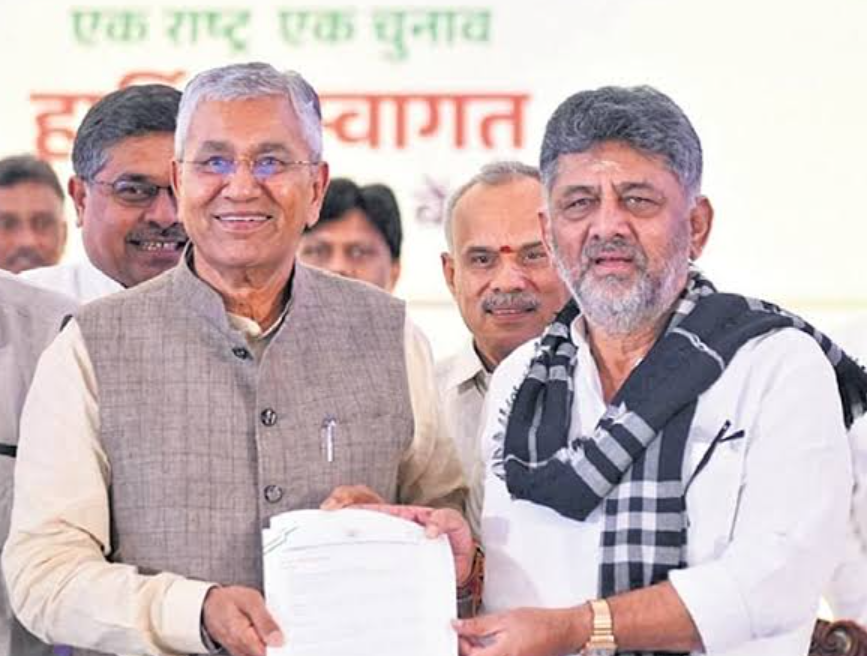
- The JPC is headed by P. P. Chaudhary and has been conducting nationwide consultations on the proposed rollout of simultaneous elections for the Lok Sabha, State Assemblies and local bodies by 2029.
- The idea of ONOE is based on recommendations of the High-Level Committee chaired by former President Ram Nath Kovind, whose report was accepted by the Union Cabinet in 2024.
About One Nation, One Election (ONOE)
- One Nation, One Election (ONOE) refers to the proposal of conducting simultaneous elections to the Lok Sabha and all State Legislative Assemblies, followed by synchronised local body elections within a fixed cycle.
- At present, elections in India are conducted separately based on the tenure of individual legislatures, resulting in frequent election cycles across the country.
- India followed simultaneous elections between 1951–52 and 1967, after which the cycle was disrupted due to the premature dissolution of Legislative Assemblies, frequent use of Article 356, and political instability.
Key Challenges in Implementation
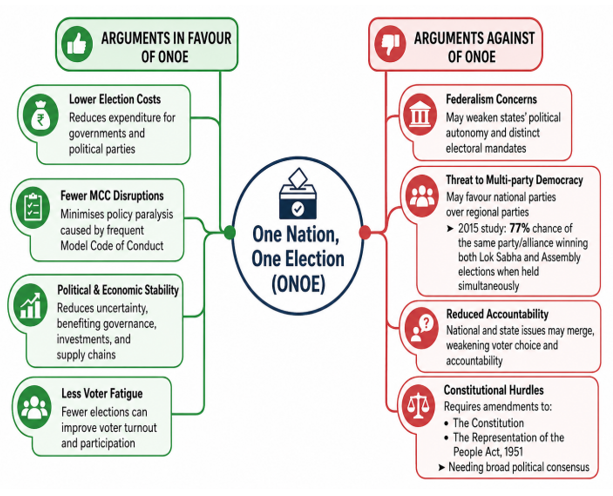
- Constitutional Amendments: Implementing ONOE requires amendments to several provisions of the Constitution, as well as the Representation of the People Act, 1951, which governs elections to the Lok Sabha and State Legislative Assemblies.
- Logistical Requirements: Simultaneous elections would require significant investment in additional Electronic Voting Machines (EVMs) and Voter Verifiable Paper Audit Trail (VVPAT) machines, which require replacement approximately every 15 years.
- Government Stability: Premature dissolution of legislatures or loss of majority raises questions about maintaining the synchronised election cycle while preserving democratic accountability.
- Impact on Election Spending: While ONOE aims to reduce election expenditure, it may not effectively address the issue of black money in elections.
Way Forward
- Consensus-Based Implementation: ONOE should be implemented gradually through wider consultations with political parties, States, and constitutional institutions to preserve the federal balance and democratic accountability.
- Complementary Electoral Reforms: Simultaneous elections should be accompanied by reforms such as greater transparency in political funding, strengthening intra-party democracy, and exploring state funding of elections.
- Strengthening Transparency and Accountability: Bringing political parties under the Right to Information (RTI) Act, 2005 can improve transparency, public trust, and accountability in the electoral process.