
SYLLABUS
GS-I Prelims: Current Events of National and International Importance.
GS-2: Issues relating to development and management of Social Sector/Services relating to Health and Human Resources.
Context: International Day of Yoga (IDY) is celebrated every year on 21 June to promote yoga as a holistic approach to physical health, mental well-being, emotional balance, and spiritual growth, while highlighting India’s ancient contribution to global wellness.
About International Day of Yoga (IDY) 2026
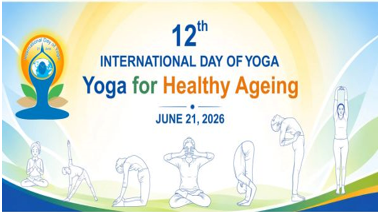
• Theme of 2026: “Yoga for Healthy Ageing”
• Marks the 12th International Day of Yoga.
• Highlights yoga’s role in:
- Promoting longevity and healthy ageing.
- Improving mobility, flexibility, balance and strength.
- Supporting mental well-being and stress management.
- Encouraging independent and active living among older adults.
• Aligns with the WHO Decade of Healthy Ageing (2021–2030).
• A nationwide live yoga session held on 14 June 2026 witnessed participation by more than 4 lakh people simultaneously, creating a new Guinness World Record.
About International Day of Yoga (IDY)
• Recognizing yoga’s universal appeal, the United Nations General Assembly (UNGA) adopted Resolution 69/131 on 11 December 2014, declaring 21 June as the International Day of Yoga.
• The proposal was introduced by Indian Prime Minister Narendra Modi during the 69th Session of the UN General Assembly and received support from 175 member states, making it one of the most widely supported UN resolutions.
- 21 June was selected as IYD as it marks the Summer Solstice, the longest day of the year in the Northern Hemisphere, which is considered significant in yogic traditions.
• The first International Day of Yoga was observed on 21 June 2015 at Rajpath, New Delhi.
• In 2016, yoga was inscribed on the UNESCO Representative List of the Intangible Cultural Heritage of Humanity, recognizing its cultural and civilizational significance.
• To ensure synchronized global participation, the Ministry of Ayush developed the Common Yoga Protocol (CYP) in 2015.
• Objectives of IDY:
- Promote awareness about yoga and its benefits.
- Encourage preventive healthcare and healthy lifestyles.
- Foster harmony between body, mind, and spirit.
- Strengthen global cooperation through wellness and cultural exchange.
About Yoga
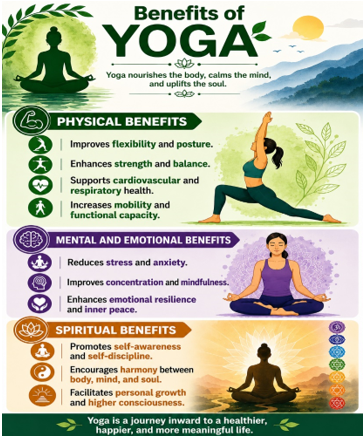
• The word Yoga is derived from the Sanskrit root “Yuj”, meaning to join, unite, or yoke, symbolizing the union of body, mind, and consciousness.
• Yoga is an ancient Indian physical, mental, spiritual, and philosophical discipline aimed at achieving harmony between the individual and the universe.
• Yoga traces its roots to the Indus-Saraswati Civilisation, making it one of the world’s oldest knowledge traditions.
• Yogic practices are mentioned in the Vedas, Upanishads, Mahabharata, Ramayana, Buddhist traditions and Jain traditions.
• Lord Shiva is traditionally regarded as the first yogi (Adi Yogi).
• Maharishi Patanjali systematized yoga through the Yoga Sutras, providing its philosophical and practical framework.
• Yoga is one of the six orthodox schools (Shad Darshanas) of Indian philosophy and is closely associated with the Sankhya school of thought.