
SYLLABUS
GS-3: Science and Technology- developments and their applications and effects in everyday life; indigenization of technology and developing new technology.
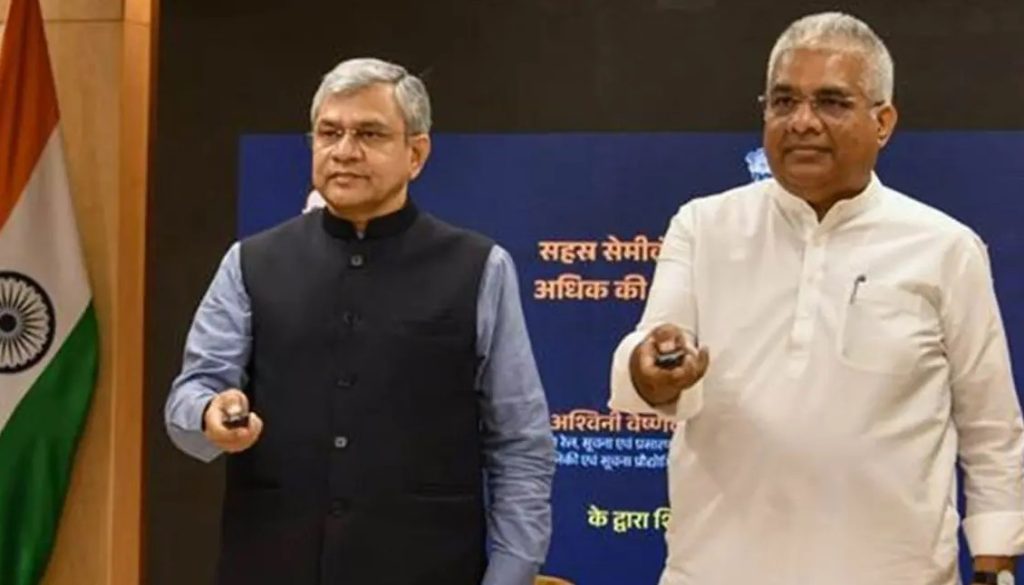
Context: Rajasthan has formally entered India’s semiconductor ecosystem with the inauguration of India’s first SME-led semiconductor assembly, testing, marking, and packaging (ATMP/OSAT) facility at Bhiwadi, alongside a new Electronics Manufacturing Cluster (EMC).
About the Electronics Manufacturing Cluster (EMC)
- The Electronics Manufacturing Cluster (EMC) developed by ELCINA at Salarpur, Khushkhera, Bhiwadi, Rajasthan, has been developed over 50.3 acres with a project cost of ₹46.09 crore.
- The Government of India has provided direct support of ₹20.24 crore under the EMC scheme.
- The cluster is equipped with testing and training centres and a dedicated Skill Development Centre.
- The EMC has attracted planned investments of over ₹1,200 crore by 20 companies.
- Eleven companies are currently operational with cumulative investments of over ₹900 crore and employment for over 2,700 persons.
About the Semiconductor ATMP/OSAT Facility
- The Semiconductor ATMP/OSAT facility of Sahasra Semiconductors Pvt. Ltd. is India’s first Small and Medium Enterprise (SME) to start commercial production of semiconductor chips.
- Developed under MeitY’s Scheme for Promotion of Manufacturing of Electronic Components and Semiconductors (SPECS), the facility has been set up with an investment of over ₹150 crore.
- The 57,000 sq. ft. facility is equipped with Class 10K and 100K cleanrooms.
- The facility will package memory chips, LED driver ICs, eSIMs and RFID products.
- The unit currently has an annual packaging capacity of 60 million semiconductor units and plans to scale up to 400–600 million units annually over the next 2–3 years.
- More than 60% of its production is being exported to markets including the United States, Germany, France, Eastern Europe, China, and Nepal.
Government Schemes Related to Semiconductor and Electronics Manufacturing
- Scheme for Promotion of Manufacturing of Electronic Components and Semiconductors (SPECS) was notified on 1st April 2020 to offset the disability for domestic manufacturing of electronic components and semiconductors.
- The scheme provides a financial incentive of 25% on the capital expenditure for the identified list of electronic goods that comprises the downstream value chain.
- Till February 2026, SPECS has led to a cumulative investment of ₹18,609 crore and employment generation of 64,443.
- Semicon India Programme: The Government launched the Semicon India Programme in January 2022 to develop a complete semiconductor ecosystem ranging from design, fabrication, assembly, testing, packaging and module manufacturing.
- The Government has approved 10 projects with investment commitments of about ₹1.6 lakh crore, and commercial production from Micron and Kaynes plants has commenced.
- Approved companies under the programme have entered into technology partnerships with global semiconductor companies from Taiwan, Japan, Korea, US, UK and Malaysia.
- Electronics Manufacturing Clusters (EMC and EMC 2.0) Schemes: The government launched EMC (2012) and EMC 2.0 (2020) schemes to provide world-class infrastructure, logistics, and plug-and-play facilities for electronics manufacturing.
- Under these schemes, 30 Greenfield Electronics Manufacturing Clusters (EMCs) and 5 Common Facility Centres (CFCs) have been established across 18 States.
- These clusters have mobilized investments of more than ₹30,000 crore and generated around 90,000 jobs.
- Electronics Components Manufacturing Scheme (ECMS): The government launched ECMS to deepen the supply chain ecosystem and develop a robust electronics component ecosystem in the country.
- The scheme aims to attract investments in Printed Circuit Boards (PCBs), passive components, electro-mechanical components, sub-assemblies, camera modules and optical transceivers.
- Till date, 75 applications approved under ECMS are expected to attract investments of ₹61,671 crore and generate 65,040 jobs.
Significance
- Rajasthan’s Entry into Semiconductor Industry: Rajasthan has formally entered India’s semiconductor ecosystem and the strategically critical semiconductor industry.
- Boost to India’s Electronics and Semiconductor Manufacturing: The event marks a significant milestone in India’s journey towards becoming a global hub for electronics manufacturing and semiconductors under Make in India, Digital India and Atmanirbhar Bharat.
- MSME-Led Semiconductor Manufacturing: India has taken a notable step in its semiconductor ambitions with the inauguration of its first SME-led chip manufacturing facility.
- Export-Oriented Semiconductor Production: More than 60 per cent of the facility’s production is being exported to international markets, highlighting India’s growing integration into the semiconductor supply chain.
- Development of Bhiwadi as Manufacturing Hub: Rajasthan Semiconductor Policy 2026 aims to develop the region near Delhi NCR into a manufacturing hub.
- Bhiwadi, traditionally known mainly for the automobile sector, is now emerging as a centre for semiconductor and electronics industries as well.
SOURCE:
DD News
The Statesman
Sansad