
SYLLABUS
GS-3: Awareness in the fields of IT, Space, Computers, robotics, Nano-technology, bio-technology and issues relating to intellectual property rights.
Context: The foundation stone for India’s first advanced 3D chip packaging unit in Bhubaneswar marks a significant milestone under the India Semiconductor Mission (ISM).
About the Advanced 3D Chip Packaging Unit
- First in India: Establishment of the country’s first Glass substrate-based Advanced Semiconductor Packaging Unit in Odisha
- Cutting-edge Technology: Introduction of advanced 3D Heterogeneous Integration modules
- Rapid Progress: Groundbreaking within months of approval by the Union Cabinet, reflecting fast-track implementation
- Strategic Investment: Project outlay of approximately ₹1,943 crore
- Employment Generation: Creation of around 2,500 direct and indirect jobs
- High Capacity: Annual production capacity of 50 million assembled units
- Critical Applications: Chips to serve key sectors including aerospace, defence, artificial intelligence, 5G technologies and Data Centres.
Understanding 3D Glass Semiconductor Technology
- Unlike traditional semiconductor manufacturing, which relies on silicon wafers and planar (2D) packaging, this facility will deploy glass-based substrates and 3D stacking technologies.
- These technologies allow multiple chip components to be vertically integrated, increasing computing power within the same footprint.
- The approach enables heterogeneous integration, where logic, memory, and sensors are combined efficiently. Glass substrates provide better thermal stability, lower signal loss, and higher precision for advanced nodes.
Why This Project is India’s Most Important Chip Bet?
- Technological Shift Beyond Moore’s Law:
- Moore’s Law, proposed in 1965, suggested that the number of transistors on a chip would double every two years. However, as chips approach physical and thermal limits, this pace has slowed.
- The semiconductor industry is now moving towards alternatives such as advanced packaging, chiplets, and 3D integration. The 3D glass semiconductor project aligns with this transition and represents an effort to sustain performance improvements through vertical integration rather than mere miniaturisation.
- Strategic Importance for India:
- Among all projects under the India Semiconductor Mission, this is considered the most significant in terms of advanced packaging technology. It positions India at the cutting edge of semiconductor innovation.
- The project strengthens India’s role in the global semiconductor value chain by:
- Enabling participation in the 3D packaging drive
- Supporting critical sectors like AI, 5G, defence, and data infrastructure
- Reducing dependence on external technology ecosystems
Future Direction: ISM 2.0
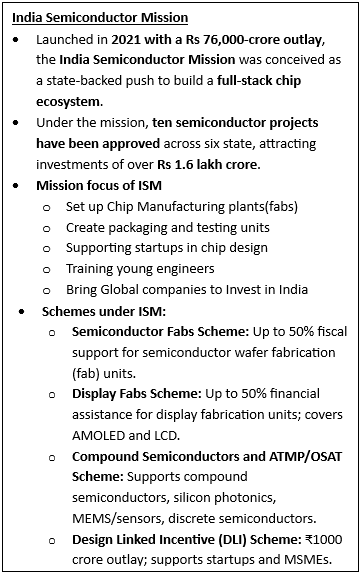
- The government is working on the next iteration of the mission, with a possible outlay of around $11 billion. While ISM 1.0 focused on infrastructure creation, ISM 2.0 is expected to emphasise ancillary industries such as gases, chemicals, and capital goods.
- The Union Budget 2026–27 marked a decisive push to India’s technology ambitions with the announcement of India Semiconductor Mission 2.0.
- A provision of Rs. 1,000 crore has been allocated for FY 2026–27, signalling continued commitment to strengthening the semiconductor ecosystem.
- There is also likely to be a stronger push towards design-linked incentives, with a focus on market-based outcomes and deeper ecosystem integration.
Challenges and Way Forward
- Despite its promise, the project faces several challenges. The semiconductor sector requires high capital investment, advanced technological capabilities, and a skilled workforce.
- India also faces competition from established semiconductor hubs and dependence on global supply chains.
- Addressing these challenges will require sustained policy support, ecosystem development, and long-term investment in research and innovation.
Sources:
PIB
Indian Express
PIB
PIB