

SYLLABUS
GS-2:Bilateral, regional and global groupings and agreements involving India and/or affecting India’s interests; Effect of Policies and Politics of Developed and Developing Countries on India’s interests.
Context: The India–UK Comprehensive Economic and Trade Agreement (CETA) and the accompanying Double Contribution Convention (DCC) will enter into force on 15 July 2026, marking a major milestone in India’s economic diplomacy and deepening trade ties with one of its key strategic partners.
More on the News
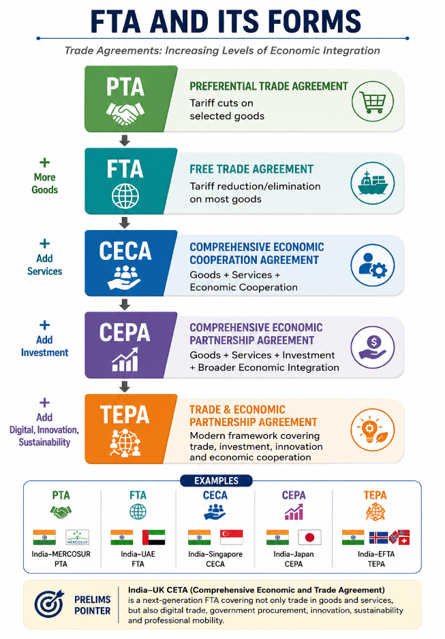
- The agreement was signed in July 2025 and has now completed all necessary domestic ratification procedures in both countries.
- The FTA is the UK’s biggest and most economically significant bilateral trade agreement since Brexit (term for the UK leaving the European Union).
- The foundation for the agreement was laid through the India–UK Enhanced Trade Partnership (2021) and the Roadmap 2030, which envisaged elevating bilateral ties to a Comprehensive Strategic Partnership and doubling bilateral trade to USD 100 billion by 2030.
- The implementation marks a major milestone in the India–UK Comprehensive Strategic Partnership and operationalises one of India’s most ambitious trade agreements with a major developed economy.
Key Features of the India–UK CETA
- Trade in Goods
- The UK will provide duty-free access to nearly 99% of India’s exports, covering almost the entire trade value of Indian exports to the UK.
- Major beneficiaries include textiles and apparel, leather and footwear, gems and jewellery, marine products, engineering goods, chemicals, auto components, processed foods, toys and sports goods.
- India has opened 89.5% of its tariff lines, covering 91% of UK exports, while protecting sensitive sectors such as dairy products, cereals, millets, pulses, edible oils and several agricultural products.
- Steel Trade Safeguard Understanding
- India and the UK reached a mutually acceptable solution regarding the UK’s steel safeguard measures, which had emerged as a key issue during the implementation process.
- The arrangement ensures that around 85% of Indian steel exports remain outside the scope of the safeguard restrictions, supported through country-specific tariff-rate quotas and other protective mechanisms.
- Services and Professional Mobility
- The UK has provided one of its most comprehensive service packages, covering 137 sub-sectors across areas such as IT/ITeS, financial services, education, healthcare, professional services, telecommunications and consultancy.
- The agreement facilitates mobility of business visitors, investors, intra-corporate transferees, contractual service suppliers and independent professionals.
- A dedicated annual quota has been created for 1,800 Indian chefs, yoga instructors and classical musicians to work in the UK.
- Double Contribution Convention (DCC)
- The DCC exempts Indian professionals and their employers from making dual social-security contributions in the UK during temporary assignments for up to five years.
- More than 75,000 Indian professionals and over 900 companies are expected to benefit, with estimated savings exceeding ₹4,000 crore.
- Trade Facilitation and New Areas of Cooperation
- The agreement simplifies Rules of Origin through exporter self-certification and reduced documentation requirements for small consignments, thereby facilitating participation by MSMEs and e-commerce businesses.
Significance of the Agreement
- Boost to Labour-Intensive Exports: Duty-free access to the UK market for nearly 99% of Indian exports is expected to enhance the competitiveness of labour-intensive sectors such as textiles, leather, footwear, gems and jewellery, marine products, and processed foods.
- Strengthening India’s Services Advantage: Expanded market access across 137 service sub-sectors, coupled with enhanced mobility provisions and social-security exemptions under the DCC, will create new opportunities for Indian professionals and service providers.
- Advancing India’s Trade Strategy: The agreement reinforces India’s strategy of pursuing comprehensive bilateral trade agreements with major economies and strengthens its position in global trade and supply chains.
- Deepening India–UK Strategic Partnership: Beyond trade, CETA is expected to promote cooperation in investment, innovation, digital economy, clean energy, advanced manufacturing and resilient supply chains, thereby strengthening the broader India–UK Comprehensive Strategic Partnership.
- Supporting Post-Brexit Economic Engagement: The agreement provides India with deeper access to a major developed market while helping the UK diversify its trade partnerships in the post-Brexit era.
Challenges and Concerns
- Non-Tariff Barriers: Compliance with stringent UK standards relating to quality, sustainability, sanitary and phytosanitary measures may continue to pose challenges for Indian exporters.
- Utilisation Gap: Experience from earlier FTAs suggests that many MSMEs may not fully utilise available benefits due to limited awareness of rules of origin, certification requirements and market opportunities.
- Emerging Trade Regulations: Future measures relating to carbon emissions, sustainability standards and trade remedies could affect the competitiveness of certain Indian exports.
- Domestic Sectoral Concerns: Careful monitoring will be required to ensure that tariff liberalisation does not adversely affect vulnerable domestic sectors while maintaining overall trade competitiveness.
Way Forward
- Improve FTA Utilisation: Strengthen awareness, capacity-building and handholding support for MSMEs and exporters to effectively utilise market-access opportunities and Rules of Origin provisions.
- Enhance Export Competitiveness: Invest in quality standards, technology upgradation, logistics efficiency and value addition to maximise gains in key sectors such as textiles, leather, gems and jewellery, engineering goods and marine products.
- Address Emerging Trade Challenges: Proactively engage with the UK on sustainability standards, carbon-related trade measures and other non-tariff barriers to safeguard the interests of Indian exporters.
- Deepen Economic Cooperation: Fast-track the proposed Bilateral Investment Treaty (BIT) and expand collaboration in innovation, clean energy, advanced manufacturing and resilient supply chains.