
SYLLABUS
GS-2: Bilateral, regional and global groupings and agreements involving India and/or affecting India’s interests.
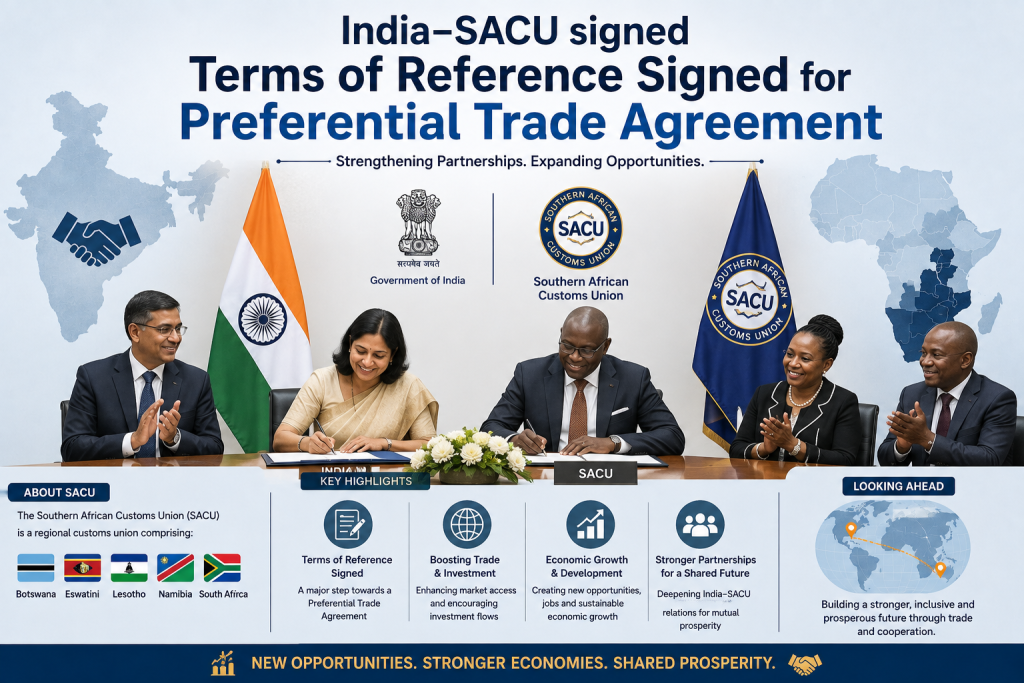
Context: India and the Southern African Customs Union (SACU) signed the Terms of Reference (ToR) to formally launch negotiations for a Preferential Trade Agreement (PTA) between India and SACU.
More on the News
• The negotiations seek to provide preferential market access to an already established commercial relationship, with significant complementarities in engineering goods and machinery, automobiles, pharmaceuticals, textiles, agriculture and agri-processing.
• The PTA is envisaged to cover eight important chapters:
• Trade in goods and market access for goods
- Rules of origin and origin procedures
- Customs procedures and trade facilitation
- Trade remedies, including a bilateral safeguard mechanism
- Sanitary and phytosanitary measures
- Technical barriers to trade
- Dispute settlement
- Legal and horizontal provisions
• The negotiations are expected to begin within a month, with both sides aiming to conclude the trade talks within a year.
About the Southern African Customs Union (SACU)
• SACU is a customs union comprising Botswana, Eswatini, Lesotho, Namibia and South Africa.
• SACU is the world’s oldest existing customs union.
• Its present configuration was established in 1910 through a Customs Union Agreement between the Union of South Africa and the High Commission Territories of Bechuanaland, Basutoland and Swaziland.
• Following the independence of the member territories, the arrangement was updated and relaunched as SACU in 1969 through a new agreement between South Africa, Botswana, Lesotho and Swaziland (now Eswatini).
• The agreement entered into force on 1 March 1970.
• Namibia joined SACU in 1990 following its independence from South Africa, becoming the fifth member.
• Headquarters: Windhoek, Namibia.
• Key Features:
- SACU provides for the free interchange of goods between member countries and maintains a common external tariff and common excise tariff.
- Customs and excise revenues collected in the common customs area are pooled and shared among members according to an agreed revenue-sharing formula.
India–SACU Trade & Economic Relations
• India’s bilateral trade with the five-member SACU was $16.81 billion in 2025–26, including exports worth $7.55 billion.
• India is the second-largest supplier to the SACU group, with companies present in sectors such as pharmaceuticals and healthcare, IT, automotive manufacturing and infrastructure.
• Automobiles and auto parts were India’s second-largest export category to SACU after petroleum products, with shipments worth $1.7 billion in the fiscal year ended March 2026.
• India is expected to seek duty concessions for automobiles and auto parts, pharmaceuticals, machinery, electrical equipment, chemicals and textiles.
• India is also seeking more reliable access to SACU supplies of critical minerals, including platinum-group metals, manganese and copper.
Significance
• Formal Roadmap for Negotiations: The ToR sets the boundaries, goals, scope and rules for the proposed trade negotiations and provides structure, transparency and predictability to the process.
• Market Diversification: The PTA can help diversify India’s export markets and provide preferential market access for Indian businesses in sectors such as automobiles, pharmaceuticals, machinery and textiles.
• Global Supply Chains: India can help integrate SACU countries into global supply chains, particularly in areas where their businesses are competitive and where skills and talent can be developed.
• Critical Minerals: Stronger engagement can improve India’s access to platinum-group metals, manganese and copper, which are important for manufacturing, batteries and clean energy technologies.
• India–Africa Partnership: The ToR strengthens India–Africa economic engagement through trade, investment, capacity building and development cooperation, while reviving negotiations that saw five rounds between 2002 and 2010 without a final agreement.
• Development-Oriented Trade: The PTA aims to be balanced, mutually beneficial and development-oriented, while addressing the different development needs of SACU Member States.