
SYLLABUS
GS-2: Important International institutions, agencies and fora- their structure, mandate.
GS-3: Conservation, environmental pollution and degradation, environmental impact assessment.
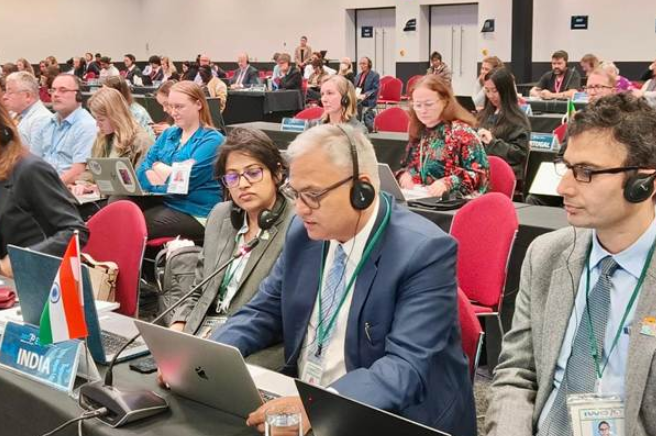
Context: India reaffirmed its commitment to the conservation of whales and other cetaceans at the 70th meeting of the International Whaling Commission (IWC-70), being held in Hobart, Australia, from 28 September to 2 October 2026.
More on the News
- In its Opening Statement, India emphasised continued collaboration among range countries, scientific institutions and relevant international organisations for effective cetacean conservation.
- India highlighted that improved scientific information on population status, distribution, movements, breeding ecology and threats is essential for strengthening conservation measures and supporting informed decision-making.
- India reaffirmed support for scientific studies and evidence-based approaches, along with greater cooperation among governments, researchers and local communities to develop practical and locally appropriate approaches to address threats to cetaceans.
- IWC-70 is significant as it coincides with the 80th anniversary of the signing of the International Convention for the Regulation of Whaling.
About the International Whaling Commission
- The International Whaling Commission (IWC) is an inter-governmental organisation established in 1946 under the International Convention for the Regulation of Whaling, signed in Washington, D.C., on 2 December 1946.
- It has 89 member governments and serves as the global body responsible for the management of whaling and conservation of whales.
- The Convention provides the IWC’s legal framework, while its legally binding Schedule sets measures such as catch limits, whale sanctuaries, protection of calves and females accompanied by calves, and restrictions on hunting methods.
- The IWC’s Scientific Committee provides scientific advice through research, population assessments and studies of cetacean biology.
Why was the IWC Created?
- Declining whale populations: Intensive and poorly regulated whaling severely depleted whale stocks, with Antarctic whale catches rising from 195 in 1904 to around 37,000 in 1931, while Antarctic blue whales declined from an estimated 2–3 lakh to fewer than 400.
- Need for international regulation: Since whales are migratory and cross national boundaries, unilateral measures were inadequate to regulate their exploitation and conserve their populations, creating the need for coordinated international action.
Evolution of the IWC
- From regulation to conservation: The IWC initially focused on regulating whaling, but the rise in global whale catches from 35,000 in 1946 to 66,000 in 1962 led to stronger conservation measures, including the commercial whaling moratorium adopted in 1982 and effective from 1986.
- Broader conservation role: The IWC later expanded its focus to threats such as bycatch, entanglement, ship strikes, ocean noise, pollution, disease and climate change.
- Different national positions: Norway continues commercial whaling under its formal objection to the moratorium, while Iceland rejoined the IWC in 2002 with a reservation to the moratorium; Japan withdrew from the IWC in 2019 and resumed commercial whaling.
- Aboriginal subsistence whaling: The IWC regulates limited whale hunting by indigenous communities for their traditional food and cultural needs through scientifically determined catch limits.
India’s Conservation Efforts towards Whales and Other Cetaceans
- Wild Life (Protection) Act, 1972: Cetacean species occurring in Indian waters receive the highest level of legal protection under the Act.
- Marine Protected Areas: India has notified several MPAs to protect marine biodiversity, including whales, dolphins, dugongs, sharks, rays, turtles and corals.
- Project Dolphin (2020): Launched on 15 August 2020, Project Dolphin adopts a holistic approach towards conserving dolphins, whales, porpoises and associated aquatic ecosystems.
- Arabian Sea Humpback Whale: India has accorded particular importance to its conservation; it is among the 25 species identified for focused conservation efforts.
- India and IWC (1981): India has been a member of the IWC since 1981 and has reiterated that its future work should remain guided by science-based conservation priorities, international cooperation and practical measures to address threats to whales and other cetaceans.