
SYLLABUS
GS-2: Bilateral, Regional and Global Groupings and Agreements involving India and/or affecting India’s Interests.
GS-3: Conservation, Environmental Pollution and Degradation.
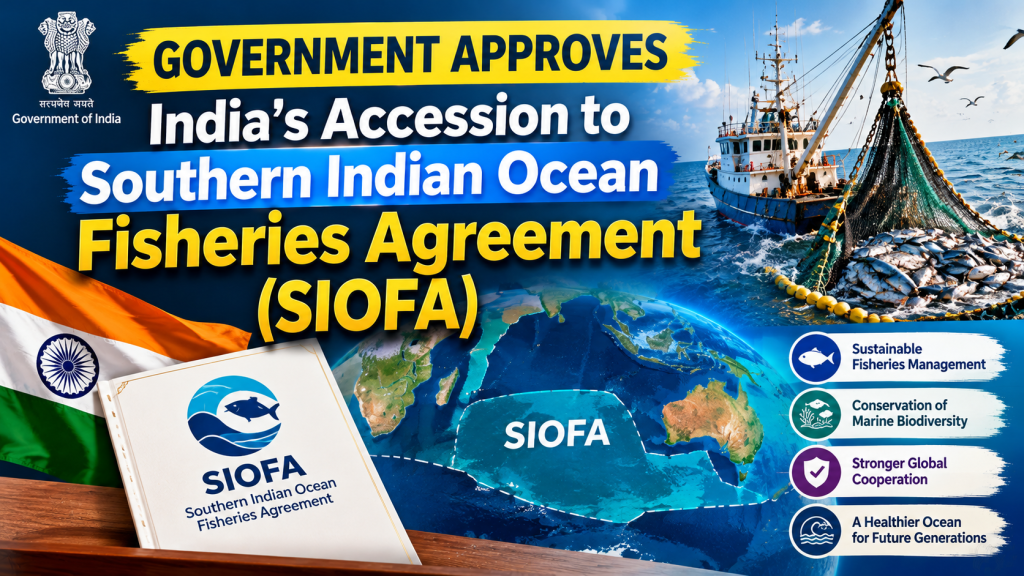
Context: The Central Government has approved India’s accession to the Southern Indian Ocean Fisheries Agreement (SIOFA) to expand high-seas fishing opportunities and strengthen India’s role in regional fisheries governance.
More on the News
- India has been a Cooperating Non-Contracting Party (CNCP) to SIOFA since 2022, with limited participation in its decision-making bodies.
- The approval follows the Guidelines for High Seas Fisheries, issued by the Government in December 2025, which provide a policy framework for expanding India’s fishing operations into international waters.
About Southern Indian Ocean Fisheries Agreement (SIOFA)
- Nature and objective: SIOFA is a regional fisheries agreement signed in Rome on 7 July 2006 and in force since June 2012. It aims to ensure the long-term conservation and sustainable use of fishery resources in the high seas of the southern Indian Ocean.
- Coverage: It covers fish, molluscs, crustaceans and certain sedentary species within its area of competence.
- It excludes highly migratory species listed in Annex I of the United Nations Convention on the Law of the Sea (UNCLOS) and sedentary species under coastal States’ fisheries jurisdiction, as specified in Article 77(4) of UNCLOS.
- Regional framework: The Indian Ocean has two major regional fisheries management frameworks: SIOFA and the Indian Ocean Tuna Commission (IOTC). India has been an IOTC Contracting Party since 1996.
- The IOTC regulates highly migratory tuna and tuna-like species.
India’s Need to Build High-Seas Fishing Capacity
- Existing capacity gap: Indian fishing vessels operate largely within 60–80 nautical miles of the EEZ, highlighting the need to expand operations into suitable high-seas areas.
- Global context: The high seas constitute approximately 65% of the global ocean and are currently dominated by five countries/regions: China (21%), Taiwan (13%), Japan (11%), South Korea (11%) and Spain (8%).
- Capacity requirements: India needs modern vessels, skilled personnel, technology and monitoring systems to expand high-seas fishing. It can also explore access agreements in other countries’ Exclusive Economic Zones (EEZs) to diversify fishing opportunities and increase economic returns.
Significance of India’s Accession
- Expanded fishing opportunities: Following completion of accession, Indian-flagged vessels and enterprises could undertake authorised fishing of squid, toothfish, alfonsino and other eligible non-highly migratory fish stocks in SIOFA’s area, subject to applicable conservation measures and fishing authorisations.
- Economic and strategic interests: Accession will provide a regional framework for expanding India’s fishing operations, creating opportunities for Indian fishers and enterprises, and strengthening India’s recognised presence in high-seas fisheries.
- Scientific cooperation: India will be able to participate more fully in scientific research, resource assessments and stock-management processes, supporting sustainable harvesting and the long-term viability of marine resources.
- Regional cooperation and coastal security: Participation in SIOFA’s High Seas Boarding and Inspection (HSBI) Scheme will strengthen cooperation on high-seas monitoring and inspection. India’s participation can also support efforts to prevent illegal, unreported and unregulated (IUU) fishing and promote responsible fishing practices.