
Context: A political debate has emerged in Bihar over the 1996 India–Bangladesh Ganga Water Treaty, which governs the sharing of Ganga waters at Farakka during the lean season. The treaty is due to expire in December 2026 and may be renewed only through mutual consent.
About the Treaty
- India and Bangladesh signed the Treaty on Sharing of the Ganga/Ganges Waters at Farakka on 12 December 1996.
- Parties: India and Bangladesh
- Location: Farakka Barrage, West Bengal — the last control structure on the Ganga within India.
- Water-sharing period: 1 January to 31 May every year.
- Basis of allocation: Water is allocated in ten-day periods according to the formula specified in the treaty.
- Duration: 30 years, renewable through mutual consent.
- Monitoring mechanism: A Joint Committee comprising representatives of both countries monitors implementation, including flow measurements at Farakka and Hardinge Bridge.”
- The treaty was designed to regulate lean-season water sharing while seeking to ensure equitable utilisation by both countries. It has been implemented since 1997.
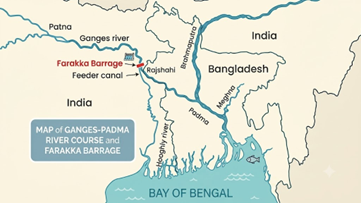
Why It Matters for Bihar
- The Ganga is central to Bihar’s irrigation, ecology, inland navigation, fisheries and floodplain livelihoods.
- Any future negotiation must account for the interests of upstream and downstream Indian States, particularly Bihar, West Bengal, Uttar Pradesh and Jharkhand.
Key concerns include:
- Lean-season flows: Adequate dry-season water is needed for irrigation, drinking water, river ecology and navigation.
- Sedimentation: Heavy silt loads in the Ganga–Farakka system affect river morphology, drainage and flood management.
- Floods and erosion: Bihar’s concern is not only water quantity but also monsoon flooding, bank erosion and changing river courses.
Humanoid Robots at Beijing Games
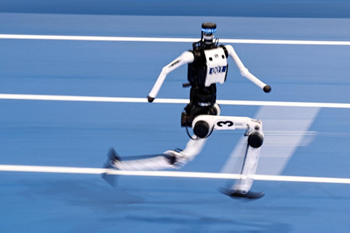
Context: Chinese humanoid robots demonstrated major advances in speed, balance and coordination at the second World Humanoid Robot Games, held at Beijing’s National Speed Skating Oval from 22 August 2026.
Record-Setting Performances
- A Chinese humanoid robot completed a 100-metre race in 9.39 seconds, officially beating the human world record of 9.58 seconds set by Usain Bolt at the 2009 World Athletics Championships
- Another X-Humanoid robot reportedly reached 2.88 metres in a standing high-jump event, compared with the 0.95-metre robotic best at the 2025 edition.
- During a pre-event trial, Chinese smartphone company Honor’s humanoid robot clocked 9.32 seconds in the 100 metres, reaching a stated peak speed of 14.5 metres per second.
Important Caveat
- The results do not replace official human athletics world records. Athletics records are set by human athletes under World Athletics rules, whereas robots depend on motors, batteries, sensors and programmed control systems.
- Moreover, Javier Sotomayor’s 2.45-metre record is for the conventional running high jump, whereas the robot’s reported 2.88-metre feat was a standing jump.
Significance
- Humanoid robotics: The performance reflects progress in bipedal locomotion, high-power actuators, balance control, machine vision and real-time AI decision-making.
- Embodied AI: Unlike purely digital AI, humanoid robots must sense, reason and act reliably in the physical world.
- Technology competition: The event coincided with Beijing’s World Robot Conference, where companies exhibited about 3,000 products. It highlighted China’s focus on advanced robotics amid intensifying technological competition with the United States.
Three New RBI Central Board Directors
Context: The Union government has appointed Annie George Mathew, Syed Akbaruddin and Janmejaya Kumar Sinha as part-time, non-official directors on the Reserve Bank of India’s Central Board. The Appointments Committee of the Cabinet approved the appointments on 22 August 2026 for a term of four years or until further orders, whichever is earlier.
Appointees
Annie George Mathew
- Former Special Secretary (Expenditure), Ministry of Finance.
- Serving member of the Sixteenth Finance Commission.
- Over three decades of experience in public finance, audit, accounts, procurement and financial management.
Syed Akbaruddin
- Former Permanent Representative of India to the United Nations.
- Former spokesperson of the Ministry of External Affairs.
- Associated with the Kautilya School of Public Policy.
Janmejaya Kumar Sinha
- “Economist and management consultant; Chairman of Boston Consulting Group’s India Practice.”
- Formerly associated with BCG Asia-Pacific.
RBI Central Board
The Central Board is the apex governing body of the RBI, established under the Reserve Bank of India Act, 1934. It provides broad oversight and advice to the central bank on monetary, financial, economic and regulatory matters.
It comprises: Section 8 of the RBI Act, 1934:
- Governor + not more than four Deputy Governors — official directors.
- Four directors, one from each Local Board.
- Ten directors nominated by the Central Government from different fields.
- Two government officials nominated by the Central Government.
- The RBI Governor is currently Sanjay Malhotra.
Assam’s First IVF-Born Lakhimi Calf
Context: Assam has reported the birth of the world’s first IVF-born female calf of the indigenous Lakhimi cattle breed at the Assam Veterinary and Fishery University. Announced by Chief Minister Himanta Biswa Sarma on 22 August 2026, the achievement marks a notable application of reproductive biotechnology for conserving and improving a native cattle breed.
Why It Matters
The Lakhimi calf was produced through in-vitro fertilisation (IVF)—a process in which eggs are fertilised outside the animal’s body in laboratory conditions. The resulting embryo is transferred into a surrogate cow for gestation and birth.
This approach can help:
- Multiply the progeny of genetically superior indigenous animals more rapidly than conventional breeding.
- Strengthen Assam’s dairy sector and raise livestock-based incomes for small and marginal farmers.
- Build scientific capacity in animal reproduction and embryo-transfer technology in the Northeast.
In March 2026, Assam had also recorded its first IVF-born calf through embryo-transfer technology—a female Gir calf born at a dairy farm in Sonapur, Kamrup district.