
SYLLABUS
GS 3: ECONOMIC DEVELOPMENT- Storage, Transport and Marketing of Agricultural Produce and Issues and Related Constraints; E-technology in the aid of farmers
Context: National Agriculture Market (e-NAM), launched in April 2016 is a pan-India electronic trading platform integrating agricultural mandis into a unified digital market enabling seamless online trading transparent price discovery and wider market access for farmers and traders representing a major step toward achieving the vision of “One Nation One Market” in agricultural marketing.
Key Achievements of e-NAM
- e-NAM has emerged as a major digital reform in agricultural marketing, strengthening market integration and improving transparency in trade across India.
- Its achievements reflect both scale expansion and deeper structural transformation of agricultural markets.
- A total of 1,656 mandis across 23 States and 4 Union Territories have been successfully integrated into the platform, indicating wide geographical coverage and increasing adoption of digital trading systems.
- The platform has built a strong stakeholder ecosystem with more than 80 crore farmers, 2.73 lakh traders, and 4,724 Farmer Producer Organizations (FPOs) registered, showing large-scale participation of key actors in agricultural markets.
- In terms of trade performance, e-NAM has enabled cumulative transactions of around 25 crore metric tonnes of agricultural produce valued at approximately ₹4.84 lakh crore (2016–2026), reflecting its growing role in national agricultural commerce.
- The platform has also demonstrated strong growth momentum, with trade value rising significantly from ₹3.19 lakh crore in 2024 to ₹4.84 lakh crore in 2026, highlighting increasing trust and deeper market engagement among stakeholders.
- Operational activity remains robust, with over 204.76 lakh metric tonnes of produce traded in recent periods, indicating sustained usage and expanding digital participation in mandis.
- The e-NAM mobile application provides real-time price information for 247 agricultural commodities, enabling farmers to access market signals and improve price realisation.
- Additionally, the government has supported infrastructure development by providing financial assistance of up to ₹75 lakh per mandi, strengthening digital and physical integration of mandis into the e-NAM ecosystem.
Objectives of e-NAM:
- To create a unified national market for agricultural commodities through digital integration of mandis
- To ensure transparent price discovery through competitive online bidding
- To enhance market access for farmers, FPOs, and traders beyond local mandis
- To reduce intermediaries and transaction inefficiencies in agricultural trade
- To promote digital payments and financial inclusion in agricultural marketing
- To improve post-harvest value realization and reduce distress sales
Key Features e-NAM
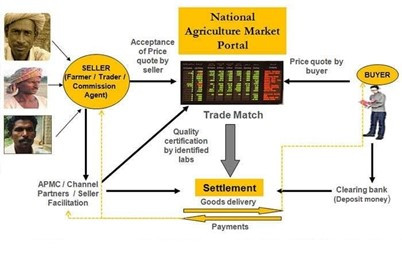
- Single-window service: It connects APMC mandis across India and develops a single unified national market for agricultural commodities; Commodity arrivals, quality assaying, bidding, payment, all on one platform;
- Unique Lot ID tracking: Each lot tracked from gate entry to final sale via mobile
- Live price dashboard: Real-time commodity prices, mandi arrivals, trade volumes, publicly accessible.
- Inter-state trade facility: State Unified License enables traders to bid across State boundaries
- The platform integrates multiple digital payment modes, including NEFT, RTGS, internet banking, and UPI, enabling it to adapt across states.
- Unique lot ID tracking system ensuring transparency from arrival to sale
- Multilingual mobile application enabling wider accessibility for farmers (12-language interface: Hindi, English, Gujarati, Marathi, Telugu, Bengali, Tamil, Odia and others).
- A key advancement in the evolution of e-NAM was the introduction of the Platform of Platforms (PoP) on 14 July 2022, which integrates a wide range of services through a unified digital interface on the e-NAM mobile application.
- It enables farmers and stakeholders to access services across the agricultural value chain, including logistics, warehousing, quality assurance, grading and packaging, agri-inputs, financial and insurance services, along with advisory support such as weather updates and crop forecasting.
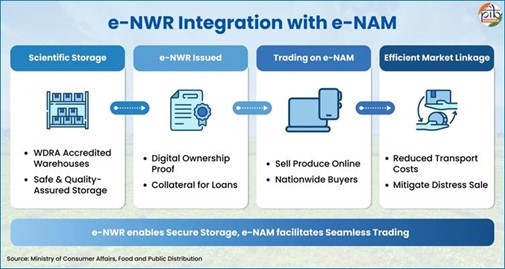
- The Electronic Negotiable Warehouse Receipt (e-NWR) system has been integrated with e-NAM to enable a more seamless and efficient agricultural.
Benefits of e-NAM
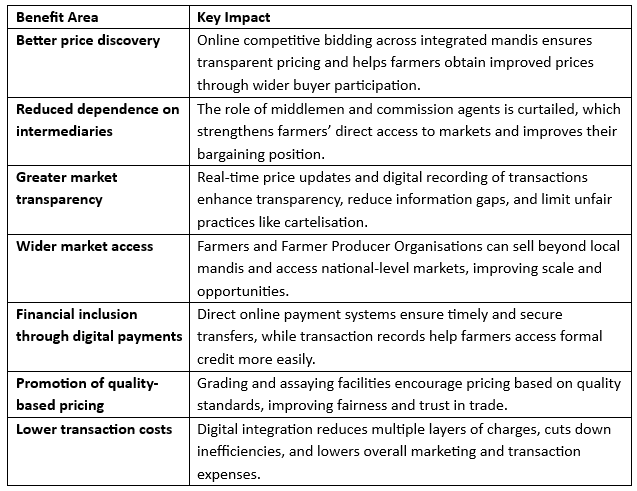
Challenges
- Uneven digital infrastructure and internet connectivity in rural areas
- Limited digital literacy among small and marginal farmers
- Slow integration and adoption by some APMC mandis and states
- Inadequate standardization of quality grading and assaying infrastructure
- Resistance from traditional market intermediaries
- Logistics bottlenecks in inter-state agricultural movement
- Limited awareness about advanced features like PoP and e-NWR linkage
Way Forward
- Strengthen rural digital and physical infrastructure by improving internet connectivity, standardizing grading facilities, and ensuring better APMC reforms across states for smoother e-NAM integration.
- Promote digital literacy among farmers through targeted training and capacity-building programs so that small and marginal farmers can effectively participate in online agricultural markets.
- Enhance collective participation and partnerships by empowering Farmer Producer Organisations (FPOs) and collaborating with private logistics and fintech companies to improve market access and backend support systems.
- Improved coordination between states for seamless inter-state trade
- Wider awareness of e-NWR-based trading and collateral financing
- Integration of AI-based price forecasting and market intelligence tools
Conclusion
The National Agriculture Market (e-NAM) represents a structural shift in India’s agricultural marketing system by transitioning from fragmented mandi-based trade to a digitally integrated national marketplace. While challenges in adoption and infrastructure remain, its expanding ecosystem—linking markets, storage, finance, and logistics—positions it as a key instrument for achieving efficient, transparent, and farmer-centric agricultural transformation in India.
Source:
PIB
Research Gate