SYLLABUS
GS-3: Achievements of Indians in science & technology; indigenization of technology and developing new technology.
Context: India’s indigenous defence production reached an all-time high of ₹1.78 lakh crore in FY 2025–26, reflecting the growing success of the Aatmanirbhar Bharat initiative and India’s transformation into a major defence manufacturing nation.
More on the News
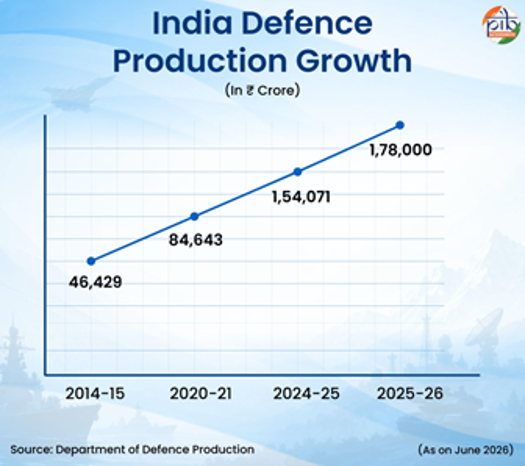
- India’s defence production increased to ₹1.78 lakh crore in FY 2025–26, registering 15.6% growth over FY 2024–25 (₹1.54 lakh crore).
- Defence production has grown by 110% since FY 2020–21 (₹84,643 crore) and nearly four times compared to FY 2013–14 (₹43,746 crore).
- Defence Public Sector Undertakings (DPSUs) and PSUs contributed about 76% of total production, while the private sector contributed 24%(around ₹42,000 crore), its highest-ever share.
- Growth in domestic production supported record defence exports of ₹38,424 crore in FY 2025–26, with exports reaching more than 80 countries.
- India’s defence manufacturing ecosystem now includes:
- 16 DPSUs
- Around 500 licensed defence companies
- Nearly 17,000 MSMEs
- Nearly 65% of defence equipment is now produced domestically, compared to an import dependence of 65–70% earlier.
Significance
- Strengthening Aatmanirbhar Bharat: Reduces dependence on imported weapons and military systems and enhances strategic autonomy and national security.
- Boost to Defence Exports: Record exports of ₹38,424 crore indicate growing global acceptance of Indian defence products and help India emerge as a reliable defence supplier.
- Increased Private Sector Participation: Private sector contribution reached an all-time high of ₹42,000 crore and encourages innovation, competition and efficiency in defence manufacturing.
- Employment and Industrial Growth: Supports a large ecosystem of DPSUs, MSMEs, startups and defence manufacturers and generates skilled employment and strengthens supply chains.
- Technological Advancement: Promotes indigenous development of advanced platforms such as Tejas, Akash, BrahMos, AI-based systems and hypersonic technologies and enhances India’s long-term defence preparedness.
- Strategic and Economic Benefits: Reduces import bills, improves foreign exchange savings and strengthens India’s position as a global defence manufacturing hub.
Government Initiatives Promoting Defence Production
- Defence Acquisition Procedure (DAP), 2020: Prioritises indigenous procurement and domestic manufacturing, promotes “Buy Indian” categories and higher indigenous content, and encourages Indian design, development and production.
- Positive Indigenisation Lists (PILs): Introduced under Aatmanirbhar Bharat to progressively ban imports of specified defence items, with five lists covering 5,012 items notified and more than 15,700 defence items indigenised.
- Innovations for Defence Excellence (iDEX): Supports startups, MSMEs, innovators and academia, with 676 startups/MSMEs engaged and 551 design and development contracts signed by March 2026, encouraging indigenous defence innovation.
- SRIJAN Portal & SRIJAN DEEP: Connects industry with DPSUs and Armed Forces for indigenisation, facilitates replacement of imported components through domestic manufacturing, and has over 41,000 vendors and 2.7 lakh products registered on SRIJAN DEEP.
- Defence Industrial Corridors: Established in Uttar Pradesh and Tamil Nadu to promote defence manufacturing clusters, investments and employment, attracting investments worth over ₹74,000 crore combined.