

SYLLABUS
GS-3: Indian Economy and issues relating to Planning, Mobilization of Resources; Government Budgeting.
Context: The Union Ministry of Finance, in its Monthly Economic Review (MER), April 2026, has cautioned that states with persistent revenue deficits and high debt burdens may face heightened fiscal stress, particularly during economic shocks.
Key Highlights of the MER
- Prevalence of Revenue Deficits Across States:
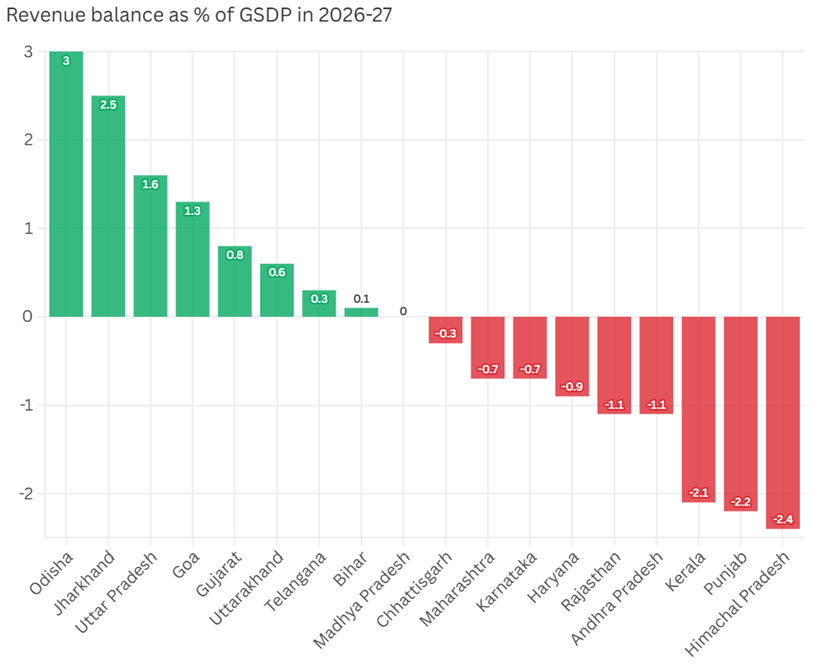
- 9 out of 18 large states have revenue deficits as per their own projections for 2026-27. Seven States are projected to be revenue surplus, while one is in revenue balance.
- The magnitude of deficits is significant, with some states recording revenue deficits exceeding 2% of GSDP, indicating structural fiscal imbalances.
- Magnitude of Revenue Deficits: The States with projected revenue deficits as a percentage of their gross state domestic products (GSDP) are Himachal Pradesh (-2.4%), Punjab (-2.2%), Kerala (-2.1%), Andhra Pradesh (-1.1%), Rajasthan (-1.1%), Haryana (-0.9%), Karnataka (-0.7%), Maharashtra (-0.7%), and Chhattisgarh (-0.3%).
- High Debt-Servicing Burden:
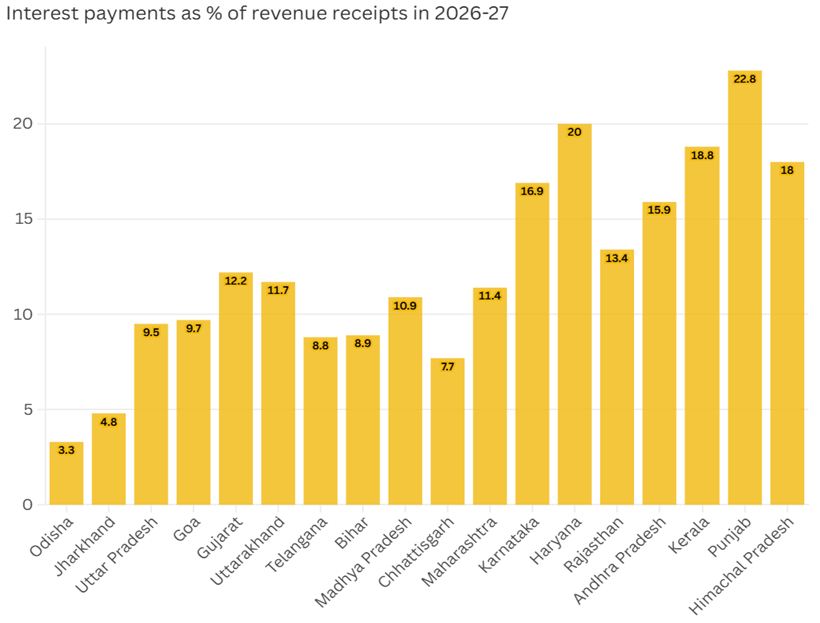
- Revenue-deficit states are constrained by significant interest payment obligations, with six states spending over 15% of their revenue receipts on interest payments.
- Punjab is particularly stressed, with around 22.8% of its revenue receipts going toward interest payments, severely limiting fiscal flexibility.
- Reduced Fiscal Flexibility and Shock Absorption:
- The MER highlights that states with revenue deficits and high debt burdens have fewer “degrees of freedom” to respond to economic shocks.
- Such states may be forced to cut productive expenditure or increase dependence on central assistance, affecting long-term growth prospects.
Key Drivers of Fiscal Stress in States
- High Committed Expenditure: States allocate a large share of budgets to salaries, pensions, subsidies, and interest payments, leaving limited room for productive spending.
- Weak Own-Revenue Mobilisation: Several states struggle to expand their tax base (e.g., property tax, stamp duty) and rely heavily on GST transfers and central grants.
- Legacy Debt and Off-Budget Liabilities: High levels of past borrowings, contingent liabilities (such as power sector debts), and guarantees continue to exert pressure on state finances.
- Compression of Capital Expenditure: Due to inflexible revenue expenditure, states often cut capital spending during fiscal stress, adversely affecting long-term growth prospects.
Implications for the Economy
- Higher Aggregate Debt and Fiscal Risks: States’ outstanding liabilities have risen to around 27% of GDP (2024–25), raising concerns about aggregate fiscal sustainability and crowding out of private investment.
- Liquidity Stress and Borrowing Pressures: Several states have increasingly relied on Ways and Means Advances (WMA) and overdrafts from the Reserve Bank of India, indicating short-term liquidity stress.
- Impact on Growth and Infrastructure: Reduction in capital expenditure can slow infrastructure development, weakening long-term economic growth and competitiveness.
- Strain on Cooperative Federalism: Increased demand for central assistance and fiscal support may strain Centre–State relations and complicate fiscal coordination.
Measures Required to Improve the Fiscal Discipline of States
- Strengthening Own Revenue Base: States should improve tax compliance, widen tax bases, and enhance non-tax revenues to reduce dependence on central transfers.
- Rationalising Expenditure: There is a need to optimise subsidies, rationalise wage and pension liabilities, and prioritise productive expenditure.
- Enhancing Debt Management: States should adopt prudent debt management strategies, including transparency in off-budget borrowings and limiting contingent liabilities.
- Prioritising Capital Expenditure: Greater focus on infrastructure and productivity-enhancing investments can generate long-term revenue and economic growth.
- Strengthening Fiscal Frameworks: Adherence to FRBM targets and revenue deficit reduction roadmaps is essential for sustainable fiscal management.
- Centre–State Coordination: The Centre can provide conditional fiscal support and reform-linked incentives, while strengthening monitoring frameworks under Finance Commission norms.
SOURCES
the hindu