

SYLLABUS
GS-2: Important International Institutions, agencies and fora – their Structure, Mandate.
Context: The Central Information Commission (CIC) recently ruled that the Board of Control for Cricket in India (BCCI) is not a “public authority” under the Right to Information (RTI) Act, 2005, and therefore cannot be compelled to disclose information under the law.
More on the News
- The CIC decision came while hearing appeals related to information sought from the BCCI under the RTI Act.
- An earlier CIC bench headed by Information Commissioner M. Sridhar Acharyulu had in 2018 held the BCCI to be a public authority and directed it to appoint Central Public Information Officers (CPIOs) and comply with disclosure obligations under the RTI Act.
- The BCCI challenged the 2018 order before the Madras High Court, which in 2025, set aside the CIC order and remanded the matter back to the Commission for fresh consideration in light of relevant Supreme Court judgments.
- Now, in its fresh ruling, the CIC has overturned its own 2018 order and held that the BCCI neither satisfies the statutory requirement of being “substantially financed” by the government nor automatically becomes a public authority merely because it regulates cricket in India.
Key Highlights of the CIC Verdict
- BCCI Not a “Public Authority” under Section 2(h)
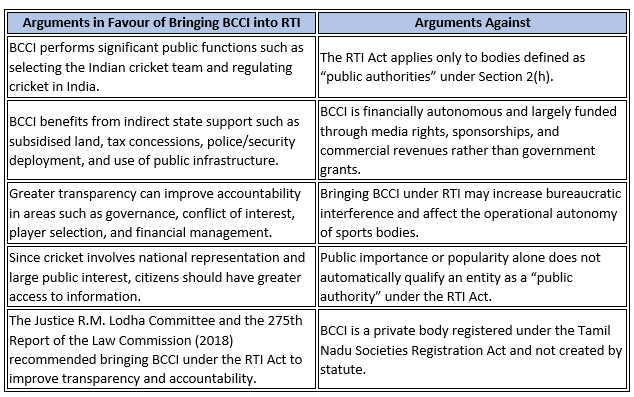
- The CIC held that the BCCI does not qualify as a “public authority” under Section 2(h) of the RTI Act, which covers bodies established by the Constitution, by law made by Parliament or State Legislature, or substantially financed directly or indirectly by the government.
- The Commission observed that the BCCI is registered as a private society under the Tamil Nadu Societies Registration Act and is not created through any statute.
- No Substantial Government Financing
- The CIC noted that the BCCI is financially self-sufficient and primarily earns revenue through media rights, sponsorships, broadcasting agreements, and cricket-related commercial activities.
- It held that indirect benefits such as tax concessions, land allotments, or security arrangements do not amount to “substantial financing” under the RTI Act.
- Public Function Alone Insufficient
- The Commission observed that although the BCCI performs important public functions such as selecting the national cricket team, regulating cricket, representing India internationally, and organising major tournaments, these functions alone are insufficient to classify it as a public authority under the RTI Act.
- The order distinguished between “public importance” and statutory status under the RTI framework.
- Reliance on Supreme Court Observations
- The CIC referred to earlier Supreme Court judgments of Zee Telefilms Ltd. vs Union of India (2005), and the BCCI reforms case (2016) linked to the Lodha Committee.
- In Zee Telefilms, the Supreme Court had held that the BCCI is not “State” under Article 12 of the Constitution, although it performs certain public duties.
About the Right to Information (RTI) Act, 2005
- The Right to Information (RTI) Act, 2005, was enacted to promote transparency, accountability, and participatory governance by providing citizens access to information held by public authorities.
- The Act operationalises the fundamental right to information under Article 19(1)(a) (Freedom of Speech and Expression) as recognised by the Supreme Court.
- Under Section 2(h), a “public authority” includes bodies established by the Constitution, parliamentary/state laws, government notifications, or substantially financed directly or indirectly by the government.
About the Central Information Commission (CIC)
- The Central Information Commission (CIC) is the apex statutory body established under the RTI Act, 2005, to hear appeals and complaints regarding access to information under Central public authorities.
- The CIC consists of:
- One Chief Information Commissioner,
- and up to ten Information Commissioners appointed by the President of India.
- The Commission has powers similar to a civil court in matters relating to summoning records, examining evidence, and directing disclosure of information.
- The CIC adjudicates second appeals under the RTI Act and plays a key role in enforcing transparency and accountability in public administration.