
SYLLABUS
GS-3: Issues related to Direct and Indirect Farm Subsidies and Minimum Support Prices.
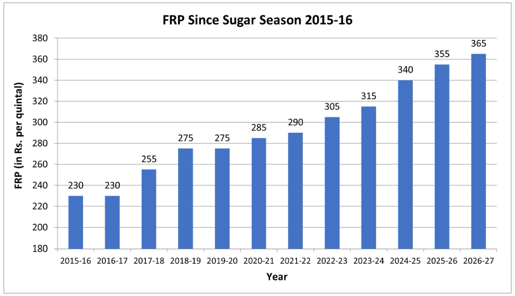
Context: The Cabinet Committee on Economic Affairs, chaired by the Prime Minister, has approved an increase in the Fair and Remunerative Price (FRP) of sugarcane to ₹365 per quintal for the 2026–27 sugar season (October–September).
More on the News
• This marks a ₹10 (about 2.81%) increase over the previous FRP of ₹355 per quintal for 2025–26, reflecting continued government support to sugarcane farmers.
• The FRP of ₹365 per quintal is based on a basic sugar recovery rate of 10.25%.
- Premium: a premium of ₹3.56 per quintal will be provided for each 0.1% increase in recovery over and above 10.25%.
- Deduction: a reduction in FRP by ₹3.56 per quintal for every 0.1% decrease below 10.25%.
• However, to protect the interests of farmers, no deduction will be made for mills with recovery rates below 9.5%, ensuring a minimum payment of ₹338.3 per quintal to farmers supplying these mills.
• The cost of production (A2 +FL) of sugarcane for the Sugar Season 2026-27 is ₹182/qtl. Thus, the FRP of ₹365/qtl at a recovery rate of 10.25% is higher by 100.5% over production cost.
Significance of the Increase in FRP
• Safeguarding Farmers’ Interests: The FRP hike ensures that the sugarcane farmers receive a fair price for their produce amidst fluctuating market conditions.
• Support for Rural Livelihoods: Sugarcane farming supports around 5 crore farmers and 5 lakh mill workers, making the sector vital for rural employment. A higher FRP helps maintain operations across the entire supply chain.
• Ensuring Fairness in Recovery Rate: The revised policy provides a premium for better sugar recovery and protection for farmers with low recovery rates by ensuring a minimum payment of ₹338.3 per quintal. This balances incentives with safeguards.
• Impact on Sugar Production: The FRP hike aims to motivate farmers to increase sugarcane cultivation, especially in light of the decline in sugar production in recent years.
- As per the Indian Sugar and Bio-Energy Manufacturers Association, the total sugar output for the 2024-25 season was around 264 lakh metric tonnes (LMT), down from around 319 LMT in the 2023-24 season.
Sugarcane Pricing Policy
• The pricing of sugarcane is governed by the statutory provisions of the Sugarcane (Control) Order, 1966, issued under the Essential Commodities Act (ECA), 1955.
- Sugarcane is the only agricultural crop with a statutory price backing.
- Other crops with Minimum Support Price (MSP) have no legal backing, so farmers cannot demand MSP as a legal right if the government fails to procure.
- However, even the FRP is not payable by the government, and the responsibility to make FRP payments to farmers within 14 days of cane purchase lies solely with the sugar mills (mostly private). In case of non-payment, the cane commissioner can take action against the mill.
• Prior to the 2009-10 sugar season, the Central government used to fix the Statutory Minimum Price (SMP) of sugarcane, and farmers were entitled to profit sharing with the sugar mill on a 50:50 basis.
• As this sharing of profits remained unimplemented, the SMP was replaced by the FRP in 2009 through amendments to the Sugarcane (Control) Order.
About Fair and Remunerative Price (FRP)
• It is the minimum price mandated by the Government that sugar mills are legally obligated to pay farmers for their produce.
• It is linked to a basic sugar recovery rate with a premium payable to farmers for higher recoveries of sugar.
- The basic sugar recovery is the percentage of sugar produced from the sugarcane crushed.
• The FRP is based on the recommendations of the Rangarajan Committee report on reorganizing the sugarcane industry.
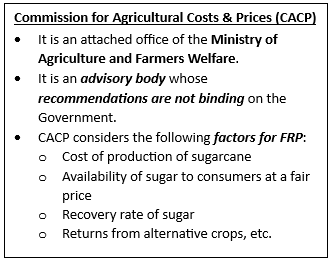
• The FRP for sugarcane is decided every year by the Cabinet Committee on Economic Affairs, headed by the Prime Minister, on the recommendation of the Commission for Agricultural Costs and Prices (CACP) and after consultations with State Governments and other stakeholders of the sugar industry.
• State-Advised Prices (SAPs): Certain states like Uttar Pradesh, Punjab, and Haryana declare their own SAP, which is typically higher than the FRP, reflecting local production costs and productivity levels.
SOURCES
PIB
The Hindu
Economictimes