
SYLLABUS
GS-2: Bilateral, Regional and Global Groupings and Agreements involving India and/or affecting India’s interests.
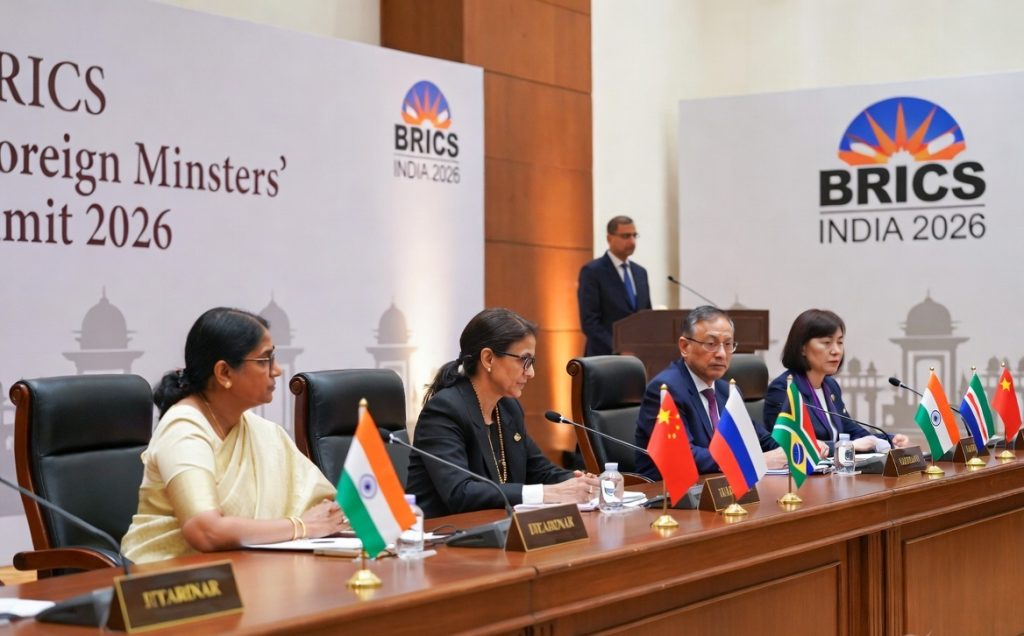
Context: India, as the BRICS Chair for 2026, recently hosted the BRICS Foreign Ministers’ Summit in New Delhi on 14–15 May 2026.
More on the News
- The Meeting was held under the theme “Building for Resilience, Innovation, Cooperation and Sustainability”.
- The meeting discussed global and regional developments, reform of multilateral institutions, economic cooperation, and priorities for BRICS@20.
- Unlike previous meetings, the summit concluded without a joint ministerial communiqué because of differences among member states over the West Asia conflict, particularly tensions involving Iran and the UAE. India instead issued a “Chair’s Statement and Outcome Document”.
- India is the present chair of BRICS from 1 January 2026 and is scheduled to host the 18th BRICS Summit later in 2026.
- India will chair BRICS for the fourth time in 2026, having previously held the Chairship in 2012, 2016, and 2021.
Key Outcomes of the Summit
- Reform of Global Governance
- BRICS Foreign Ministers reiterated the need for comprehensive reform of global governance institutions to make them more representative, democratic, and responsive to contemporary geopolitical realities.
- India strongly advocated reforms of the UN Security Council and greater representation for developing countries, especially from Asia, Africa, and Latin America.
- Focus on BRICS@20 Priorities: Discussions were held under India’s BRICS@20 agenda centred on resilience, innovation, sustainability, economic cooperation, and strengthening the voice of the Global South.
- West Asia Conflict and Internal Divergences
- The summit witnessed significant divisions over the ongoing West Asia conflict, particularly regarding the positions of Iran and the UAE, preventing the adoption of a consensus joint statement.
- While members broadly supported respect for sovereignty, civilian protection, and regional stability, disagreements emerged over references to Iran, Israel, Red Sea security, and the role of external powers.
- Counter-Terrorism and Security Cooperation: The ministers reiterated strong opposition to terrorism in all its forms and called for enhanced international cooperation against terrorism, extremism, and transnational organised crime.
About BRICS
- The term “BRIC” was first coined by Goldman Sachs economist Jim O’Neill in 2001, highlighting the growth potential of Brazil, Russia, India, and China to challenge the dominance of G7 economies.
- The first official BRIC (Brazil, Russia, India and China) summit took place in Yekaterinburg, Russia, in 2009. South Africa joined in 2010 (making it BRICS).
- Currently, the grouping is comprised of eleven countries: Brazil, China, Egypt, Ethiopia, India, Indonesia, Iran, Russia, Saudi Arabia, South Africa, United Arab Emirates.
- First major expansion of BRICS took place in 2024 with Egypt, Ethiopia, Iran, Saudi Arabia and UAE becoming member countries. Further, Indonesia joined BRICS in 2025.
- In 2023, Argentina was also invited to join BRICS. However, Argentina later declined the invitation, while Saudi Arabia is yet to formally ratify its membership.
- BRICS represents a combined population of approximately 3.6 billion (almost 48% of the world’s population).
- It accounts for around 40% of global GDP in purchasing power parity (PPP) terms.
- The bloc relies on consensus-based decision-making and is largely informal with no defining charter or secretariat.
- Established in 2014 and headquartered in Shanghai, the BRICS’ New Development Bank (NDB) finances infrastructure and sustainable development projects in BRICS and other developing countries.
- The BRICS Contingent Reserve Arrangement (CRA) is afinancial safety net that provides liquidity support to member countries facing balance of payments crises.
Challenges Before BRICS
- Geopolitical Divergences: Differences among members on conflicts such as West Asia and Ukraine continue to hinder consensus-building and collective diplomatic positioning.
- Balancing Expansion with Cohesion: Rapid expansion of BRICS has increased its global influence but also complicated internal coordination due to diverse political, economic, and strategic interests.
- Economic Asymmetry within BRICS: China’s dominant economic position within the grouping creates concerns regarding imbalance in decision-making and influence among member states.
- Institutional Limitations: BRICS lacks a permanent secretariat and a legally binding institutional framework, limiting implementation capacity and long-term policy coordination.