
SYLLABUS
GS-2: Bilateral, Regional and Global Groupings and Agreements involving India and/or affecting India’s interests; Important International Institutions, agencies and fora – their Structure, Mandate.
Context: The Gaza Board of Peace announced an agreement with Hamas on its phased disarmament, marking the first major implementation milestone under the 20-point Gaza Peace Plan.
Background of the 20-Point Gaza Peace Plan
- The 20-point Gaza Peace Plan, unveiled by US President Donald Trump in 2025, seeks to end the Israel–Hamas conflict through a phased political, security and reconstruction roadmap.
- Phase I focuses on a ceasefire, hostage exchange and limited withdrawal of Israeli forces.
- Phase II envisages Hamas’ disarmament, transfer of governance to a technocratic Palestinian administration, deployment of an International Stabilization Force (ISF) and reconstruction of Gaza.
- The present agreement marks the beginning of the implementation of Phase II.
Key Highlights of the Agreement
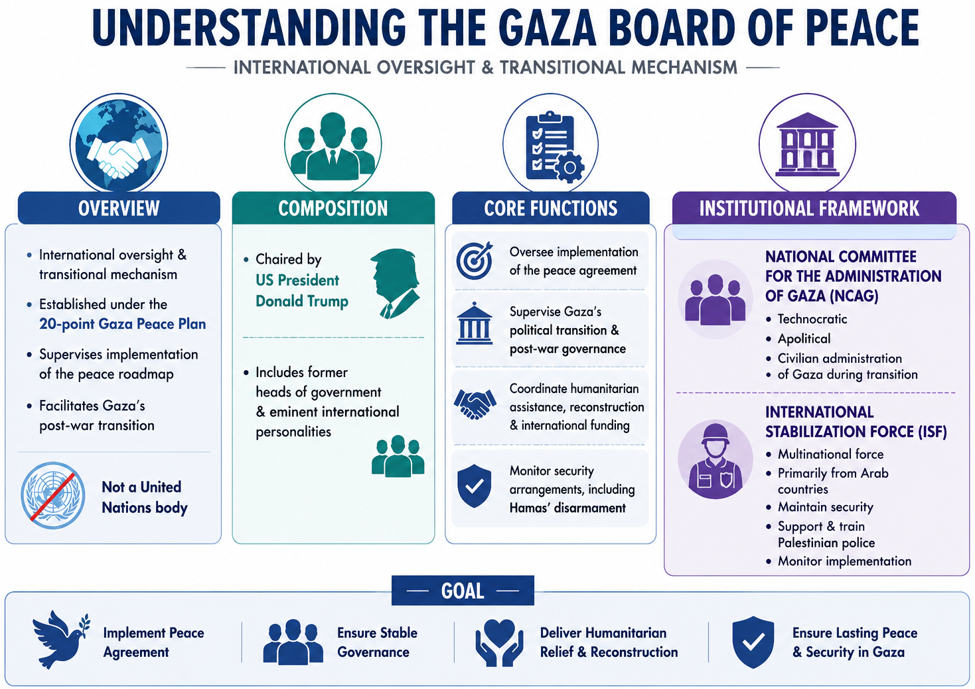
- Phased Disarmament: Hamas agreed to a framework for the phased disarmament of its military wing under an internationally supervised mechanism, subject to the agreed implementation roadmap.
- Political Transition: Gaza’s administration will be transferred to the National Committee for the Administration of Gaza (NCAG), a technocratic and apolitical Palestinian body, ending Hamas’ governing role.
- International Security Mechanism: An International Stabilization Force (ISF), comprising troops from Arab countries, is proposed to maintain security, train Palestinian police and oversee implementation of the agreement.
- Implementation Remains Conditional: While the agreement represents a diplomatic breakthrough, differences persist over the sequencing of disarmament, Israeli military withdrawal, hostage release and long-term security guarantees.
Significance of the Agreement
- First Major Implementation Breakthrough: Represents the first concrete political milestone under the 20-point Gaza Peace Plan, moving the peace process from negotiations towards implementation.
- Facilitates Political Transition: Opens the possibility of replacing Hamas’ armed governance with a technocratic Palestinian administration, laying the foundation for institutional reforms in Gaza.
- Enables Humanitarian Recovery: Creates conditions for expanding humanitarian assistance, reconstruction of critical infrastructure and revival of Gaza’s economy.
- Revives Diplomatic Process: If implemented successfully, it could reduce regional tensions and create fresh momentum towards a negotiated Two-State Solution.
Challenges/Concerns
- Sequencing Dispute: Hamas seeks guarantees of a permanent ceasefire and complete Israeli withdrawal before full disarmament, while Israel insists on verified disarmament before completing troop withdrawal.
- Verification & Enforcement: Monitoring weapons stockpiles, tunnel networks and compliance with disarmament commitments remains a major operational challenge.
- Post-Conflict Governance: The proposed NCAG must gain legitimacy among Palestinians while ensuring effective coordination with Israel and international stakeholders.
- Wider Political Deadlock: The agreement focuses on Gaza, but unresolved issues relating to the West Bank, Jerusalem, Palestinian political unity and final-status negotiations continue to impede a durable peace.
Way Forward
- Implement a Phased & Verifiable Roadmap: Ensure that disarmament, hostage release, Israeli withdrawal and ceasefire commitments proceed through transparent, internationally verified milestones.
- Strengthen Inclusive Palestinian Governance: Empower the NCAG through broad Palestinian participation and sustained international political and financial support.
- Mobilise Coordinated International Support: Ensure sustained humanitarian assistance, reconstruction financing and diplomatic engagement through the UN, Arab States and other international partners.
- Revive the Political Process: Build on the present agreement to resume negotiations towards a Two-State Solution, enabling Israel and an independent, sovereign Palestine to coexist peacefully in accordance with relevant UN resolutions.