
SYLLABUS
GS-3: Awareness in the field of bio-technology; Science and Technology- developments and their applications and effects in everyday life.
Context: Africa recorded 183 polio detections during January–July 2026, a 33% decline from 2024, bringing the continent closer to a polio-free future. However, continued circulation of vaccine-derived poliovirus (VDPV) remains a challenge.
Africa’s Progress Towards a Polio-Free Future
- Wild polio-free status: The WHO African Region was certified free of wild poliovirus (WPV) in 2020, after four years without a wild-polio case. However, vaccine-derived strains continue to circulate.
- Declining detections: Of the 183 detections, 133 were cVDPV2. 31 of 47 countries reported fewer detections than in 2024, although recent increases in cVDPV1 and cVDPV3 remain a concern.
- Outbreaks closed: Five type-2 outbreaks in Burundi, Ghana, Guinea-Bissau, Republic of Congo and Uganda were closed after independent assessments confirmed interruption of transmission.
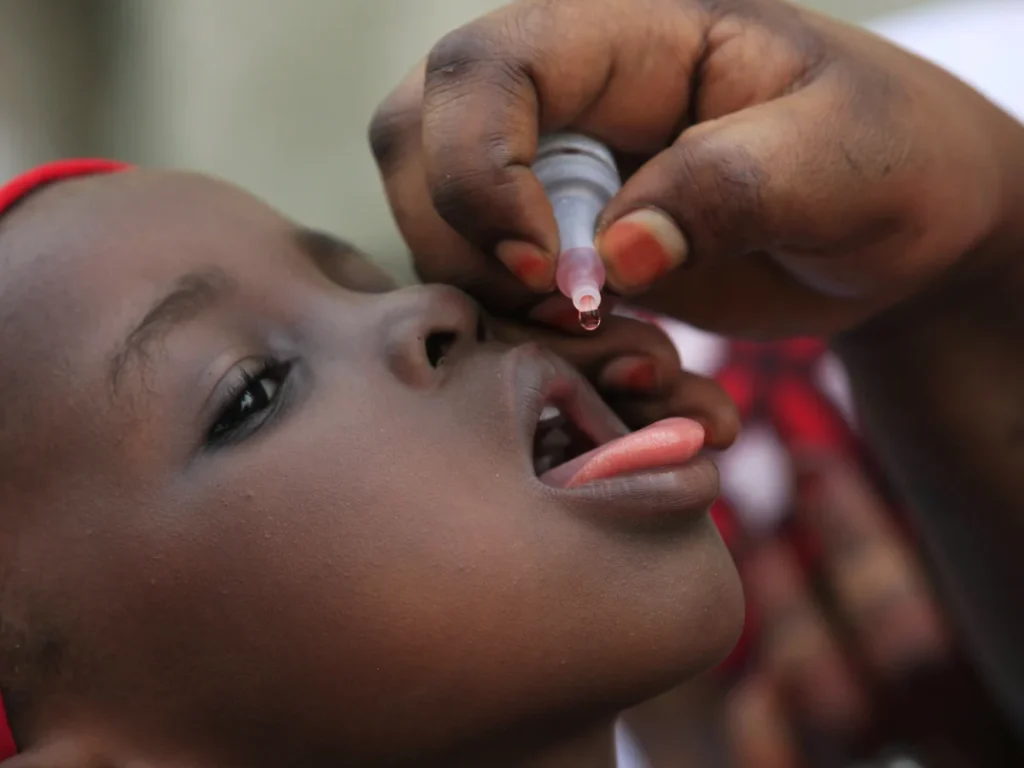
- Vaccination gains: 142 million children received at least one polio-vaccine dose across 17 countries, with 248 million doses delivered during January–July 2026. Campaigns were integrated with measles and diphtheria vaccination, vitamin-A supplementation, malaria and neglected-tropical-disease interventions.
- Stronger surveillance: Digital tools such as eSurv Companion and the AFRO Geodatabase, along with 10 upgraded laboratories, are strengthening surveillance and faster detection; eSurv Companion is operational in 19 countries.
Understanding Poliomyelitis
- What is polio? Poliomyelitis is a highly infectious viral disease, mainly affecting children below five. It spreads primarily through the faecal–oral route, including contaminated food or water, and can invade the nervous system.
- Disease impact: Most infections do not cause severe symptoms, but about 1 in 200 infections can result in irreversible paralysis. There is no cure, making vaccination the principal means of prevention.
- Three serotypes: Poliovirus has types 1, 2 and 3. Wild poliovirus types 2 and 3 have been eradicated, while wild type 1 continues to circulate in Afghanistan and Pakistan.
- Wild vs vaccine-derived: Wild poliovirus (WPV) refers to naturally circulating strains, while vaccine-derived poliovirus (VDPV) can emerge from the weakened virus used in the oral polio vaccine under specific conditions.
Understanding VDPV
- How it emerges: OPV contains live, attenuated poliovirus. Where population immunity is low, the vaccine virus may circulate for a prolonged period and undergo genetic changes, potentially regaining the ability to cause paralysis.
- cVDPV: When such a vaccine-derived strain acquires the capacity for sustained transmission within an under-immunised community, it is termed circulating vaccine-derived poliovirus (cVDPV).
- Other forms: iVDPV can persist in people with certain primary immunodeficiencies, while VAPP refers to the rare occurrence of paralysis associated with OPV itself.
- Key distinction: VDPV emergence primarily reflects gaps in population immunity and prolonged circulation of vaccine-derived virus; it does not mean that polio vaccination is inherently unsafe.
Polio Vaccines: OPV and IPV
- OPV: A live attenuated oral vaccine that is easy to administer and generates strong intestinal immunity, making it particularly useful for interrupting person-to-person transmission. Its live-virus component creates the possibility of VDPV emergence where immunity is inadequate.
- IPV: An inactivated injectable vaccine containing poliovirus types 1, 2 and 3. It provides strong protection against paralytic disease and does not cause VDPV.
- Complementary roles: OPV has been particularly important for interrupting transmission, while IPV provides strong individual protection against paralysis. Both therefore have important roles in eradication strategies.
India’s Polio-Eradication Journey
- Eradication milestone: India reported its last wild-poliovirus case in January 2011 in Howrah, West Bengal and was officially declared polio-free on 27 March 2014 after meeting WHO certification requirements.
- Mass + routine immunisation: The Pulse Polio Immunisation Programme, launched nationally in 1995, used repeated OPV campaigns to reach every child below five, complemented by routine immunisation under the Universal Immunization Programme (UIP).
- IPV transition: India introduced Inactivated Polio Vaccine (IPV) in 2015, initially in six states and nationwide by 2016, strengthening protection during the global transition from trivalent OPV to bivalent OPV.
- Maintaining the gains: India continues polio vaccination, AFP/environmental surveillance and border vaccination to prevent re-importation and maintain its polio-free status.