SYLLABUS
GS-2: India and its neighborhood- relations.
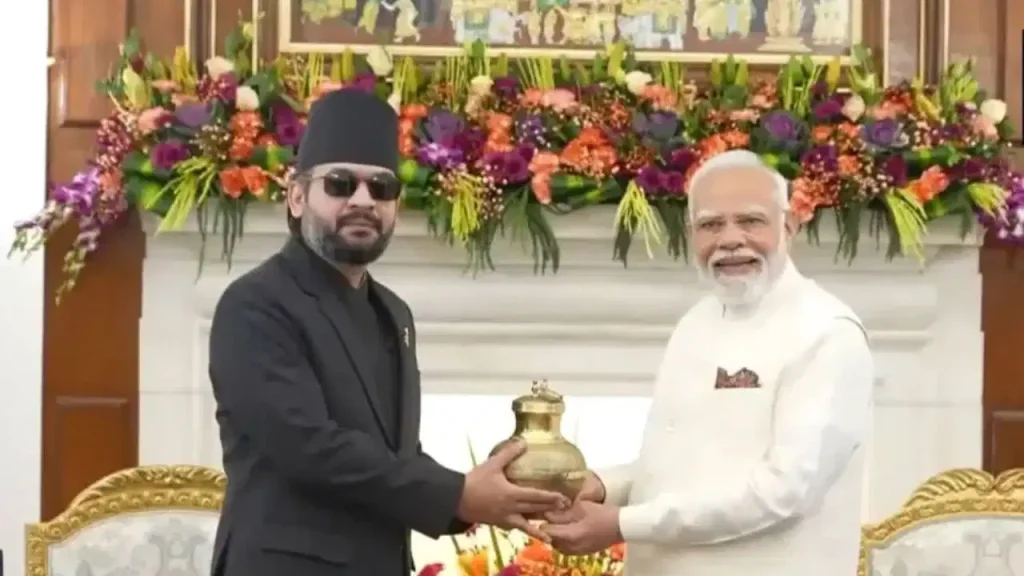
Context: At the invitation of Prime Minister Narendra Modi, Nepalese Prime Minister Balendra Shah undertook his first State Visit to India on 22–23 November 2026 since assuming office in March 2026, aimed at strengthening bilateral relations and advancing development cooperation.
Key Outcomes of the Visit
- Development Assistance: India announced ₹15,000 crore (NPR 24,000 crore): ₹3,500 crore in grants and ₹11,500 crore as a Line of Credit for energy projects.
- Joint Vision: Adopted the “Viksit Bharat and Samunnat Nepal” Vision covering economy, connectivity, energy, climate resilience and technology.
- Connectivity: Nepal received transit access through Kandla Port. Access to Paradip Port will be available once the requisite infrastructure is in place.
- Field Location Survey (FLS) for the proposed Raxaul–Kathmandu electrified broad-gauge railway line was finalised.
- Infrastructure: Flagged off the Sarayu-Kamala Express (Ayodhya–Janakpur), inaugurated the Dharchula–Darchula bridge and announced a new Integrated Check Post at Banbasa.
- Energy Cooperation: Dedicated Phase II of the Motihari–Amlekhgunj pipeline and laid the foundation stone for the 669 MW Lower Arun Project. Both sides agreed to expedite multipu
- rpose water projects and cross-border transmission lines.
- Development and Technology: India announced an offshore IIT campus, start-up incubator and innovation hub in Nepal. An Agro-Industrial Park will be established in Chitwan with Indian grant assistance.
- Agreements: Exchanged eight MoUs covering security, education, health, Ayurveda, satellite communication, urban development, livestock and fisheries.
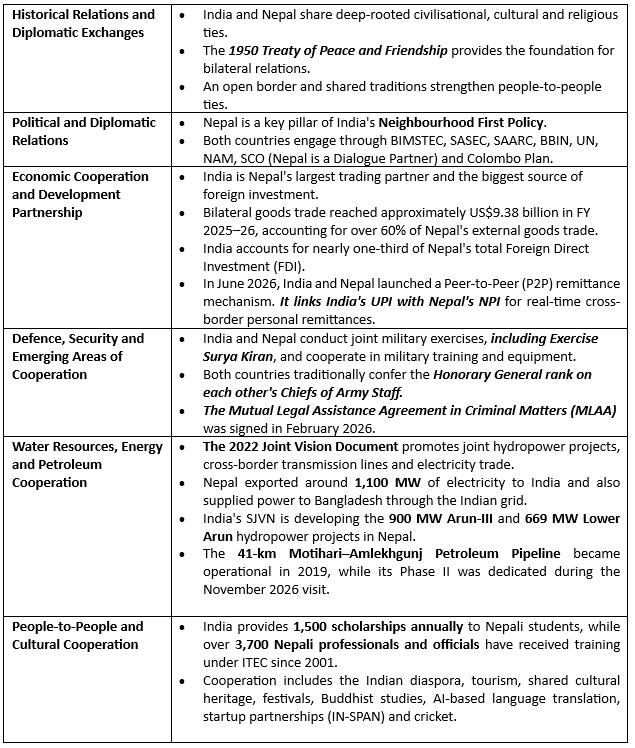
India–Nepal Bilateral Relations