SYLLABUS
GS-3: Conservation, environmental pollution and degradation, environmental impact assessment.
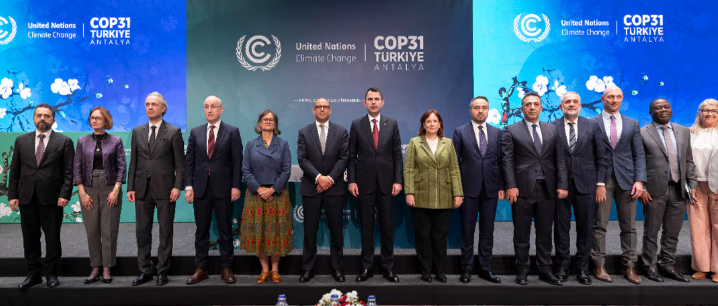
Context: The COP31 to the United Nations Framework Convention on Climate Change (UNFCCC) was held in Antalya, Türkiye, from November 9–20, 2026, focusing on implementing existing climate commitments, mobilising climate finance and accelerating global climate action.
More on the News
- COP31 brought together nearly 200 countries and concluded on 22 November, after over 50 hours of extended negotiations, becoming the longest-running UN climate conference.
- Dual leadership: Türkiye held the COP Presidency, while Australia’s Chris Bowen served as President of Negotiations.
- Triple COP Year (2026): UNCCD COP17 – Mongolia (August); CBD COP17 – Armenia (October); UNFCCC COP31 – Türkiye (November).
- No consensus was reached on the Antalya Pact, mainly due to disagreements over fossil fuels and climate finance.
Key Outcomes of COP31
- Failure of the Antalya Pact and Fossil Fuel Transition: The proposed Antalya Pact was not adopted due to disagreements over language on transitioning away from fossil fuels.
- Around 130 countries supported stronger recognition of the transition, while some countries opposed it.
- The revised draft dropped explicit fossil-fuel transition language.
- However, the COP28 commitment to transition away from fossil fuels remains valid.
- 1.5°C Goal and Climate Overshoot: The draft proposed limiting the magnitude and duration of any overshoot beyond the 1.5°C threshold.
- It also dropped a proposed work programme on pathways to return to 1.5°C.
- Carbon Dioxide Removal (CDR), involving natural or technological removal of carbon dioxide from the atmosphere, appeared in the draft as a possible response.
- These proposals were not adopted through the failed Antalya Pact.
- Climate Finance and Adaptation: The COP29 New Collective Quantified Goal (NCQG) calls for at least $300 billion annually by 2035, while the Baku-to-Belém Roadmap aims to scale up finance from all sources to $1.3 trillion annually by 2035.
- The call to triple adaptation finance by 2035 continued, but disagreements over the baseline, funding and accountability remained.
- The proposed $120 billion adaptation-finance target was dropped from the revised draft.
- Discussions continued on the Fund for Responding to Loss and Damage (FRLD), established at COP27 and operationalised at COP28.
- Global Goal on Adaptation (GGA): COP31 advanced work on operationalising the 59 Belém Adaptation Indicators, adopted at COP30, to measure climate resilience and reduce vulnerability.
- A task force of national experts is to refine the indicators and develop guidance by October 2027.
- Electrification and Clean Energy Transition: Türkiye promoted the voluntary 35-by-2035 initiative, seeking to increase electricity’s share in global final energy consumption from approximately 23% to 35%.
- Nearly 100 countries supported it, but it did not become a formal negotiated target.
- The Action Agenda promoted renewable energy, battery storage, electrification and clean-energy investment.
- Just Transition and Adaptation Fund: Countries advanced the UAE Just Transition Work Programme to protect workers and vulnerable communities during the shift towards clean energy.
- Further work on the proposed mechanism’s arrangements will continue towards COP32.
- The Adaptation Fund completed its transition to serve the Paris Agreement exclusively.
- It will receive a mandatory 5% share of proceeds under Article 6.4, alongside voluntary funding under Article 6.2.
India’s Position and Priorities
- Climate Justice and Finance: India emphasised equity and CBDR-RC, equitable access to the remaining global carbon budget and predictable public finance under Article 9.1 of the Paris Agreement.
- Just Transition and Mitigation: India advocated a two-tier, Party-guided and country-driven Just Transition Mechanism, considering employment, social protection, poverty eradication and energy access.
- It called for the Mitigation Work Programme to remain facilitative and non-prescriptive.
- Electrification and Trade: India did not endorse 35×35 and opposed unilateral trade measures penalising developing countries in the name of climate action.
- Transboundary Rivers: India stated that water cooperation should promote shared prosperity but cannot rely on archaic mechanisms or remain separate from bilateral relations.
- India placed the 1960 Indus Waters Treaty in abeyance following the April 2025 Pahalgam terror attack and cited demographic, developmental, climatic and technological changes as reasons for seeking renegotiation.
- Support for Small Island Developing States (SIDS): India offered technical assistance in renewable energy, disaster preparedness and resilient infrastructure through Infrastructure for Resilient Island States (IRIS), launched in 2021 under CDRI.
About the Conference of the Parties (COP)
- The Conference of the Parties (COP) is the supreme decision-making body of the United Nations Framework Convention on Climate Change (UNFCCC).
- It reviews the implementation of the Convention and takes decisions to advance global climate action.
- The UNFCCC was adopted at the 1992 Rio Earth Summit and entered into force in 1994.
- It provides the international framework for addressing climate change.
- COP31 was held alongside two other major climate meetings:
- CMP21: 21st meeting of the Parties to the Kyoto Protocol.
- CMA8: 8th meeting of the Parties to the Paris Agreement.
- Key Climate Agreements:
- Kyoto Protocol (1997): Established legally binding emission-reduction targets for developed countries.
- Paris Agreement (2015): Aims to keep the rise in global average temperature well below 2°C and pursue efforts to limit it to 1.5°C above pre-industrial levels.
- Global Stocktake (GST): Established under Article 14 of the Paris Agreement, the GST assesses collective progress towards achieving the Agreement’s goals.
- It takes place every five years.
- The first GST concluded at COP28 (2023).
- The second Global Stocktake (GST-2) began at COP31 in November 2026 and is scheduled to conclude at COP33 in 2028.