
SYLLABUS
GS-3: Achievements of Indians in science & technology; indigenization of technology and developing new technology.
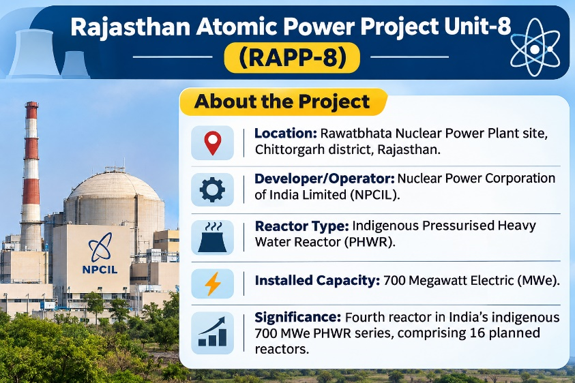
Context: The Atomic Energy Regulatory Board (AERB) granted permission for the First Approach to Criticality (FAC) of Rajasthan Atomic Power Project Unit-8 (RAPP-8), marking a significant milestone in India’s indigenous nuclear power programme.
About the First Approach to Criticality (FAC)
- Meaning: FAC is an important stage in nuclear reactor commissioning, marking the beginning of a controlled, self-sustaining nuclear fission chain reaction.
- Criticality: A reactor achieves criticality when the neutrons produced through nuclear fission sustain the chain reaction at a steady rate.
- Purpose: It establishes the reactor’s ability to sustain a controlled nuclear chain reaction and enables subsequent commissioning activities.
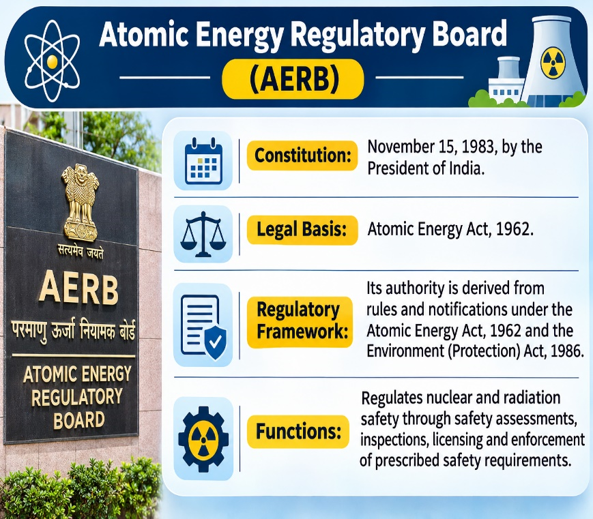
- Regulatory Approval: AERB grants permission for FAC after reviewing reactor safety, construction, commissioning test results and operational preparedness.
- Commercial Operation: FAC does not mean immediate electricity generation. Further testing, power escalation, grid synchronisation and regulatory approvals are required.
Stages of Nuclear Reactor Commissioning
- Initial Fuel Loading (IFL): Nuclear fuel is loaded into the reactor core after obtaining regulatory permission and completing prescribed safety requirements.
- Pre-Criticality Safety Checks: Reactor systems undergo integrity checks, safety evaluations and commissioning tests to establish operational readiness.
- First Approach to Criticality (FAC): The reactor is gradually brought to criticality, establishing a controlled, self-sustaining nuclear fission chain reaction.
- Low-Power Physics Experiments: Reactor behaviour, nuclear characteristics and safety systems are tested at low power.
- Power Ascension and Grid Synchronisation: Reactor power is gradually increased, followed by testing and synchronisation with the electricity grid.
- Commercial Operation: Commercial electricity generation begins after satisfactory completion of commissioning tests and requisite regulatory approvals.
India’s Three-Stage Nuclear Power Programme
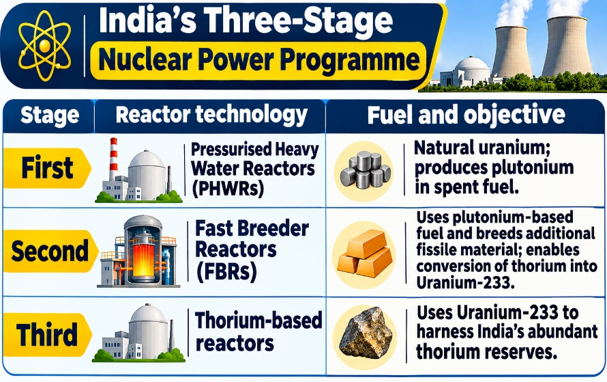
- Conceived by Dr. Homi Jehangir Bhabha, India’s three-stage nuclear power programme aims to utilise limited domestic uranium reserves and abundant thorium resources through a closed nuclear fuel cycle.
- On April 6, 2026, India’s indigenously designed 500 MWe Prototype Fast Breeder Reactor (PFBR) at Kalpakkam, Tamil Nadu, attained first criticality.
- Developed by Bharatiya Nabhikiya Vidyut Nigam Limited (BHAVINI), with technology developed by the Indira Gandhi Centre for Atomic Research (IGCAR).
- Uses Uranium-Plutonium Mixed Oxide (MOX) fuel and a Uranium-238 blanket to breed additional Plutonium-239.
- Its eventual thorium blanket utilisation will support the transition towards the third stage.
- This milestone marked India’s entry into the second stage of its nuclear power programme.
About PHWR Technology
- PHWR uses heavy water (D₂O) as both moderator and coolant.
- It generally uses natural uranium as fuel, reducing dependence on enriched uranium.
- Heavy water slows down neutrons while absorbing relatively few of them, supporting an efficient nuclear chain reaction.
Government Initiatives for Nuclear Energy
- Nuclear Energy Mission: Announced in Union Budget 2025–26, it aims to achieve 100 GW of nuclear power capacity by 2047.
- Financial Outlay: ₹20,000 crore allocated for the development and deployment of Small Modular Reactors (SMRs).
- SMR Target: At least five indigenously designed SMRs to become operational by 2033.
- Indigenous Technology: BARC is developing BSMR-200 (200 MWe), SMR-55 (55 MWe) and a high-temperature gas-cooled reactor for hydrogen generation.
- SHANTI Act, 2025: Modernises India’s nuclear legal framework and enables limited private-sector participation under regulatory oversight.