

SYLLABUS
GS-3:Indian Economy and issues relating to planning, mobilization of resources, growth, development and employment.
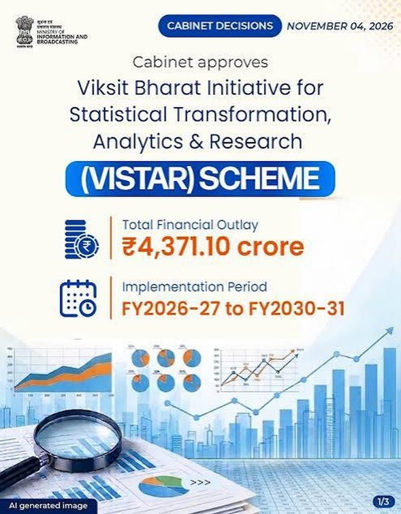
Context: The Union Cabinet has approved the Viksit Bharat Initiative for Statistical Transformation, Analytics & Research (VISTAR), a Central Sector Scheme with an outlay of ₹4,371.10 crore for FY 2026–27 to FY 2030–31, to modernise India’s official statistical system in line with the vision of Viksit Bharat 2047.
About the Viksit Bharat Initiative for Statistical Transformation, Analytics & Research (VISTAR)
- Nodal Ministry: Ministry of Statistics and Programme Implementation (MoSPI).
- Duration: Five years (FY 2026–27 to FY 2030–31).
- Financial Outlay: ₹4,371.10 crore.
- Objective: To establish a dynamic, real-time and future-ready statistical architecture through improved data timeliness, granularity and interoperability, supported by harmonised and AI-ready datasets.
- Coverage: Encompasses all statistical and data management activities of MoSPI, including surveys, research, digital transformation and national data governance.
- The scheme has three major components:
- Comprehensive Statistical Operations and Strengthening of Ecosystem:
- MoSPI proposes to conduct 59 surveys during the 16th Finance Commission cycle, compared to 43 major surveys conducted previously.
- Promotes end-to-end digitalisation and integration of AI and ML into data processing, validation and analysis.
- Proposes new indicators, including the Headline Index of Services Production and the Index of Unincorporated Sector Enterprises.
- Strengthens data harmonisation through cataloguing, interoperability, machine readability, data-sharing protocols and privacy-by-design principles.
- Integrates alternative data sources, including mobile phone, scanner and e-commerce data, to complement surveys, reduce respondent burden and fill data gaps.
- Support for Statistical Strengthening (SSS):
- Provides financial assistance to States/UTs through a redesigned, deliverable-linked framework called SSS 2.0.
- Strengthens state-level statistical capabilities, indigenous data processing and generation of granular district-level estimates.
- Supports district-level and million-plus-city estimates under PLFS, HCES and ASUSE, along with State/District-level GDP and State-level IIP compilation.
- Economic Census (EC):
- MoSPI will undertake the 8th Economic Census in collaboration with States/UTs.
- Collects granular information on non-farm establishments and workers hired therein, up to Gram Panchayat and Ward levels.
- Provides an assessment of the unorganised sector and serves as the baseline for developing the National Statistical Business Register (SBR) to facilitate targeted enterprise surveys and policy interventions.
- Comprehensive Statistical Operations and Strengthening of Ecosystem:
Need and Significance of VISTAR
- Modernisation of Statistical Infrastructure: Establishes a dynamic, real-time and future-ready statistical architecture by improving data timeliness, granularity, accuracy and interoperability.
- Bridging Critical Data Gaps: Expansion from 43 to 59 proposed surveys during the 16th Finance Commission cycle will improve statistical coverage and enable timely, targeted policy interventions.
- Promoting Evidence-Based Policymaking: AI-driven analytics, harmonised datasets and alternative data sources will improve programme targeting, reduce duplication and respondent burden, and strengthen government decision-making.
- Strengthening Decentralised Statistical Capabilities: SSS 2.0 will improve district-level and million-plus-city estimates, strengthen indigenous data-processing capabilities and promote data-driven local policymaking.
- Improving Assessment of the Unorganised Sector: The 8th Economic Census and National Statistical Business Register will provide granular information on non-farm establishments and workers, helping estimate the unorganised sector’s contribution to GDP.