
SYLLABUS
GS-1: Distribution of key natural resources across the world (including South Asia and the Indian sub-continent); factors responsible for the location of primary, secondary, and tertiary sector industries in various parts of the world (including India).
Context: The Union Cabinet has approved the Capex Support Scheme to Promote Critical Mineral Processing, with an outlay of ₹2,814 crore over five years (FY 2026–27 to 2030–31), to develop domestic processing capacity, promote value addition and reduce import dependence.
About the ‘Capex Support Scheme to Promote Critical Mineral Processing’
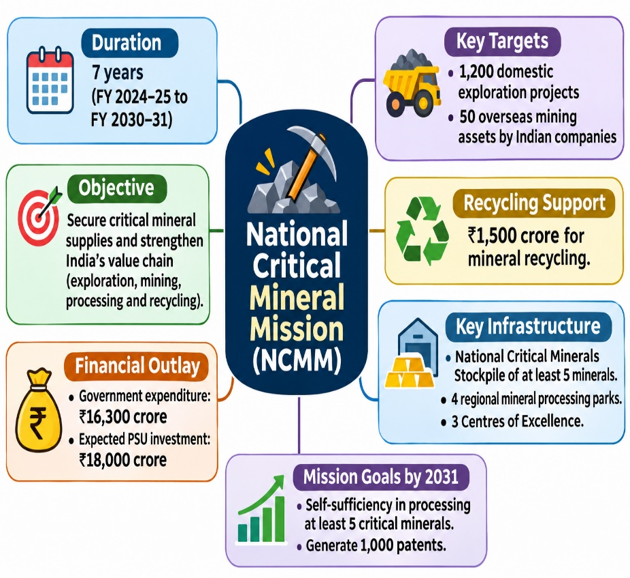
- Nodal Initiative: The scheme is part of the government’s broader efforts under the National Critical Mineral Mission (NCMM) to strengthen India’s critical mineral value chain.
- Objective: To establish and operationalise domestic processing facilities for critical minerals, promote domestic value addition, reduce import dependence and develop resilient end-to-end value chains.
- Financial Outlay: ₹2,814 crore over five years (FY 2026–27 to FY 2030–31).
- Nature of Assistance: Capital subsidy of 30% of eligible investment for establishing four critical mineral processing plants.
- Targeted Processing Facilities:
- Lithium: Two processing plants, each with a minimum capacity of 30 kilotonnes (kt).
- Nickel: Two processing plants, each with a minimum capacity of 50 kt.
- Maximum Capital Support:
- Lithium: ₹500 crore per beneficiary.
- Nickel: ₹900 crore per beneficiary.
- Mineral Processing: The scheme targets the processing of lithium and nickel ores/intermediate products into high-purity compounds.
- Cobalt is also expected to be recovered as a by-product of nickel production.
- Beneficiary Selection: A two-stage process involving:
- Technical assessment of applications to determine eligibility.
- Financial bidding, with two beneficiaries selected for each mineral based on the least-cost criterion (lowest capital support sought).
- Disbursement Mechanism: Financial assistance will be released in three tranches linked to the achievement of specified project milestones.
- Target Sectors: Electric mobility, Battery Energy Storage Systems (BESS), electronics, defence and speciality steel.
Need and Significance of the Scheme
- Reduce Import Dependence: Reduce India’s substantial import dependence on refined intermediates and high-purity lithium, nickel and cobalt materials by developing domestic processing capacity.
- Strengthen Supply Chain Resilience: Reduce vulnerability to geopolitical disruptions, export restrictions and price volatility, particularly given China’s control over approximately 90% of global critical mineral processing.
- Promote Domestic Value Addition: Enable domestic processing of lithium and nickel ores and intermediate products into high-purity compounds, strengthening India’s critical mineral value chain.
- Support Strategic Industries: Strengthen mineral availability for electric vehicles, battery energy storage systems (BESS), electronics, semiconductors, defence equipment and speciality steel.
- Advance Clean Energy Transition: Support battery manufacturing, decarbonisation targets and Atmanirbhar Bharat by strengthening domestic capabilities and economic security.
About Critical Minerals
- Critical minerals are minerals essential for a nation’s economic development, technological advancement and national security.
- Criticality: Their criticality is determined by two factors:
- High economic importance.
- High risk of supply disruption.
- India’s List of Critical Minerals (2023): The Ministry of Mines released a list of 30 critical minerals for India:
- Antimony, Beryllium, Bismuth, Cobalt, Copper, Gallium, Germanium, Graphite, Hafnium, Indium, Lithium, Molybdenum, Niobium, Nickel, Platinum Group Elements (PGE), Phosphorus, Potash, Rare Earth Elements (REE), Rhenium, Silicon, Strontium, Tantalum, Tellurium, Tin, Titanium, Tungsten, Vanadium, Zirconium, Selenium and Cadmium.
- Classification of Important Mineral Groups:
- Platinum Group Elements (PGE): Comprise six elements—Platinum (Pt), Palladium (Pd), Rhodium (Rh), Ruthenium (Ru), Osmium (Os) and Iridium (Ir).
- Rare Earth Elements (REE): Comprise 17 elements—Lanthanum (La), Cerium (Ce), Praseodymium (Pr), Neodymium (Nd), Promethium (Pm), Samarium (Sm), Europium (Eu), Gadolinium (Gd), Terbium (Tb), Dysprosium (Dy), Holmium (Ho), Erbium (Er), Thulium (Tm), Ytterbium (Yb), Lutetium (Lu), Scandium (Sc) and Yttrium (Y).
- Applications: These minerals are essential for manufacturing mobile phones, tablets, electric vehicles, solar panels, wind turbines and fibre-optic cables, as well as applications in the defence and medical sectors.
- Extraction and Refining: Although critical minerals are found across the globe, their extraction and refining are costly, technically challenging and energy-intensive.