
SYLLABUS
GS-3: Various Security Forces and Agencies and Their Mandate; Security Challenges and Their Management; Indigenisation of Technology.
Context: The Defence Acquisition Council (DAC), chaired by Defence Minister Rajnath Singh, has accorded in-principle approval to Project 18A to develop next-generation stealth guided-missile destroyers for the Indian Navy.
Understanding Project 18A
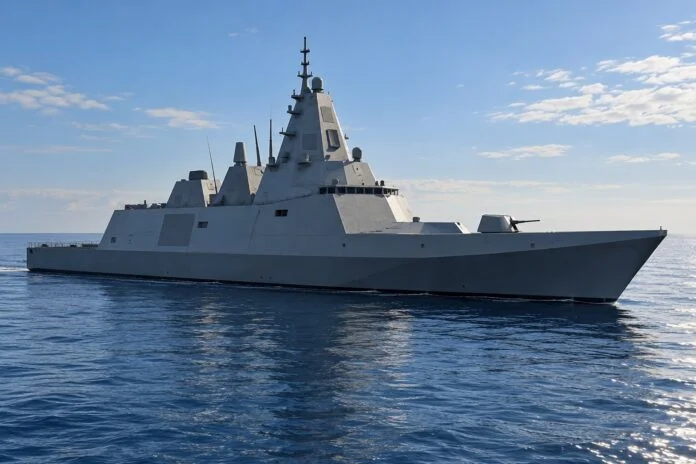
- Project 18A, also known as the Next-Generation Destroyer (NGD) programme, aims to develop advanced stealth guided-missile destroyers for India’s future naval requirements.
- It will succeed the Visakhapatnam-class (Project 15B) destroyers and advance India’s indigenous guided-missile destroyer development.
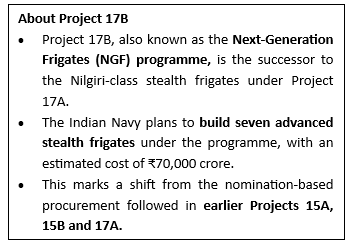
- The programme is being designed by the Navy’s Warship Design Bureau (WDB) and forms part of its broader modernisation plan, alongside Next-Generation Frigates (Project 17B) and Next-Generation Corvettes.
- The programme is estimated to cost ₹75,000–80,000 crore.
Key Features of Project 18A
- Larger Warships: The proposed destroyers are expected to have a displacement exceeding 10,000 tonnes, with some reports suggesting around 13,000 tonnes.
- This is significantly higher than the approximately 7,400-tonne displacement of Visakhapatnam-class destroyers, allowing greater capacity for weapons, sensors and future upgrades.
- Advanced Weapons Systems: Reported designs envisage up to 144 Vertical Launch System (VLS) cells.
- These could accommodate BrahMos variants, Barak-8 Extended Range and Long-Range Land Attack Cruise Missiles (LR-LACM), alongside advanced air-defence and future missile systems.
- Advanced Surveillance and Stealth: The proposed destroyers will feature advanced radars, integrated combat-management systems and electronic warfare suites.
- Stealth-oriented designs will improve multi-domain threat detection, tracking and survivability.
- Integrated Electric Propulsion (IEP): The proposed system will generate electricity centrally for propulsion and onboard equipment.
- It will provide greater electrical capacity for advanced sensors, electronic warfare systems and potential future directed-energy weapons.
- Enhanced Anti-Submarine Warfare: Advanced sonar, underwater surveillance and anti-submarine weapons will improve the detection and neutralisation of hostile submarines.
- Provisions for unmanned underwater systems could further enhance surveillance and mine detection.
- Indigenous Manufacturing: Approximately 75% indigenous content is envisaged.
- Participation of domestic Defence Public Sector Undertakings (DPSUs) and private shipyards will promote local development of weapons, sensors, propulsion systems and advanced shipbuilding technologies.
Need and Significance of Next-Generation Stealth Destroyers
- Strengthening Maritime Deterrence: Advanced weapons, stealth and surveillance systems will help counter China’s expanding naval presence and Pakistan’s growing underwater warfare capabilities in the Indian Ocean Region (IOR).
- Protecting Maritime Interests: Safeguard vital Sea Lines of Communication (SLOCs), maritime trade and strategic infrastructure. Support India’s wider Indo-Pacific commitments.
- Enhancing Blue-Water Capabilities: Greater firepower, endurance and advanced combat systems will strengthen long-distance naval operations. Protect aircraft carrier groups and maritime task forces.
- Modernising the Naval Fleet: Help replace ageing destroyers nearing decommissioning. Maintain the strength of India’s surface combat fleet against emerging maritime threats.
- Promoting Self-Reliance and Future Readiness: Indigenous manufacturing, advanced propulsion, electronic warfare and next-generation weapons will strengthen India’s defence industry. Reduce import dependence and prepare the Navy for multi-domain naval warfare.