
SYLLABUS
GS-2: Issues relating to development and management of Social Sector/Services relating to Health, Education, Human Resources.
Context: Ayushman Vay Vandana, which extends Ayushman Bharat–Pradhan Mantri Jan Arogya Yojana (AB PM-JAY) benefits to all senior citizens aged 70 years and above, completed two years on 29 October 2026, recording 23.46 lakh authorised hospital admissions worth ₹5,668.80 crore.
About Ayushman Vay Vandana
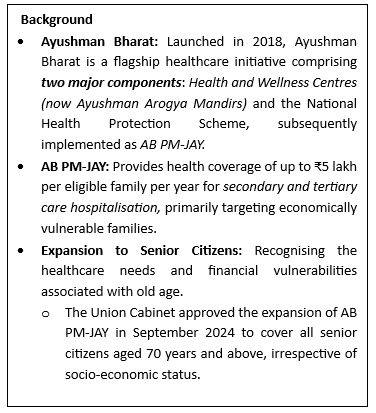
- Launch: Launched by Prime Minister Narendra Modi on 29 October 2024 to extend publicly funded healthcare coverage to all senior citizens aged 70 years and above.
- Implementing Agency: Implemented by the National Health Authority (NHA) under the Ministry of Health and Family Welfare.
- Coverage: Aims to benefit approximately 6 crore senior citizens belonging to around 4.5 crore families across the country.
- Eligibility: All senior citizens aged 70 years and above are eligible, irrespective of their income or socio-economic status.
- Health Coverage: Provides coverage of up to ₹5 lakh per family per year for secondary and tertiary care hospitalisation.
- Additional Coverage: Senior citizens aged 70 years and above belonging to families already covered under AB PM-JAY receive an additional top-up cover of up to ₹5 lakh annually, exclusively for themselves, separate from the existing coverage available to family members below 70 years.
- Beneficiary Registration: Eligible senior citizens can register through the Ayushman Bharat beneficiary portal, mobile application and designated offline registration facilities, with Aadhaar-based e-KYC for identity verification.
- Nature of Benefits: Provides cashless hospitalisation at public and empanelled private hospitals across the country, with nationwide portability.
Key Achievements of Ayushman Vay Vandana
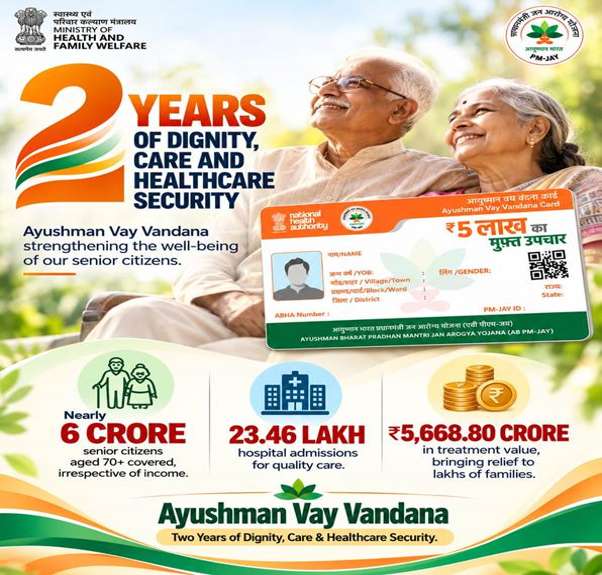
- Expansion of Healthcare Coverage: Extends coverage to approximately 6 crore senior citizens across 4.5 crore families, irrespective of income or socio-economic status, with age (70 years and above) as the eligibility criterion.
- Healthcare Utilisation: Recorded 23.46 lakh authorised hospital admissions worth ₹5,668.80 crore as of 20 October 2026.
- Major Treatment Categories: Cataract surgery accounted for the highest number of treatments (4.71 lakh; 20.1%), followed by chronic haemodialysis (2.90 lakh), while PTCA recorded the highest authorised treatment value (₹649 crore); other major treatments included knee replacement, COPD, acute febrile illness and acute kidney injury and renal failure.
- Financial Protection: Reduces out-of-pocket hospitalisation expenditure through cashless treatment, while providing an additional ₹5 lakh top-up to eligible elderly members of already covered PM-JAY families without reducing the coverage of members below 70 years.
- Healthcare Accessibility: Enables nationwide portability and cashless treatment at public and empanelled private hospitals by leveraging AB PM-JAY’s existing healthcare infrastructure.
- Expansion of Geographical Coverage: West Bengal became the 36th State/UT to join AB PM-JAY in June 2026, expanding the scheme’s nationwide reach.
Shortcomings and Implementation Gaps
- Biometric Authentication Challenges: Age-related deterioration of fingerprints can cause Aadhaar authentication failures, potentially excluding elderly beneficiaries where alternative authentication mechanisms are unavailable or inadequately implemented.
- Awareness and Digital Literacy: Limited awareness of eligibility, registration and benefits, coupled with low digital literacy, particularly in rural, remote and tribal areas, restricts enrolment and utilisation.
- Regional Healthcare Disparities: Unequal distribution of empanelled hospitals and specialised healthcare facilities in rural and remote regions forces some beneficiaries to travel considerable distances for treatment.
- Enrolment–Utilisation Gap: Issuance of health cards does not guarantee treatment access, as authentication failures, inadequate awareness, geographical barriers and limited healthcare facilities can prevent beneficiaries from utilising coverage.