
SYLLABUS
GS-3: Infrastructure: Ports.
Context: The Union Cabinet has approved the Container Manufacturing Promotion Scheme (CMPS) with an outlay of ₹10,000 crore up to FY 2039–40 to develop a globally competitive domestic container manufacturing ecosystem, reduce import dependence and strengthen supply-chain resilience.
About the Container Manufacturing Promotion Scheme
• Announcement: Union Budget 2026–27.
• Nodal Ministry: Ministry of Ports, Shipping and Waterways.
• Total Outlay: ₹10,000 crore, with scheme support extending up to FY 2039–40.
• Objective: To promote new (greenfield) manufacturing facilities and expand existing (brownfield) units, while developing testing infrastructure and improving the cost competitiveness of Indian-made shipping containers.
• Target: Increase annual domestic container manufacturing capacity approximately ten-fold to 7.5 lakh Twenty-foot Equivalent Units (TEUs).
- A TEU is the standard unit for measuring container capacity, based on a 20-foot shipping container. A 40-foot container is equivalent to 2 TEUs.
• Local-content requirement: Manufacturers receiving operational assistance must meet a minimum domestic content requirement of 70% up to FY 2031–32, increasing to 90% from FY 2032–33.
• Components under CMPS: The scheme provides financial assistance through three major components.

1. Interest Subvention Assistance (ISA)
2. Operational Expenditure Assistance (OEA)
3. Testing and Certification Assistance
Key eligibility and assistance provisions
• Greenfield facilities: Must have an annual manufacturing capacity of at least 1,00,000 TEUs.
• Brownfield expansion: Must add at least 25,000 TEUs of annual capacity and be commissioned within three years of in-principle approval.
• Operational assistance per container:
- 20-foot container: ₹49,500.
- 40-foot container: ₹86,625.
- Specialised 20-foot container: ₹37,125–₹74,250.
• Domestic value addition: Minimum local content of 70% up to FY 2031–32, rising to 90% from FY 2032–33.
Need and Significance of the Scheme
• Reducing Import Dependence: India imports nearly 2 million empty containers annually, against domestic production of only 24,000 TEUs in FY 2023–24, making it vulnerable to global freight volatility and supply-chain disruptions.
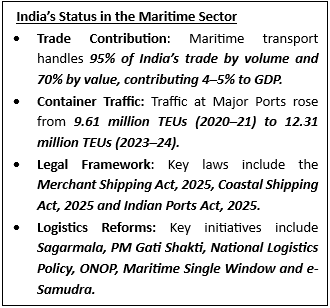
• Expanding Domestic Manufacturing: CMPS targets annual capacity of 7.5 lakh TEUs (about 37.5% of annual import requirements) by supporting new facilities, existing-unit expansion and technology development.
• Enhancing Global Competitiveness: Operational assistance and local-content requirements will bridge cost disadvantages, particularly against China, and strengthen domestic supply chains for specialised steel, corner castings, wooden frames and other components.
• Generating Employment and Promoting Exports: The scheme is expected to create 3,000 direct and over 50,000 indirect jobs while positioning India as a potential global export hub for quality shipping containers.
• Strengthening the Maritime Ecosystem: CMPS complements the proposed Bharat Container Shipping Line (BCSL), supported by an MoU signed in February 2026, and PM Gati Shakti, the National Logistics Policy and Sagarmala to strengthen container availability, port connectivity and multimodal logistics.