

SYLLABUS
GS-2: Important aspects of governance, transparency and accountability, e-governance- applications, models, successes, limitations, and potential; citizens charters, transparency & accountability and institutional and other measures.
Context: India ranked 88th out of 143 countries and jurisdictions in the World Justice Project (WJP) Rule of Law Index 2026, with a score of 0.48, declining two places from 86th in 2025.
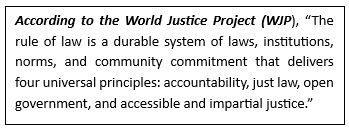
About the WJP Rule of Law Index
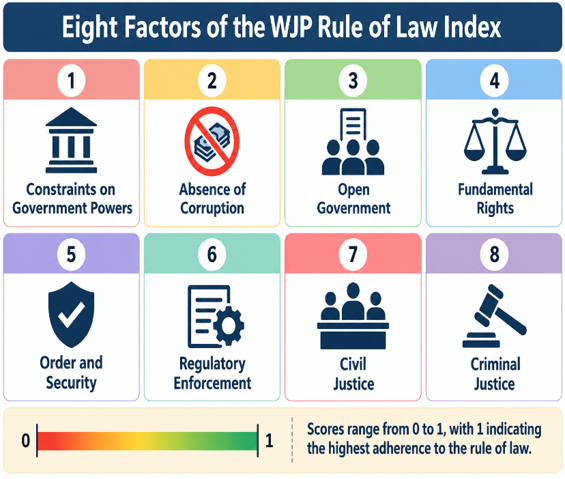
- The World Justice Project (WJP) releases the WJP Rule of Law Index annually.
- It measures how the rule of law is experienced and perceived in everyday life across countries and jurisdictions.
- The 2026 Index covers 143 countries and jurisdictions, representing approximately 95% of the world’s population, and uses household surveys and legal practitioner and expert surveys.
About the World Justice Project (WJP)
- The World Justice Project (WJP) is an independent, multidisciplinary organisation working to advance the rule of law worldwide by creating knowledge, building awareness and stimulating action.
- Founded by William H. Neukom in 2006 as a presidential initiative of the American Bar Association (ABA), it became an independent non-profit organisation in 2009.
Key Findings of the Index
- India’s Performance:
- India ranked 88th out of 143 countries, with a score of 0.48, declining two places from 86th in 2025.
- India places 3rd in South Asia, following Nepal (top performer in the region) and Sri Lanka.
- Global Rankings:
- Top-ranked countries: Denmark (1st), Norway (2nd) and Finland (3rd).
- Lowest-ranked countries: Venezuela (143rd), Afghanistan (142nd), Haiti (141st), Cambodia (140th) and Nicaragua (139th).
- Other major countries: The United States ranked 30th, China 92nd and Russia 121st.
- Global Rule of Law Decline:
- The global rule of law recession continued for the ninth consecutive year, with scores declining in 62% of countries.
- More than 86% of countries experienced a sustained five-year decline in at least one safeguard against authoritarian rule: constraints on government powers, open government or fundamental rights.
- Declining Civic Freedoms:
- Freedom of opinion and expression declined in 64% of countries.
- Freedom of assembly and association declined in 67% of countries.
- Civic participation declined in 65% of countries.
- Weakening Justice Systems
- Civil justice deteriorated in 64% of countries, while criminal justice deteriorated in 58%.
- Judicial constraints on government powers declined in 63% of countries.
- The report identified undue executive pressure and improper government influence as major drivers of weakening justice systems.
- Access to Justice
- Access to and affordability of civil justice improved in 54% of countries.
- Freedom from discrimination in civil justice improved in 52% of countries.
- Economic Stability and Rule of Law
- Countries with GDP per capita above the global average of US$14,406 scored 0.68 or higher on the Index.
- Countries with inflation below the median of 3.23% scored 0.60 or higher.
- Countries with investment-grade sovereign credit ratings (AAA to BBB) recorded Index scores of 0.66 or higher.
- Country-Level Changes
- Largest declines: Haiti (−5.6%), Tanzania (−3.5%) and Sudan (−2.8%).
- Largest improvements: Latvia (+1.6%), Trinidad and Tobago (+1.2%) and Guatemala (+1.1%).