
SYLLABUS
GS-3: Science and Technology- developments and their applications and effects in everyday life; Achievements of Indians in Science & Technology; Indigenization of Technology and Developing New Technology.
Context: In a scientific breakthrough that can offer the much-needed impetus to India’s energy transition efforts, scientists at Bhabha Atomic Research Centre (BARC) have developed a new technique to efficiently extract lithium from seawater.
More on the News
- Research Development: BARC scientists developed the technique, with their findings published in the scientific journal Talanta.
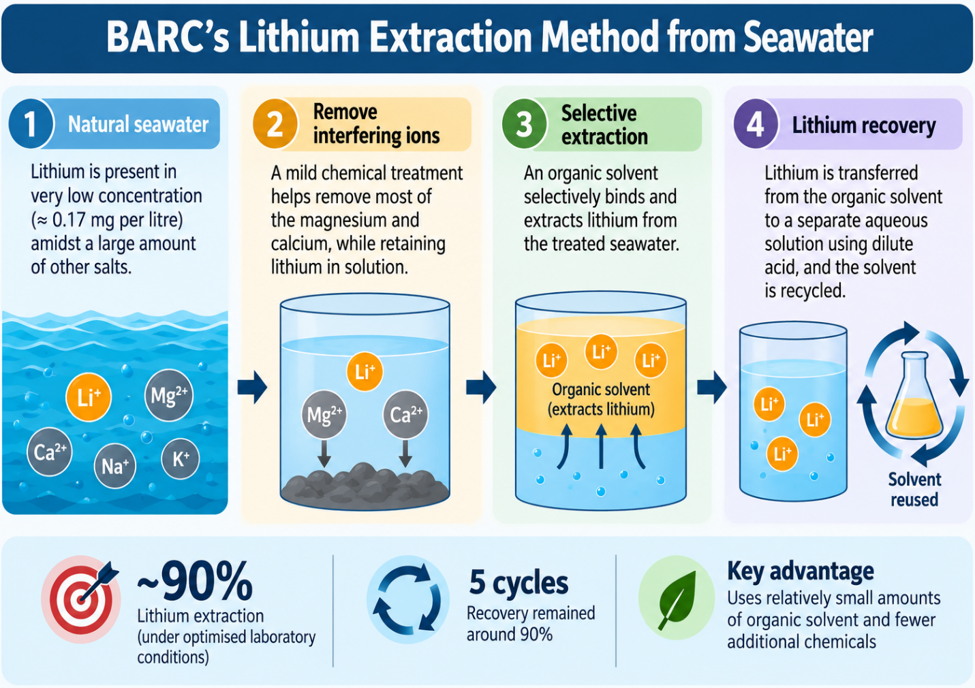
- Key Achievement: The method achieved approximately 90% lithium extraction from natural seawater under optimised laboratory conditions.
- Distinctive Feature: It uses relatively little organic solvent and fewer additional chemicals, while allowing solvent reuse. However, solvent losses remain a challenge.
Why Is Lithium Extraction from Seawater Challenging?
- Strategic Importance: Lithium is a critical mineral used in lithium-ion batteries for electric vehicles (EVs) and renewable-energy storage systems.
- Vast Resource Potential: Seawater is estimated to contain 180–230 billion tonnes of dissolved lithium, making it an enormous potential resource. This estimate does not represent economically recoverable reserves.
- Low Concentration: Lithium occurs at only about 0.17 mg per litre of seawater, requiring the processing of enormous volumes of water.
- Selective Extraction Challenge: The magnesium-to-lithium ratio exceeds 6,000, making it difficult to separate lithium from competing ions.
- Processing Constraints: Solvent consumption, energy requirements, extraction efficiency and waste management remain important considerations for commercial viability.
Significance of the Achievement
- Diversification of Supply: Seawater extraction could supplement conventional lithium sources and diversify global supply chains.
- Strategic Relevance for India: The technology could eventually support domestic battery manufacturing and reduce vulnerability to import disruptions.
- Promising Process Efficiency: High laboratory-scale recovery, lower solvent requirements and reduced dependence on additional chemical additives make the technique promising.
- Potential Environmental Benefits: Lower chemical consumption and solvent reuse may reduce waste, but the overall environmental advantage remains to be established.
Limitations
- Commercial Scalability: Laboratory results do not establish the method’s economic or technical feasibility at industrial scale.
- Operational Challenges: Approximately 10% of the organic solvent was physically lost per reuse cycle, while persistent emulsion formation during prolonged mixing may affect process efficiency.
- Environmental Concerns: Energy consumption, chemical costs, solvent losses and potential effects on marine ecosystems require further assessment.
Way Ahead
- National R&D Priorities: India should build on NITI Aayog’s recommendation for a national R&D grand challenge on direct lithium extraction from seawater, focusing on higher recovery, lower costs, reduced energy consumption and lower emissions.
- Pilot-Scale Demonstration: The BARC process needs larger-scale testing to assess long-term performance, solvent recovery, operating costs and environmental impacts.
- Desalination Plant Integration: As recommended by NITI Aayog, India should evaluate lithium concentration and extraction economics in discharge streams from seawater desalination plants.
- Global Technology Assessment: Emerging approaches, including ion-selective membranes and electrochemical extraction, should be compared with the BARC method on cost, efficiency and environmental performance.