
SYLLABUS
GS-2: Functions and responsibilities of the Union and the States, issues and challenges pertaining to the federal structure, devolution of powers and finances up to local levels and challenges therein.
Context: President Droupadi Murmu has given assent to the Frontier Nagaland Territorial Authority (FNTA) BillS, 2026, paving the way for a decentralised self-governing authority in six eastern districts of Nagaland.
More on the News
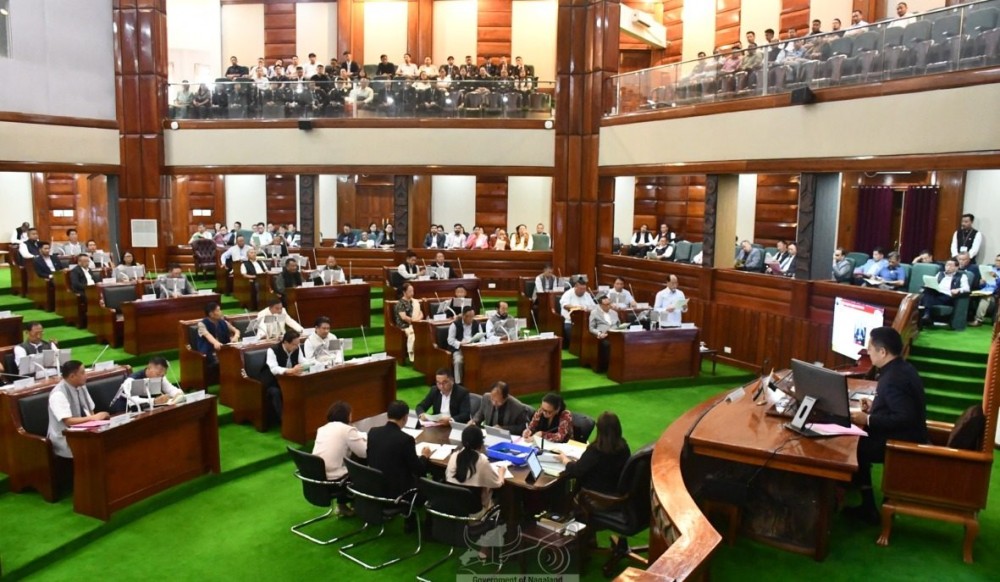
- The Nagaland Legislative Assembly unanimously passed the Bill on 3 September 2026, following the withdrawal of an earlier version introduced in March.
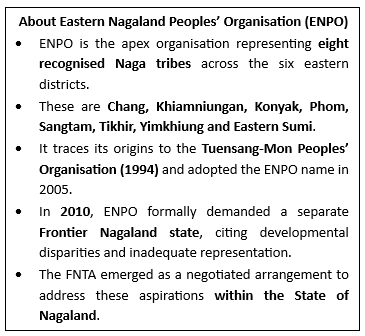
- The Act follows a 5 February 2026 Memorandum of Agreement (MoA) signed by the Governments of India and Nagaland and the Eastern Nagaland Peoples’ Organisation (ENPO);
- it will commence on a date notified by the State Government in the Official Gazette.
Key Features of the Act
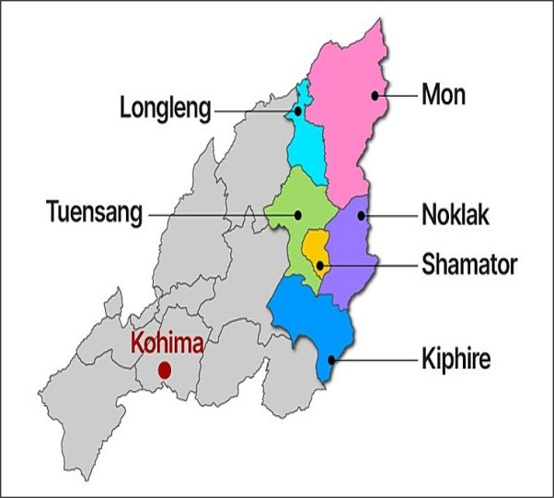
- Territorial Coverage: The FNTA covers six districts—Tuensang, Mon, Longleng, Kiphire, Noklak and Shamator.
- Composition: The Authority will have 62 members:
- 40 directly elected members, with one-third seats reserved for women.
- 20 MLAs from the territory as ex-officio members without voting rights.
- Two members nominated by the Governor from unrepresented or under-represented recognised tribes, with voting rights.
- Tenure and Elections: Elected and nominated members will ordinarily have a five-year tenure, while elections will be overseen by the State Election Commission.
- Executive Council: An Executive Council of up to nine members, headed by a Chief Executive Member (CEM), will exercise executive powers.
- Powers and Functions: The FNTA will exercise legislative, executive, administrative and financial powers over 46 transferred subjects, including agriculture, health, school education, rural development, tourism, social welfare, village councils, urban local bodies and specified public works.
- Legislative Powers: The Authority may initiate laws on transferred subjects.
- Such laws require approval by a majority of voting members, followed by the Governor’s approval and publication in the Official Gazette.
- Interim Council: Until elections are held, the State Government may constitute an Interim Council of up to 13 members, recommended by ENPO in consultation with tribal councils.
- It can function for a maximum of one year or until the first elected FNTA is constituted.
- Financial Provisions: The Authority will receive annual allocations under a separate major subhead in the State Budget, with development funds subject to Comptroller and Auditor General (CAG) audit.
- Constitutional Safeguards: The arrangement preserves, without amendment or dilution, Article 371A, the Bengal Eastern Frontier Regulation, 1873, and the existing exemption from Panchayati Raj provisions.
- Review: The FNTA arrangement is envisaged to be reviewed after 10 years.
Need and Significance
- Addressing Regional Disparities: Enables focused intervention to tackle long-standing gaps in infrastructure, healthcare, education and connectivity in eastern Nagaland.
- Decentralised Self-Governance: Transfers decision-making over 46 subjects closer to local communities, allowing policies to reflect regional priorities.
- Inclusive Federalism: Provides substantial territorial autonomy within Nagaland, demonstrating constitutional flexibility without creating a separate state.
- Political Representation: Direct elections, women’s reservation and representation for under-represented tribes strengthen democratic participation and inclusion.
- Peace and Stability: Addresses long-standing regional grievances through negotiated and democratic mechanisms while preserving Article 371A and Nagaland’s territorial unity.