SYLLABUS
GS-2: Statutory, regulatory and various quasi-judicial bodies; Government policies and interventions for development in various sectors and issues arising out of their design and implementation.
GS-3: Conservation; environmental pollution and degradation.
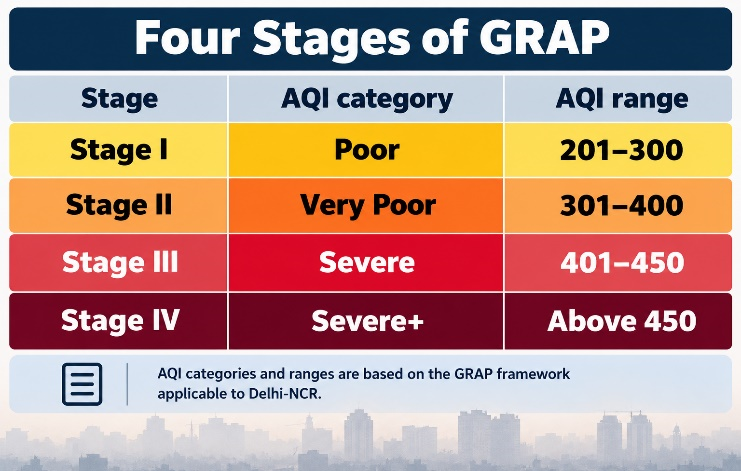
Context: The Commission for Air Quality Management (CAQM) invoked Stage-I of the Graded Response Action Plan (GRAP) across Delhi-NCR on 21 October 2026 after Delhi’s Air Quality Index (AQI) rose to 244, entering the ‘poor’ category.
More on the News
• The decision followed forecasts by the India Meteorological Department (IMD) and the Indian Institute of Tropical Meteorology (IITM), which indicated that air quality was likely to remain in the ‘poor’ category over the coming days.
• CAQM directed concerned agencies across the National Capital Region (NCR) to implement, monitor and review Stage-I measures with immediate effect.
Understanding Graded Response Action Plan (GRAP)
• GRAP is an emergency response mechanism to prevent further deterioration of air quality across Delhi-NCR through progressively stricter pollution-control measures.
• Following Supreme Court directions in 2016, GRAP was notified by the Ministry of Environment, Forest and Climate Change (MoEFCC) on 12 January 2017, based on recommendations of the Central Pollution Control Board (CPCB).
• Implementation: Initially implemented by the Environment Pollution (Prevention and Control) Authority (EPCA), GRAP is now overseen by the CAQM, a statutory body established under the CAQM Act, 2021.
• How Does GRAP Work?
- GRAP operates through four stages determined by Delhi’s average AQI, with air-quality forecasts and meteorological conditions also informing the invocation of measures.
- Cumulative Approach: Measures under earlier stages continue when a higher stage is invoked, with additional restrictions introduced as pollution worsens.
• Institutional Framework
- Coordination: CAQM coordinates GRAP implementation through the CPCB, State Pollution Control Boards, Delhi Pollution Control Committee (DPCC), State governments, municipal bodies and other enforcement agencies.
- Regional Approach: Coordinated action across Delhi-NCR is essential because pollution originates from multiple sources, including vehicular emissions, construction dust, industries, waste and biomass burning, and is aggravated by adverse winter meteorological conditions.
Key Measures Under GRAP-I
• Road Dust and Construction Activities: Authorities must conduct mechanised road sweeping, water sprinkling and dust suppression, while enforcing construction-site dust-control rules and ensuring proper covering and transportation of construction materials and waste.
• Waste Management and Open Burning: Agencies must ensure proper waste collection and disposal, prevent illegal dumping and landfill fires, and prohibit open burning of waste and biomass.
• Vehicular Pollution and Traffic Management: Authorities must enforce PUC requirements and applicable vehicle restrictions, divert non-destination trucks through the Eastern and Western Peripheral Expressways, and improve traffic flow at congestion points.
• Industrial Emissions and Diesel Generator Sets: Industries, brick kilns and hot-mix plants must meet emission standards and use approved fuels, while DG-set emissions are regulated, regular backup-power use is discouraged, and electricity interruptions are minimised.
• Hotels, Restaurants and Eateries: Hotels, restaurants and open eateries must comply with the existing ban on coal and firewood in tandoors and use electricity, gas or other permitted clean fuels.
• Public Transport and Public Awareness: Authorities must promote public transport and shared commuting, conduct awareness campaigns, address pollution complaints through designated platforms and enforce applicable firecracker restrictions.
• Citizen Charter: Residents should maintain valid PUC certificates, avoid unnecessary engine idling, prefer public transport or carpooling, segregate waste, avoid open burning and report pollution violations through designated apps.