
SYLLABUS
GS-2: Salient features of the Representation of People’s Act; Appointment to various Constitutional posts, powers, functions and responsibilities of various Constitutional Bodies.
Context: Recently, the Election Commission of India (ECI) announced a Special Summary Revision (SSR) of electoral rolls in 17 States and UTs, with 1 January 2027 as the qualifying date.
More on the News
- Coverage: The exercise covers 14 States and 3 UTs, including Uttar Pradesh, Punjab, Uttarakhand, Goa and Manipur, where Assembly elections are due in early 2027.
- Link with SIR: The 17 comprise 13 States and 3 UTs where SIR has been completed, and Assam, where SIR was not conducted. The SSR schedule for 17 other States/UTs where SIR is ongoing or has recently concluded will be announced later. Himachal Pradesh, Jammu and Kashmir, and Ladakh will be scheduled separately, considering weather conditions.
- Schedule: Polling-station rationalisation is to be completed by 2 November 2026; draft rolls will be published on 12 November; claims and objections can be filed until 11 December; disposal is scheduled by 28 December; and final rolls will be published on 4 January 2027.
- Enrolment: Advance applications are invited for the qualifying dates of 1 April, 1 July and 1 October 2027. District- and Assembly-constituency-level help desks will facilitate enrolment, especially for migrants, vulnerable groups and marginalised communities.
Significance
- Electoral accuracy: The ECI’s instructions provide for the removal of confirmed duplicate, permanently shifted and deceased electors through the prescribed process, helping improve the reliability of voter lists.
- Inclusion of new voters: The 1 January 2027 qualifying date and advance applications for three subsequent dates create opportunities for eligible young and first-time voters to enrol without waiting for the next annual cycle.
- Greater scrutiny: The claims-and-objections window from 12 November to 11 December gives electors an opportunity to seek inclusion or correction and to raise objections under the applicable procedure.
Concerns
- Wrongful exclusion: Errors in records or changes of residence may leave eligible electors out of the roll. This makes careful scrutiny of the draft roll and timely correction particularly important.
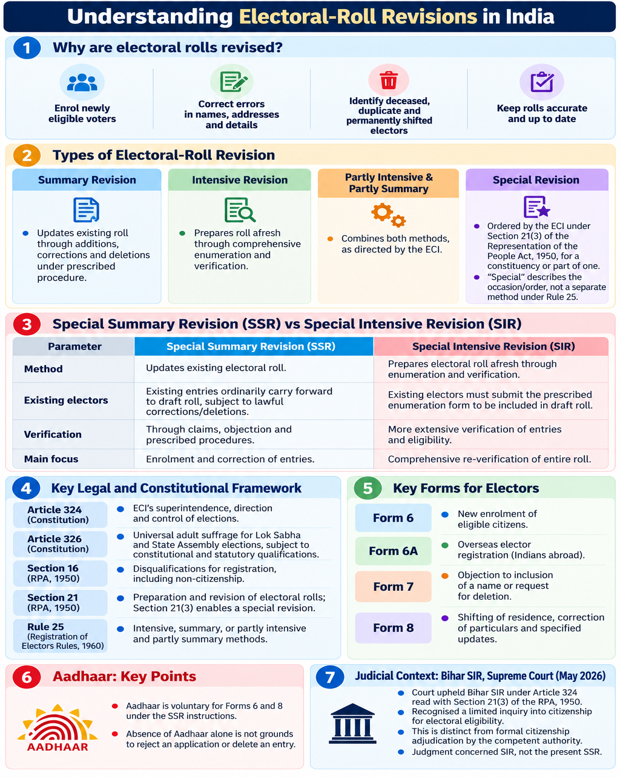
- Safeguards against arbitrary deletion: The ECI has directed that confirmed demographically or photographically similar entries, permanently shifted electors, and deceased electors may be removed only after Form 7 is received from the elector or, in a death case, a near relative or family member.
- Accessibility and documentation: Migrants and marginalised groups may face difficulties navigating enrolment procedures. The ECI has clarified that Aadhaar is voluntary for Forms 6 and 8; an application cannot be rejected, or an existing entry deleted, solely because Aadhaar is not furnished.
Way Forward
- Facilitate enrolment: Use district-level help desks and Booth Level Officers to assist eligible citizens, especially first-time voters, migrants and marginalised groups.
- Make correction mechanisms accessible: Form 6 can be used for new enrolment, Form 6A for overseas electors, Form 7 for objections to inclusion or requests for deletion, and Form 8 for shifting, corrections and other specified changes. Applications can also be submitted through the ECI’s Voter Service Portal.
- Ensure due process: Deletions must follow the prescribed procedure, and claims and objections should be decided within the announced schedule.
- Balance accuracy with inclusion: Electoral-roll revision must remove ineligible entries without creating avoidable barriers for eligible voters.