
SYLLABUS
Gs-1: Population and associated issues.
GS-2: Government policies and interventions for development in various sectors and issues arising out of their design and implementation.
GS-2: Issues relating to development and management of Social Sector/Services relating to Health, Education, Human Resources.
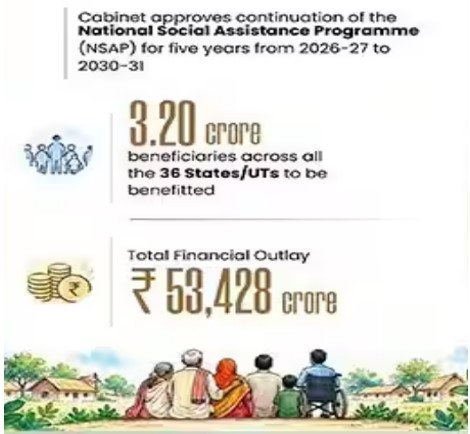
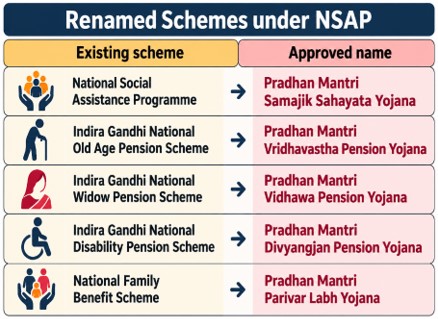
Context: The Union Cabinet has approved the continuation of the National Social Assistance Programme (NSAP), renamed the Pradhan Mantri Samajik Sahayata Yojana, for five years from 2026–27 to 2030–31, with a total outlay of ₹53,428 crore.
More on the News
• The approval includes renaming the programme and its sub-schemes, revising eligibility criteria and assistance rates for persons with disabilities, and continuing old-age and widow pensions and the family benefit scheme in their existing form.
• The approval is expected to benefit 3.20 crore beneficiaries across all 36 States and Union Territories. Revised disability pension guidelines will be issued and implemented within three months.
About the Pradhan Mantri Samajik Sahayata Yojana
• Launch: The National Social Assistance Programme was launched on 15 August 1995.
• Nodal Ministry: Ministry of Rural Development.
• Objective: To provide social assistance to poor households, particularly vulnerable elderly persons, widows, persons with disabilities and families facing the death of a primary breadwinner.
• Constitutional basis: Article 41 of the Constitution, under the Directive Principles of State Policy, provides for public assistance in cases of unemployment, old age, sickness, disablement and other cases of undeserved want, within the limits of the State’s economic capacity and development.
• Funding: The Centre provides 100% central assistance under NSAP to ensure uniform support across the country.
• Key changes in disability pension:
- Monthly assistance: ₹375 for beneficiaries aged 0–79 years and ₹625 for those aged 80 years and above.
- Benchmark disability: Reduced from 80% to 40%.
- Minimum age: Eligibility extended from birth.
- Other components: Old-age and widow pension schemes and the family benefit scheme continue in their existing form.
Need and Significance of the Scheme
• Social security: Provides financial assistance to vulnerable sections with limited income and inadequate access to formal social security.
• Inclusive welfare: Supports elderly persons, widows, persons with disabilities and poor families facing the loss of a primary breadwinner.
• Addressing an ageing population: India’s elderly population is projected to rise from around 15 crore to over 34 crore, with nearly one in five Indians expected to be aged 60 years or above by 2050.
• Disability inclusion: Aligns the benchmark disability criterion with the Rights of Persons with Disabilities Act, 2016, by reducing the threshold to 40%.
• Constitutional commitment: Advances the objective of Article 41 by strengthening public assistance for vulnerable groups.
Gaps/Shortcomings in the Scheme
• Inadequate pension amount: The Centre’s old-age pension contribution has remained at ₹200 per month for beneficiaries aged 60–79 and ₹500 for those aged 80 and above since 2007, eroding purchasing power due to inflation.
• Limited beneficiary coverage: NSAP’s three pension schemes cover approximately 3.09 crore beneficiaries at the central level, despite a much larger eligible population; outdated Below Poverty Line data and beneficiary ceilings constrain access.
• Lack of inflation indexation: Pension assistance is not automatically adjusted to inflation, weakening its capacity to meet essential living and healthcare expenses.
• Uneven State support: State contributions vary considerably, creating differences in the total pension received by beneficiaries across States and Union Territories.
Way Forward
• Inflation-linked pensions: Periodically revise pension assistance to preserve purchasing power and ensure support keeps pace with rising living and healthcare costs.
• Expand coverage: Update beneficiary identification using reliable and current socioeconomic data, and revise outdated ceilings to include eligible persons currently excluded.
• Strengthen Centre–State coordination: Encourage more uniform and adequate State contributions to reduce disparities in pension support across the country.
• Evidence-based implementation: Use findings from the Ministry of Rural Development’s evaluations and beneficiary surveys to assess adequacy, improve delivery and periodically review pension rates and coverage.