

SYLLABUS
GS-3: Indian Economy and issues relating to planning, mobilization of resources, growth, development and employment.
Context: The Reserve Bank of India’s (RBI) Monetary Policy Committee (MPC) raised the policy repo rate by 25 basis points to 5.50% and shifted its stance from ‘neutral’ to ‘calibrated tightening’ amid rising inflation risks and global economic uncertainty.
Key Highlights of the Meeting
• Repo Rate: Increased by 25 basis points to 5.50% from 5.25%.
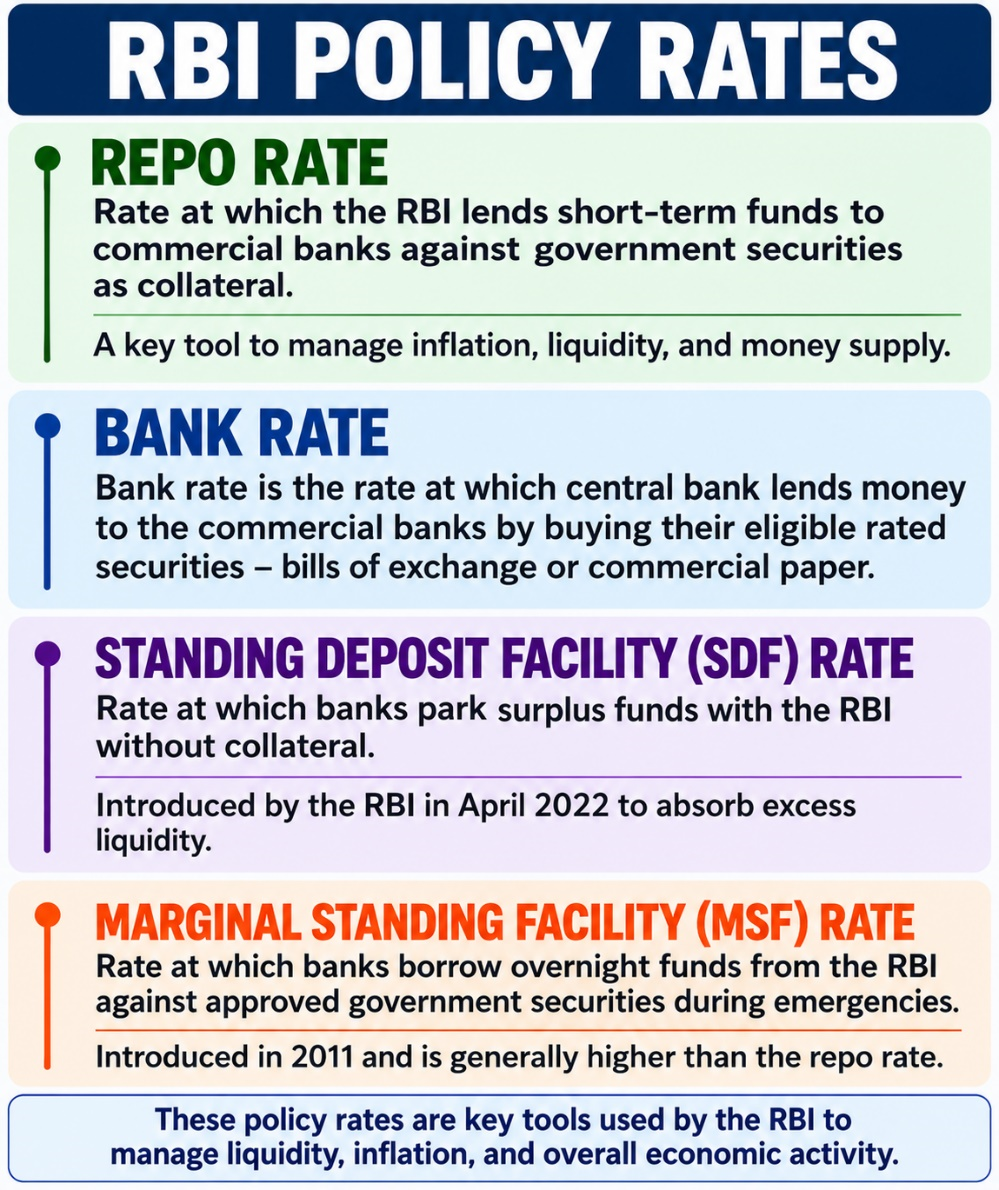
• First Rate Hike Since February 2023: The latest hike marks the reversal of the easing cycle in which the MPC had reduced the repo rate by 125 basis points, from 6.50% to 5.25%.
• MPC Decision: The decision to raise the repo rate was unanimous, while the shift to a ‘calibrated tightening’ stance was supported by a majority.
• Other Policy Rates: The Standing Deposit Facility (SDF) rate stands at 5.25%, while the Marginal Standing Facility (MSF) rate and Bank Rate stand at 5.75%.
• Inflation Outlook: Consumer Price Index (CPI) inflation projection for FY 2026–27 was raised to 5.2% from 5.0% earlier.
• Growth Outlook: Real GDP growth projection for FY 2026–27 was raised to 7.1%, reflecting resilient domestic economic activity.
• Policy Outlook: The change in stance signals that rate cuts are off the table in the near term, with future action likely to involve a rate hike or a pause.
Factors Influencing the Decision
• Geopolitical Tensions and Crude Oil: Renewed West Asia tensions and crude oil prices around US$100 per barrel have increased inflation risks for India, which imports around 90% of its crude oil requirement.
• Rising Inflation Risks: CPI inflation stood at 4.82% in August, while food-price pressures, deficient monsoon conditions and weather disruptions could push inflation higher, prompting the RBI to raise its FY27 projection to 5.2%.
• Tighter Global Financial Conditions: Elevated global interest rates, high US Treasury yields and rupee depreciation pressures have tightened financial conditions and increased risks of imported inflation.
• Resilient Domestic Economy: Strong domestic demand, manufacturing and services, along with 7.8% GDP growth in Q1 FY27, indicate that the Indian economy has sufficient resilience to absorb tighter monetary conditions.
• Liquidity Conditions: The RBI also considered increased banking-system liquidity following US$132.98 billion mobilisation through FCNR(B) deposits under the special forex swap facility, necessitating calibrated liquidity absorption.
About the Monetary Policy Committee (MPC)
• It was established in September 2016, under Section 45ZB (1) of the Reserve Bank of India Act, 1934 (RBI Act).
• The Urijit Patel Committee had recommended the setting up of the MPC
• The MPC’s primary role is to set the Policy Rate required to achieve the inflation target.
• According to Section 42B (2) of the RBI Act, the MPC consists of:
- The Governor of RBI, who serves as the Chairperson, ex officio.
- The Deputy Governor of RBI is responsible for Monetary Policy, as a member, ex officio.
- One RBI officer nominated by the Central Board, as a member, ex officio.
- Three individuals appointed by the Central Government, as Members.
• Members appointed by the Central Government hold their positions for a term of four years or until further orders, whichever is earlier.
• According to Section 45ZA of the RBI Act, the inflation target is set at 4%, with an upper tolerance level of 6% and a lower tolerance level of 2%.