
SYLLABUS
GS-3: Indian Economy and issues relating to planning, mobilization of resources, growth, development and employment.
Context: The Union Cabinet approved the Government of India’s commitment of ₹10,000 crore towards establishing the SME Growth Fund (SGF), announced under Union Budget 2026–27, to provide growth-oriented equity capital to Small and Medium Enterprises (SMEs).
More on the News
- The SGF is part of the Budget 2026–27 measures aimed at strengthening the MSME ecosystem through equity, liquidity and professional support.
- It seeks to address the structural gap in long-term growth capital for SMEs, as existing equity-support funds largely focus on early-stage enterprises and micro enterprises.
- The Fund aims to create a strong pipeline of globally competitive Indian enterprises across manufacturing, services, technology, innovation-driven sectors and strategic value chains, supporting the vision of Viksit Bharat@2047.
About the SME Growth Fund (SGF)
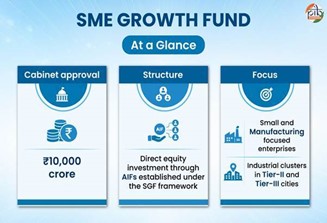
- Government Commitment: The Government of India will provide an aggregate commitment of ₹10,000 crore to an Alternative Investment Fund (AIF) established under the SGF framework.
- Nature of Support: The SGF will provide patient, long-term growth equity capital to high-potential SMEs with demonstrated business viability and scalability.
- Investment Approach: It is designed as a direct equity investment fund, providing growth-stage risk capital rather than conventional credit.
- Sectoral Coverage: The Fund will support enterprises across manufacturing, services, technology, innovation-driven sectors and strategic value chains.
- Manufacturing Priority: A majority of the allocation will be directed towards small and medium manufacturing-focused enterprises.
- Regional Focus: The Fund will also consider SMEs operating in industrial clusters in Tier-II and Tier-III cities.
- Areas of Support: Long-term capital can enable SMEs to:
- scale operations and manufacturing capacity;
- adopt advanced technologies and foster innovation;
- improve productivity and competitiveness;
- undertake acquisitions and strategic investments;
- expand into international markets; and
- integrate into global value chains.
Need and Significance of this Fund
- Addressing the Growth Capital Gap: Existing equity-support funds largely focus on early-stage and micro enterprises, creating a structural gap in growth equity capital for SMEs, which SGF addresses through long-term risk capital.
- Supporting Critical Growth Stages: Patient equity will help SMEs at critical growth stages to expand capacity, invest in technology, innovate and undertake strategic investments.
- Building Globally Competitive Enterprises: The Fund aims to create a strong pipeline of Indian companies with the scale, innovation capability and competitiveness to become sectoral champions and compete globally.
- Strengthening Manufacturing and Exports: Its manufacturing-focused allocation will help expand production capacity, improve productivity and strengthen export competitiveness through integration into global value chains.
- Balanced Regional Industrial Development: Support for industrial clusters in Tier-II and Tier-III cities will strengthen local supply chains, promote balanced regional industrial development and generate quality employment.
- Supporting Viksit Bharat@2047: By strengthening entrepreneurship, deepening the domestic capital market and promoting innovation-led industrialisation, SGF will contribute to Viksit Bharat@2047.
About Small and Medium Enterprises (SMEs)
- Under the latest MSME classification criteria effective from April 2025:
- Small Enterprise: Investment up to ₹25 crore and annual turnover up to ₹100 crore.
- Medium Enterprise: Investment up to ₹125 crore and annual turnover up to ₹500 crore.
- According to the Economic Survey 2025–26, MSMEs account for 31.1% of India’s GDP, 35.4% of manufacturing output and 48.58% of exports.
- Women’s Participation: Female-owned enterprises account for 37.6% of total MSME registrations.
- Expanding Formal MSME Base: Total MSME registrations under Udyam and the Udyam Assist Platform (UAP) reached approximately 9.78 crore, reporting around 43.28 crore employment opportunities.