
SYLLABUS
GS-3: Indian Economy and issues relating to planning, mobilization of resources, growth, development and employment.
GS-2: Government policies and interventions for development in various sectors and issues arising out of their design and implementation.
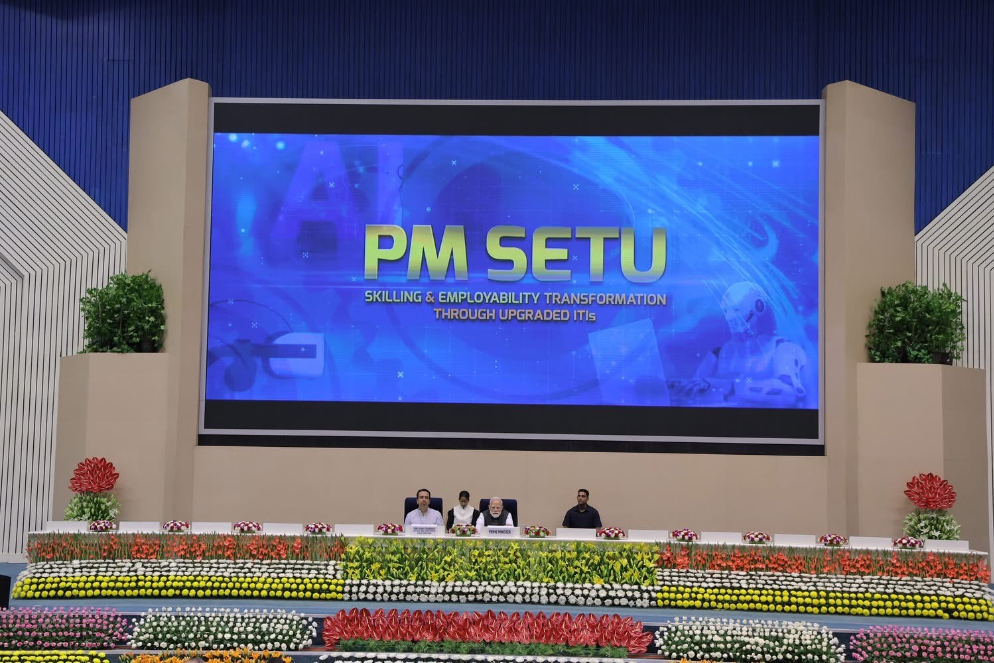
Context: The Pradhan Mantri Skilling and Employability Transformation through Upgraded ITIs (PM-SETU) completed one year on 4 October 2026, marking a shift towards modern, industry-aligned and demand-driven vocational training in India.
About PM-SETU
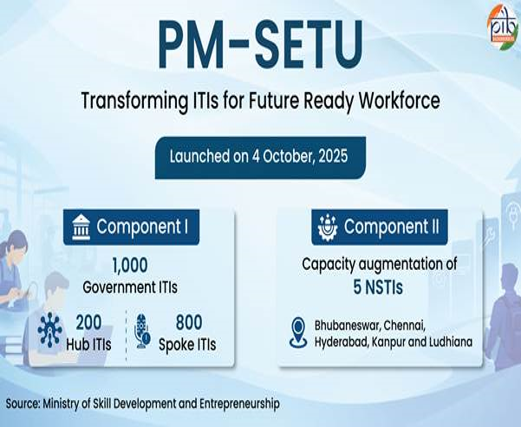
- Launched on 4 October 2025 by the Ministry of Skill Development and Entrepreneurship (MSDE), PM-SETU aims to transform Government Industrial Training Institutes (ITIs) into modern, industry-aligned skilling institutions.
- The scheme has a total outlay of ₹60,000 crore over five years, comprising ₹30,000 crore from the Centre, ₹20,000 crore from States and ₹10,000 crore from industry.
Two Components
- Upgradation of 1,000 Government ITIs: Includes 200 Hub ITIs and 800 Spoke ITIs under the Hub-and-Spoke model.
- Each Hub is connected with an average of four Spokes, enabling shared access to advanced infrastructure, modern trades, digital learning systems and incubation facilities.
- Capacity augmentation of 5 NSTIs: National Skill Training Institutes at Bhubaneswar, Chennai, Hyderabad, Kanpur and Ludhiana will be strengthened through sector-specific National Centres of Excellence and advanced training of trainers.
Key Features
- Industry-led governance: Strategic Investment Plans (SIPs), Special Purpose Vehicles (SPVs) and Anchor Industry Partners will guide cluster development and operations.
- Industry ownership: The proposed SPV structure gives 51% ownership to the Anchor Industry Partner, while the Centre and State Governments hold 24.5% each.
- Modern training ecosystem: Hub ITIs will provide innovation centres, Training-of-Trainer’s infrastructure, production units and placement services, while Spoke ITIs expand access to shared resources.
- Demand-driven training: The scheme promotes modular learning, blended learning, apprenticeships, on-the-job training and industry exposure.
- New-age skills: DGT has introduced 32 new-age courses covering Artificial Intelligence, Cyber Security, Electric Vehicles, Semiconductor Technology, Robotics, Green Hydrogen, Drones, Internet of Things, Solar Energy, 5G and Software Testing.
- Global partnerships: Singapore (NSTI Chennai), France (NSTI Kanpur) and Australia (NSTI Bhubaneswar) have signed MoUs, and Germany (NSTI Hyderabad) has exchanged a Joint Declaration of Intent, supporting advanced skilling and global standards.
Achievements of PM-SETU
- 850 ITIs Identified: Includes 172 Hub ITIs and 678 Spoke ITIs, progressing towards the target of 1,000 ITIs.
- Nationwide Rollout Approved: The National Steering Committee approved the transition from the pilot phase to a nationwide rollout across all 200 identified ITI clusters.
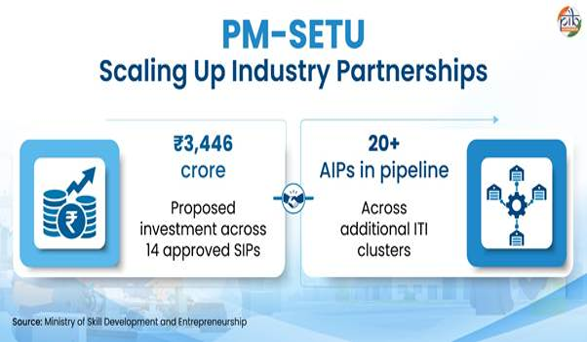
- 14 Clusters Approved: SIPs for 14 ITI clusters across eight States and one UT have been approved, involving ₹3,446 crore investment.
- State-Level Implementation: 36 States/UTs have identified clusters and created dedicated budget heads; 35 have constituted State Steering Committees; and 26 have initiated industry participation.
- ITI Network Expanded: Total ITIs increased from 9,776 in 2014 to 13,888 in 2026, while enrolment rose from 9.51 lakh in 2014–15 to 14.70 lakh in 2025–26.
Need and Significance of PM-SETU
- Bridging the Skill Gap: Aligns training with evolving industry requirements and improves graduate employability.
- Future-Ready Workforce: Prepares youth for emerging sectors such as Artificial Intelligence, semiconductors, electric mobility, robotics and green technologies.
- Modern Vocational Training: Modern infrastructure, equipment and digital learning improve the quality and relevance of ITI training.
- Training-to-Employment Link: Industry exposure, apprenticeships and placement support can strengthen the transition from training to employment and support the skilled workforce needed for Viksit Bharat 2047.
Gaps or Shortcomings in PM-SETU
- Incomplete Coverage: Only 850 of the targeted 1,000 ITIs have been identified in the first year; full transformation remains underway.
- Limited Industry Participation: Only 26 States/UTs had initiated the process of inviting industry participation.
- Uneven Implementation Capacity: Differences in industrial base, institutional capacity and readiness among States/UTs may result in uneven implementation and outcomes.
- Outcome Measurement: Long-term success will depend on training quality, industry engagement, placement outcomes and sustained employability, rather than infrastructure creation alone.