
SYLLABUS
GS-3: Science and Technology- developments and their applications and effects in everyday life; Achievements of Indians in science & technology; indigenization of technology and developing new technology; Awareness in the fields of IT, Space, Computers.
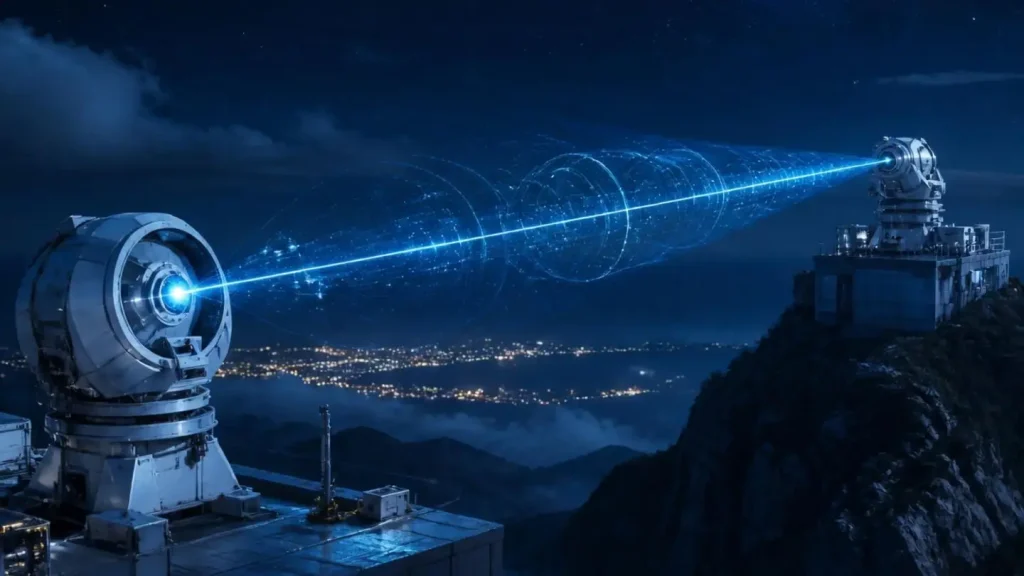
Context: India has demonstrated its first 5.56-km free-space Quantum Key Distribution (QKD) link, establishing a quantum-secure communication channel between BISAG-N and IIT Gandhinagar through the atmosphere.
More on the News
- Field trial: Conducted during the night of 27–28 September 2026, the trial established a quantum communication channel between BISAG-N and IIT Gandhinagar using QNu Labs’ Pointing, Acquisition and Tracking (PAT) system.
- Performance: The link maintained a Quantum Bit Error Rate (QBER) below 5% and generated secure keys at 230–260 bits per second (bps). QNu Labs’ Armos QKD device was used over the free-space optical channel.
- End-to-end security: The generated keys were integrated with BISAG-N’s Vedic Kavach, a post-quantum cryptography-enabled platform, enabling successful encryption, transmission and decryption of test messages. The architecture combined hardware-based QKD with Post-Quantum Cryptography (PQC) and Quantum Random Number Generation (QRNG).
- India’s progression: The achievement builds on earlier indigenous demonstrations: ISRO demonstrated free-space QKD over 300 m in 2021, followed by an entanglement-based 300-m demonstration in 2022.
- In 2025, DRDO and IIT Delhi demonstrated entanglement-based free-space quantum-secure communication over more than 1 km. The present demonstration extends India’s demonstrated terrestrial free-space range to 5.56 km.
Understanding Quantum Communication and QKD
- A. From Classical to Quantum Information
- A classical bit represents 0 or 1, whereas a qubit is a quantum system capable of existing in a superposition of states. Quantum technologies exploit properties such as superposition, entanglement and quantum measurement.
- These principles underpin applications across quantum computing, quantum communication, quantum sensing and metrology, and quantum materials and devices.
- B. Quantum Computing vs Quantum Communication
- Quantum computing uses qubits for information processing, while quantum communication uses quantum states—often photons—for secure key distribution and other networking applications.
- QKD is an application of quantum communication, not quantum computing.
- C. What is Quantum Key Distribution?
- QKD enables two parties to establish a shared cryptographic key using quantum states. An attempt to intercept or measure these states can disturb them, making eavesdropping detectable.
- The No-Cloning principle prevents an unknown quantum state from being perfectly copied, providing a fundamental basis for QKD.
- QKD distributes cryptographic keys rather than directly encrypting the complete communication; the generated keys are subsequently used within an encryption architecture.
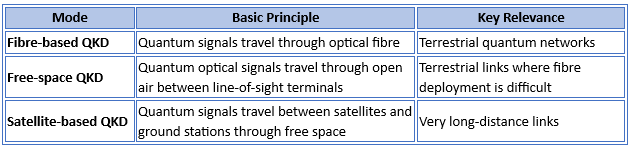
- D. Fibre vs Free-Space vs Satellite QKD
Global Developments in Quantum Communication
- China — Micius: China launched Micius (QUESS) in 2016, regarded as the world’s first quantum communication satellite. It operates in a low-Earth orbit of about 500 km and demonstrated satellite-to-ground quantum communication and QKD.
- China — Jinan-1: Launched in 2022, the smaller quantum microsatellite was designed for more practical deployment, including use with portable ground stations and real-time QKD. Tests achieved up to 1.07 million bits of secure-key material during a single satellite pass.
- Integrated networks: China has combined satellite links with a more than 2,000-km terrestrial fibre-based quantum communication backbone, demonstrating the potential of integrated space–ground networks.
- Beyond China: The European Quantum Communication Infrastructure (EuroQCI) is being developed as an EU-wide system combining terrestrial fibre networks with a future space segment. Japan is also developing terrestrial and satellite quantum communication technologies, including experiments demonstrating secure key sharing between the International Space Station and portable ground stations.
India’s Quantum Communication Roadmap
- National Quantum Mission (NQM): Approved in April 2023 with an outlay of ₹6,003.65 crore for 2023–24 to 2030–31, the Mission covers Quantum Computing, Quantum Communication, Quantum Sensing & Metrology, and Quantum Materials & Devices.
- Long-distance targets: NQM envisages inter-city QKD over 2,000 km, satellite-based secure quantum communication between ground stations over 2,000 km within India, long-distance international quantum communication and multi-node quantum networks with quantum memories.
- Indian network milestones: In 2025, NQM-supported QNu Labs demonstrated a 500-km QKD network over existing optical-fibre infrastructure. In April 2026, India reported a 1,000-km quantum communication network, advancing towards the Mission’s 2,000-km target.
- Broader ecosystem: India’s efforts now span free-space and fibre-based QKD, alongside preparations for satellite-based quantum communication, with the present 5.56-km demonstration adding another capability to this emerging ecosystem.
Significance of the Development for India
- Strengthens quantum-security capability: Demonstrates indigenous capability to distribute quantum-secure keys through an open-air optical channel, complementing fibre-based systems.
- Strategic applications: Free-space QKD has potential applications in defence, government communications, financial systems, critical infrastructure and other sensitive networks.
- Flexible communication infrastructure: It can be useful where laying optical fibre is difficult or impractical and can complement fibre- and satellite-based quantum communication.
- Strengthens the domestic ecosystem: Collaboration among QNu Labs, BISAG-N and IIT Gandhinagar brings together industry, government and academia for developing indigenous quantum technologies.
- Supports long-distance networking: The demonstration adds a terrestrial free-space capability to India’s broader effort to build long-distance and hybrid quantum communication networks under the NQM.