
SYLLABUS
GS-3: Infrastructure: Energy; Conservation, Environmental Pollution and Degradation, Environmental Impact Assessment.
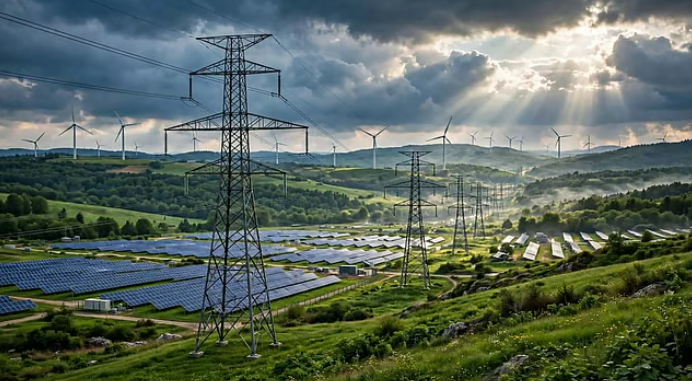
Context: The Union Cabinet recently approved Green Energy Corridor Phase-III (GEC-III) to strengthen renewable-energy transmission infrastructure, improve grid flexibility and facilitate large-scale integration of clean electricity into India’s power system.
More on the News
- GEC-III: The scheme has a total outlay of ₹1,86,405 crore to strengthen intra-state transmission, facilitate evacuation of up to 135 GW of renewable energy, and deploy 50 GWh of Battery Energy Storage Systems (BESS) by FY 2032–33.
- GEC Phase-I: Implemented across eight States, it targets 9,461 circuit kilometres (ckm) of transmission lines. By 30 June 2026, 9,130 ckm had been constructed. Its completion is expected by March 2027.
- GEC Phase-II: Implemented across seven States, it targets 7,863 ckm of transmission lines and 24,388 MVA of substation capacity. By 30 June 2026, 1,124 ckm of lines had been charged and 6,860 MVA of substation capacity commissioned. Projects are expected to be completed by 2028.
Understanding Green Energy Corridor and Battery Storage
- Green Energy Corridor (GEC): Transmission infrastructure that carries electricity from renewable-energy generation centres to the wider grid and consumption centres.
- Intra-State Transmission System (InSTS): Transmission networks within a State that connect generation sources to the wider grid and demand centres.
- Battery Energy Storage Systems (BESS): Store surplus electricity and release it when generation falls or demand rises, helping manage solar and wind variability and improve grid flexibility.
- GW and GWh: GW measures power capacity, while GWh measures the quantity of energy stored or delivered over time. GEC-III targets evacuation of up to 135 GW of renewable energy and deployment of 50 GWh of battery storage.
Key Features of the Scheme
- Transmission infrastructure: ₹1,36,378 crore allocated to develop InSTS, enabling evacuation of up to 135 GW of renewable energy.
- Battery storage: ₹50,000 crore for deploying 50 GWh of BESS at renewable-energy developer/generator sites or other locations important for grid flexibility.
- Central Financial Support (CFS): ₹54,082 crore to help offset intra-state transmission charges and contain electricity costs for end users.
- Implementation mechanism: State Transmission Utilities will be the overall implementing agencies. Greenfield projects will use Tariff-Based Competitive Bidding (TBCB), while brownfield upgrades and network strengthening will follow the Cost Plus Basis (CPB). Transmission Service Providers selected through TBCB will follow a Build-Own-Operate-Maintain (BOOM) model.
- Expected outcomes: Reduced grid congestion and peak-hour curtailment, improved renewable-energy integration and better electricity availability during non-solar hours. The scheme will also contribute to India’s target of 900 GW of installed non-fossil-fuel capacity by 2035.
Need and Significance
- Addressing transmission bottlenecks: Around 21 GW of renewable-energy capacity relies on temporary grid connections, while nearly 12 GW faces evacuation restrictions during peak solar generation, affecting developers’ revenues and project viability.
- Reducing renewable-energy curtailment: Around 6,900 GWh of clean electricity faced restrictions in FY 2025–26. Separately, 8,133 GWh of solar electricity was curtailed during April–June due to transmission bottlenecks and grid-security requirements.
- Improving grid flexibility: Transmission expansion facilitates power evacuation, while BESS stores surplus electricity for use during periods of lower generation or higher demand.
- Energy security and employment: Better renewable-energy utilisation supports decarbonisation and reduces dependence on fossil fuels, while investment in transmission and storage creates employment in manufacturing, construction and grid management.
Challenges in Implementation
- Land acquisition and right-of-way: Securing land, resolving compensation disputes and obtaining statutory clearances can delay transmission projects.
- Implementation delays: Earlier GEC phases have faced execution delays. GEC-I is expected to be completed by March 2027 and GEC-II by 2028, highlighting the importance of timely execution and monitoring under GEC-III.
- Storage economics and supply chains: Large-scale BESS deployment requires viable commercial arrangements and reliable access to batteries, components and critical minerals.
- Coordination and utilisation: Transmission planning must align with renewable-energy projects, State networks and demand centres. Delayed commissioning or inadequate integration of storage into grid operations could limit the scheme’s benefits.
Way Ahead
- Integrated planning: Align renewable-energy generation, intra-state and inter-state transmission, storage deployment and demand projections.
- Faster execution: Improve Centre–State coordination and streamline land acquisition, right-of-way procedures and project approvals.
- Strengthen the storage ecosystem: Develop viable procurement and revenue mechanisms for BESS while promoting domestic battery manufacturing, research and recycling.
- Outcome-based monitoring: Track commissioning, renewable electricity evacuated, curtailment trends and actual storage utilisation to ensure that investments translate into measurable improvements in grid performance.