
SYLLABUS
GS-3: Conservation, environmental pollution and degradation, environmental impact assessment; Infrastructure: Ports.
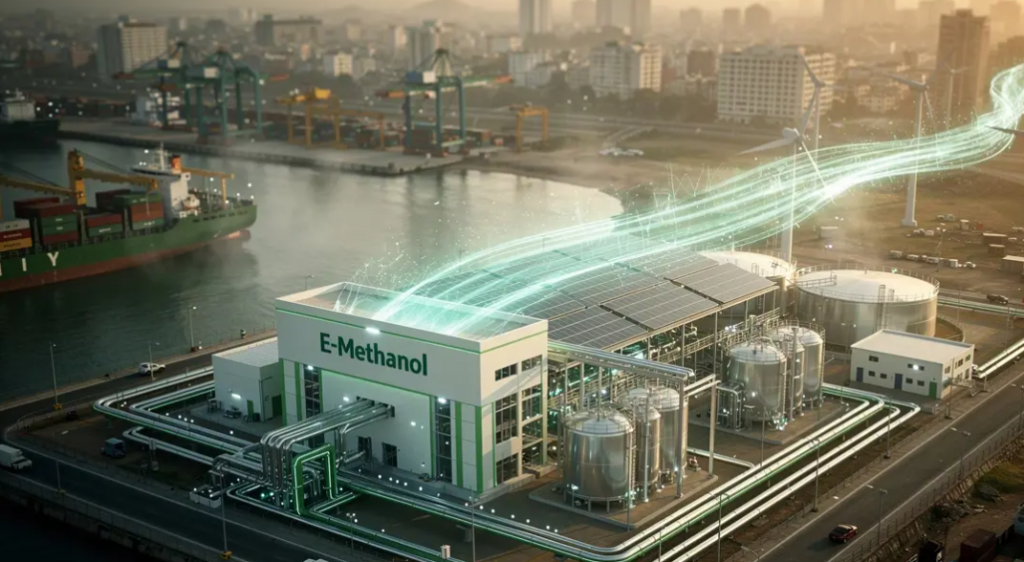
Context: In a boost to maritime decarbonisation, the government laid the foundation stone for its first port-based e-methanol production facility at Kandla, involving an investment of Rs 2,300 crore.
About India’s First Port-Based E-Methanol Plant
• Location and Capacity: The plant is being established at Deendayal Port Authority (DPA), Kandla, Gujarat, with a total production capacity of 150 tonnes of e-methanol per day, making it one of India’s largest e-methanol production facilities.
• Partners and Investment: The ₹2,300-crore project is a joint initiative of DPA and Assam Petro-Chemicals Ltd. (APCL), Namrup, with the capital contribution divided in a 76:24 ratio between DPA and APCL.
• Phased Development: Phase I will add 50 tonnes per day at an investment of ₹1,200 crore and is targeted for completion by January 2027, while Phase II will add another 100 tonnes per day at ₹1,100 crore by March 2027.
• Inputs and Infrastructure: The plant will use renewable power, water and biogenic CO₂ to produce e-methanol, while DPA will contribute ₹567.32 crore in equity, 75 acres of land, desalinated water and renewable energy in the form of green hydrogen; the project is expected to generate more than 3,500 direct and indirect jobs.
About E-Methanol
• E-methanol is a low-carbon electricity-based fuel (e-fuel) produced by combining green hydrogen with recycled or biogenic CO₂, using renewable energy.
• Production Process: Renewable electricity is used for electrolysis of water to produce green hydrogen, which is then combined with CO₂ in a synthesis process to produce e-methanol.
• Maritime Fuel: E-methanol can be used as a cleaner marine fuel and is particularly relevant for shipping, a hard-to-abate sector, helping reduce lifecycle greenhouse-gas emissions.
• Multiple Uses: Besides shipping, e-methanol can be used as a feedstock for producing e-gasoline, sustainable aviation fuel and other chemicals, while also serving as a convenient liquid carrier for renewable hydrogen.
Significance of the E-Methanol Plant
• Maritime Decarbonisation: The facility will supply e-methanol to vessels operating on the Asia-Europe International Trade Corridor, supporting the transition towards cleaner international shipping.
• Cost Competitiveness: The project is expected to produce green methanol at around US$750 per tonne, compared with a global rate of about US$1,300 per tonne, strengthening India’s potential competitiveness in the emerging green-fuel market.
• Green-Fuel Export Hub: The project can strengthen Kandla’s role as a green-fuel hub and support India’s ambition to become a producer and exporter of green fuels for global shipping.
• Green Energy Ecosystem: The plant is expected to stimulate the wider green-energy value chain around Kandla, including transportation, storage, supply and related ancillary activities, while supporting India’s Net Zero target of 2070, energy self-reliance and Make in India.
Government Initiatives Towards Maritime Decarbonisation
• National Green Hydrogen Mission (2023): Launched in January 2023, it aims to make India a global hub for production, utilisation and export of green hydrogen and its derivatives, including green fuels for sectors such as shipping.
• Harit Sagar Green Port Guidelines (2023): Launched in 2023, the guidelines promote sustainable port development through renewable energy, shore-to-ship power, electrification of port equipment, green belts and sustainable waste management.
• Green Tug Transition Programme (2024): Launched in 2024 under the Panch Karma Sankalp, it promotes the transition from conventional fuel-based harbour tugs to greener alternatives and supports domestic manufacturing.
• Maritime India Vision 2030 (2021) and Maritime Amrit Kaal Vision 2047 (2023): These long-term maritime roadmaps promote green ports, alternative fuels, green shipping corridors, sustainable shipbuilding and cleaner maritime infrastructure.